The real cost of an OTA booking: commission is only the first line
Most hoteliers know their commission rate. Few know their effective rate. Here are the other lines on every OTA booking, and how to work out what a room really costs you to sell in 2027.
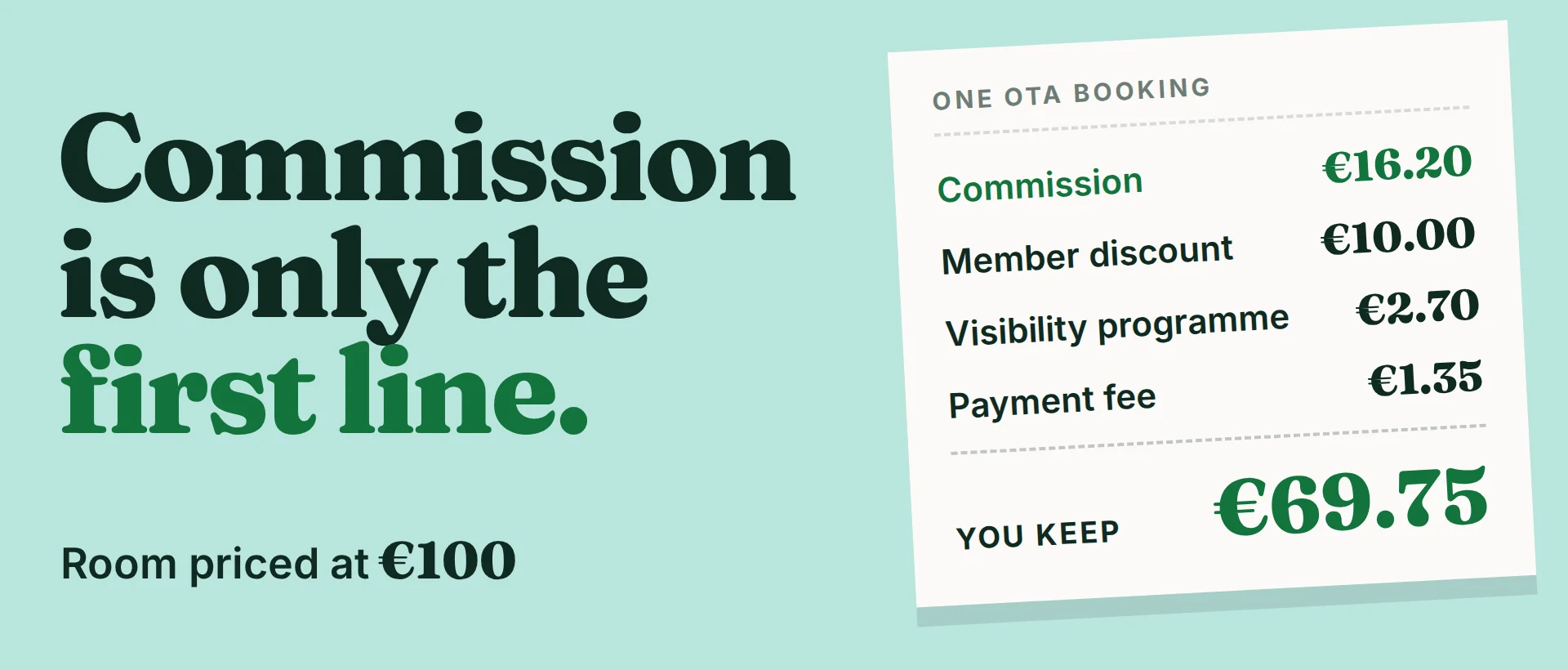
Ask a hotelier what their OTA costs them and you will hear a percentage. Fifteen. Eighteen. Twenty on a bad day.
That percentage is real, but it is only the first line on the bill. Between the rate you set and the money that reaches your account, several smaller costs take their share. None of them looks large on its own. Together, they are often the difference between a commission of 18% and an effective cost closer to 30%.
With 2027 rates and contracts being set now, it is worth knowing the real number before you decide how much of next year to sell through each channel.
The short answer
The real cost of an OTA booking is everything between the price you set and the money you keep: the commission, the discounts you fund, any paid visibility, the cost of taking payment, and the guest relationship you do not get. For a typical independent hotel using a member discount and one visibility programme, a room priced at €100 can leave around €70.
Your numbers will differ. The point is that the headline commission understates the cost, sometimes by a lot.
The lines on every OTA booking
1. The headline commission. The percentage in your contract, usually somewhere between 15 and 25% depending on the platform, the country and the property. For the details by platform, see our guides to Booking.com commission, Expedia commission and OTA commission rates.
2. Visibility programmes. Booking.com's Preferred Partner programme and Visibility Booster, and Expedia's Accelerator, raise your commission in exchange for better placement. They are optional, and they are easy to forget once switched on. A programme that adds a few points of commission turns an 18% channel into a 21% channel on every booking it touches.
3. Discounts you fund. Member programmes cut the price the guest pays, and the hotel pays for the cut. Booking.com's Genius programme starts with a 10% discount, with a higher level at 15% and optional extras like free breakfast or upgrades. Expedia's One Key member prices work in a similar way. Add mobile rates, seasonal deals and campaign discounts, and a room you priced at €100 is often sold for €85 or €90 before any commission is taken.
4. Commission on the whole reservation. Booking.com calculates commission on the total value of each reservation. If the price the guest pays includes VAT or extras, as room prices in Europe usually do, the commission is calculated on those too. Check your commission invoices to see exactly which amount your commission is based on.
5. The cost of getting paid. If the platform collects the money, it does not come free. Booking.com says its payment service costs between 1.1% and 3.1% on bank transfer payouts, depending on the country. Virtual cards carry card processing fees of their own. And the money usually arrives after the guest checks out, not when they book.
6. No-shows and cancellations. Booking.com charges commission on non-refundable bookings and on cancellations and no-shows where the guest is charged. If a guest does not arrive and you cannot collect, report the no-show in time. Otherwise you can end up paying commission on money you never received.
7. The guest you do not get. This is the line that never appears on an invoice. An OTA guest often reaches you through a platform email address rather than their own, and the platform, not you, is the one that can reach them next year. When that guest books again through the OTA, you pay the full commission a second time for someone who already knows you.
One €100 room, line by line
Take a room you have priced at €100 a night.
A Genius member books it, so the guest pays €90. Your commission is 18%, plus 3% for a visibility programme: 21% of €90 is €18.90. Payment through the platform at 1.5% costs another €1.35. You keep €69.75.
Of the €100 you priced the room at, just over €30 did not reach you. That is your effective cost for this booking: about 30%, not 18%.
Now sell the same room directly on your website at €95, a little under your OTA price. Card processing at around 1.5% costs €1.43. You keep €93.58.
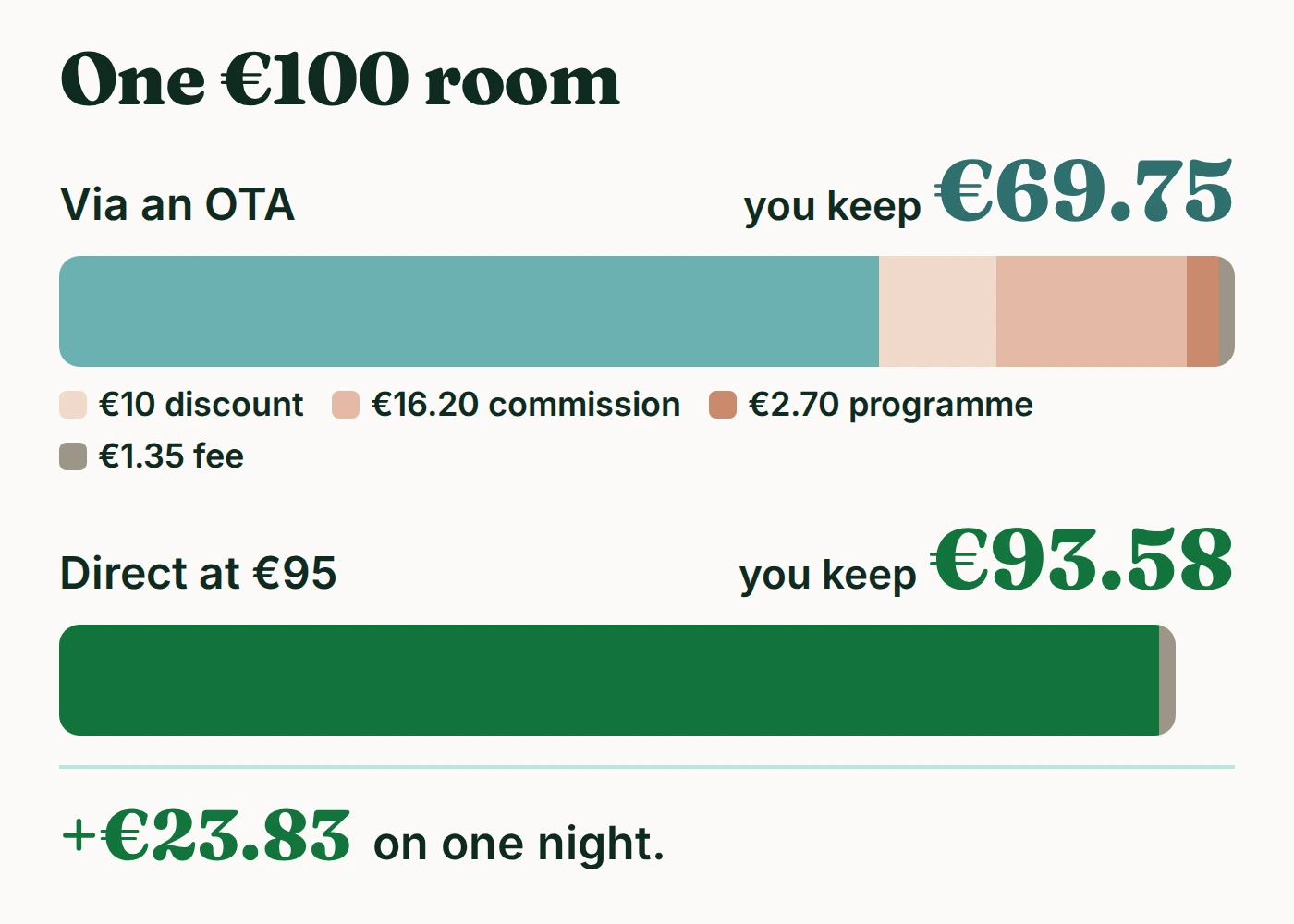
What one €100 room really leaves you. Illustrative figures.
The guest paid less. You kept almost €24 more. That is the whole argument for direct bookings in one night's stay.
How to work out your own effective rate
You need one year of numbers and about an hour.
1. Add up what the OTA sold for you. Take the total room revenue from each platform for the last twelve months, at the rates you set before member discounts.
2. Add up everything you paid. Commission invoices, programme charges, payment fees, card fees on virtual cards, and the value of the discounts you funded.
3. Divide the second number by the first. That is your effective rate for the channel. Do it separately for each OTA.
4. Do the same for your direct channel. Card fees, booking engine costs and any direct marketing. For most small hotels this number is in single digits.
5. Compare. The gap between the two effective rates is what every booking you move from an OTA to your own website is worth.
Our OTA commission calculator gives you a quick estimate from your yearly OTA revenue and commission rate, with no account needed. The full effective rate needs your invoices, but the calculator shows the order of magnitude in a minute.
What to do about it in 2027
Audit every programme. List what is switched on across your OTAs: visibility programmes, member discounts, deals, mobile rates. Keep what clearly brings extra guests in your slow periods. Switch off the rest.
Read your invoices. Check which amount your commission is calculated on, and match every cancellation and no-show against it.
Stop paying twice for the same guest. Every guest who stayed once is a guest you could welcome back directly. Collect their details at the property, keep in touch, and give them a reason to book with you next time.
Price your direct channel on purpose. In the EEA, Booking.com can no longer require you to match its price on your own website. Our guide to rate parity in Europe explains what that means for your 2027 pricing.
Keep the OTAs for what they are good at. For most independent properties, OTAs bring guests who would never find you otherwise. That reach is worth paying for. The goal is not to leave the platforms. It is to stop paying the full effective rate on guests who were already yours.
Where Tribii fits
Every line in this article gets smaller when more of your bookings come straight to your own website.
Tribii's booking engine is free forever for up to 20 rooms and charges 0% commission, with payment going through your own Stripe account. The guest CRM is free too, so the guests who stay with you become guests you can reach again, rather than guests an OTA sells back to you.
Any commission-free booking engine does the first job. What matters is that your direct channel exists, works on a phone and is easy to find.
Common questions
What is the real cost of an OTA booking for a hotel?
Everything between the price you set and the money you keep: commission, visibility programmes, member discounts, payment fees and the cost of not owning the guest relationship. For many independent hotels the effective cost lands well above the headline commission.
What is an effective commission rate?
The total you pay a channel in a year, including discounts and fees, divided by the revenue it brought at your own prices. It is the fairest way to compare an OTA with your direct channel.
Does Booking.com charge commission on VAT?
Booking.com calculates commission on the total value of each reservation. If your prices include VAT, check your commission invoices to see which amount the commission is based on.
Do I pay commission on no-shows and cancellations?
On Booking.com, yes when the guest is charged, for example on non-refundable bookings. If you cannot collect from a no-show, report it in time so the commission is not applied.
Is Genius worth it for a small hotel?
It can be, especially for a new property that needs visibility. But the discount comes out of your price on every Genius booking, so review it every year against the bookings it actually adds.
The honest summary
Commission is the number everyone knows. The real cost of an OTA booking is the number that matters, and for many independent hotels it is closer to 30% than 18%.
Work out your effective rate for each channel. Switch off what does not earn its keep. Then make sure every guest who already knows you can book with you directly.
Figures reviewed September 2026 from Booking.com and Expedia Group partner materials. Rates, programmes and fees vary by country, property and contract: check your own agreements and invoices. The worked example is illustrative. This is not financial advice.

Tribii
The free booking engine for independent hoteliers. Editorial notes.
More for the kitchen table.
OTA terms explained: a plain-language glossary for independent hotels
Commissionable rate, net rate, merchant model, narrow parity. The words in your OTA contract, explained in plain language, with what each one means for your money.
 Tribii
Booking.com Genius and Preferred Partner: what they really cost a small hotel
Genius and Preferred Partner are sold as growth tools. Both are also a price. Here is what each one costs an independent hotel, how to test whether it pays, and what to decide before 2027.
Tribii
How much commission does Expedia take? The 2026 guide for independent hotels
Expedia's headline commission is only the start. Here is what a booking really costs once you add the payment model, the visibility tools and the card fees, and how to pay less in 2027.
Tribii