How much commission does Expedia take? The 2026 guide for independent hotels
Expedia's headline commission is only the start. Here is what a booking really costs once you add the payment model, the visibility tools and the card fees, and how to pay less in 2027.
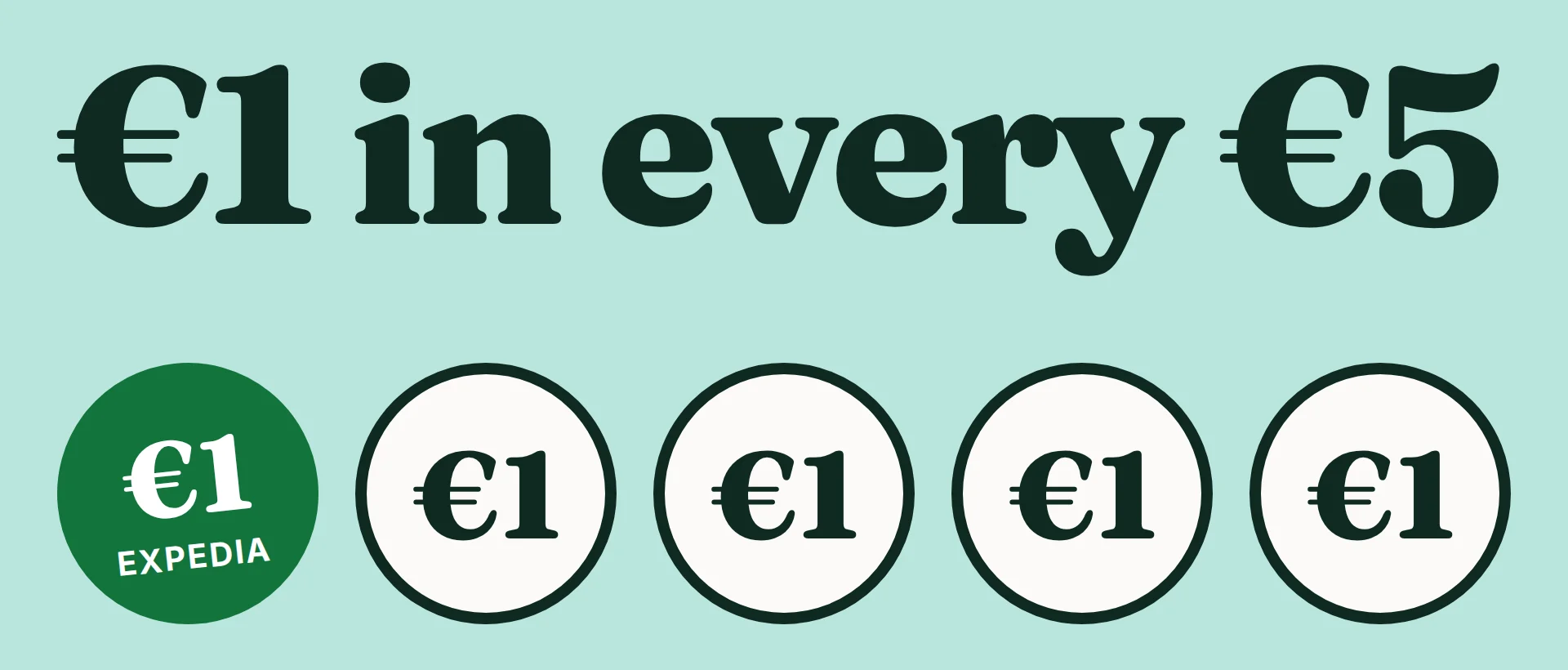
Ask a hotelier what Expedia charges and you will usually hear a single number. Eighteen percent. Twenty. "About the same as Booking."
The single number is where the confusion starts. What Expedia actually costs you depends on three decisions most properties made once, years ago, and never looked at again: how the guest pays, which visibility tools are switched on, and how the money reaches your bank. Change any of them and the real cost of a booking moves by several points.
2027 rates are being loaded now. It is a good moment to look again.
The short answer
Expedia's base commission for hotels usually sits between 15 and 25% of the booking value, and published estimates put the average at around 18 to 20%. Some markets and contracts go higher. The exact figure is in your Expedia contract and in Partner Central, not on any public price list, so check your own before trusting anyone's summary, including this one.
On top of the base rate, three things can raise what you pay: optional visibility tools, discounts for Expedia's loyalty members, and the cost of taking payment on a virtual card.
Expedia Collect or Hotel Collect: the choice that changes your bill
Every Expedia booking arrives in one of two payment models. They cost roughly the same in commission, but they behave very differently in your cash flow and your accounts.
Expedia Collect. The guest pays Expedia when they book. Expedia keeps its commission and sends you the rest, usually on a virtual credit card you charge around the stay, or by bank transfer after checkout. What you see in your system is the net rate: the commission has already been taken.
Hotel Collect. The guest pays you, at the hotel or with the card details in the booking. You receive the full price, and Expedia invoices you for its commission afterwards, typically once a month.
Many properties accept both, through Expedia's option that lets the guest choose to pay now or pay at the property.
Three practical differences matter more than the headline rate:
- Card fees. A virtual card is still a card. Your payment provider charges its normal processing fee to take the money off it, which can run from around 1.5% to 3% depending on the card and your provider. That fee comes out of your share, after Expedia has already taken its commission.
- Timing. With Expedia Collect you are paid around or after the stay, not when the guest books. For a guest who books in January for August, you carry the room for seven months before a cent arrives.
- Reconciliation. Net rates, virtual cards and monthly commission invoices are three different things to match against three different reports. If nobody on your team reconciles them, errors go unnoticed. Commission charged on a cancelled or modified booking is exactly the kind of mistake that slips through when nobody checks.
What pushes the rate up
Expedia sells several tools that promise more visibility. Each one is optional, and each one is a cost.
Accelerator. You pay extra compensation on top of your commission, only on stays that complete during the period you choose, in return for higher placement in search results. Expedia describes it as pay per stay, and reports that properties using it see more bookings. In practice it works like a temporary commission increase, so the real question is whether those bookings are extra ones or ones you would have had anyway.
TravelAds. Sponsored listings charged per click, with a daily budget you set. This is advertising, billed separately from commission, and it costs money whether or not the click becomes a booking.
VIP Access and member discounts. VIP Access is Expedia's badge for well-reviewed properties that give extra perks to members. One Key, the loyalty programme shared across Expedia, Hotels.com and Vrbo, rewards travellers with member prices. Member discounts do not raise the commission percentage, but they lower the price the commission is calculated on, and they lower what you keep.
Promotions. Seasonal campaigns and deals arrive as helpful emails in a slow month. Every one of them is a discount you fund.
None of these is wrong in itself. A new property with no reviews can sensibly pay for visibility. The mistake is leaving them switched on forever. Visibility you needed in your first season is being bought again every year, often for guests who already know your name.
What one Expedia booking really costs
Take a three-night stay at €150 a night: €450.
At an 18% base commission, Expedia keeps €81. Switch on Accelerator at an extra 5% and another €22.50 goes. Take the rest on a virtual card with a 2% processing fee and roughly €7 more disappears. You keep about €339.
The same stay booked on your own website, paid by card at a processing fee of around 1.5%, leaves you about €443.
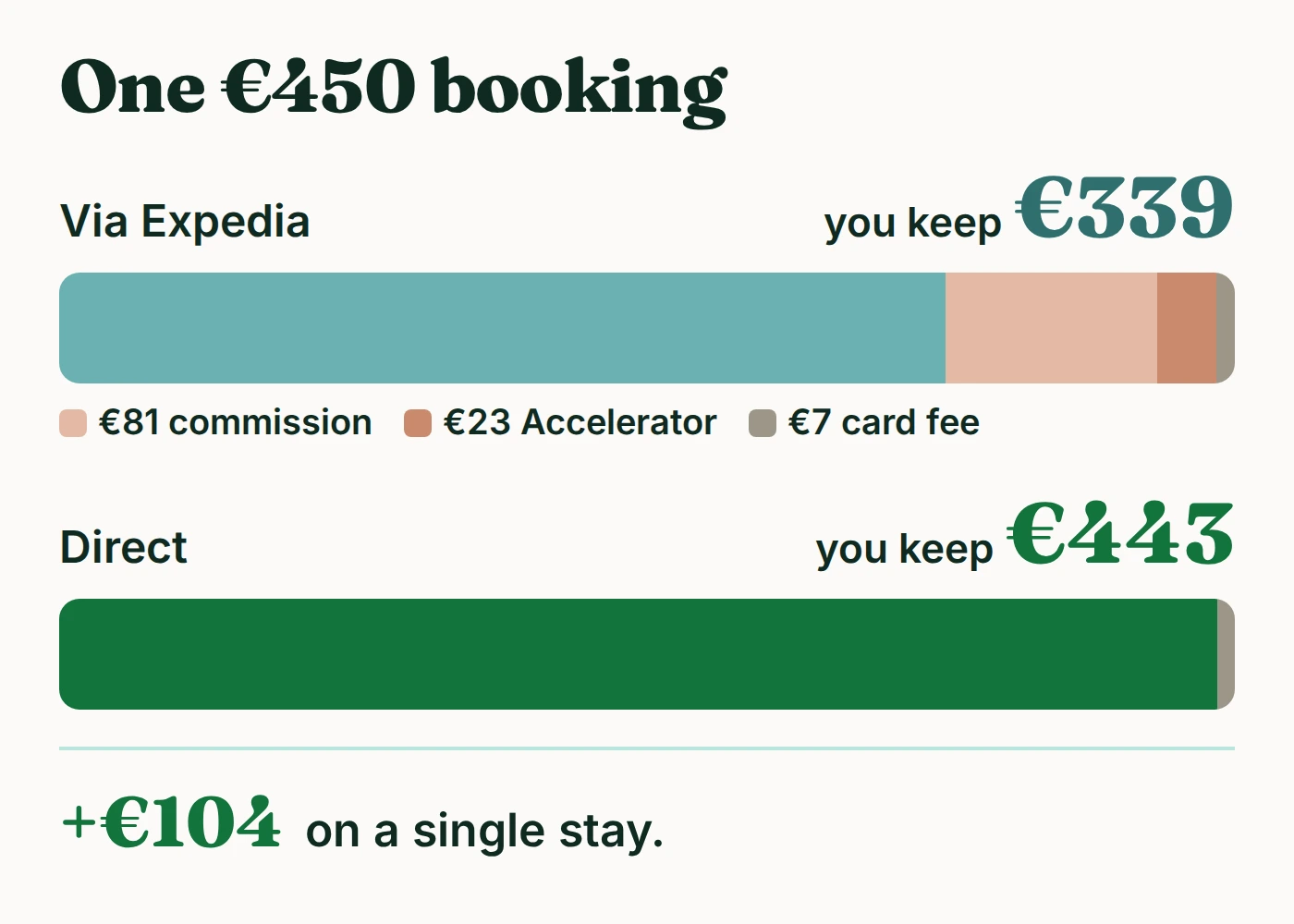
One three-night booking, two channels. Illustrative figures.
That is a gap of more than €100 on a single booking. Multiply it by the number of Expedia stays you had last year, and you have the real size of the decision. Our OTA commission calculator does that sum across a year of bookings in a minute, with no account needed.
Expedia or Booking.com: which costs more?
For most small European hotels, the base commissions land in a similar range. Booking.com's standard rate starts near 15% and commonly reaches 18 to 22% once its programmes are switched on. We cover that in detail in our guide to Booking.com commission, and both side by side in our overview of OTA commission rates.
The difference is less in the percentage and more in the plumbing. Both platforms let the guest either pay the hotel or pay the platform, and each handles payouts, card fees and invoices its own way. If you are comparing the two, compare what lands in your account after card fees and timing, not the headline rates.
What changes in 2027
Parity is a separate question for Expedia. The European rule that stopped Booking.com imposing parity comes from the Digital Markets Act, which applies to Booking.com as a designated gatekeeper. Expedia is not a designated gatekeeper, so that rule does not cover it. In 2015 Expedia waived its wide parity clauses in Europe, the ones that tied your price on Expedia to your prices on other platforms. The narrow version, covering your own website, is banned by national law in France, Austria, Italy and Belgium. Everywhere else, Germany included, where the court rulings concerned Booking.com, read your Expedia contract for anything that ties your website price to Expedia's. Our guide to rate parity in Europe covers the details.
The billboard effect still works. Plenty of guests find a hotel on Expedia and then look it up before booking. Whether they complete the booking with you or go back to Expedia depends on one thing: whether your website lets them book, easily, at a price that makes sense.
How to pay Expedia less in 2027
1. Find your real rate. Open last year's Expedia invoices and virtual card statements. Divide everything you paid Expedia, plus the card fees, by the revenue it brought. That percentage is your real rate, and it is usually higher than the one in your head.
2. Review every visibility tool. List what is switched on: Accelerator, TravelAds, VIP Access, member deals, promotions. Keep the ones that clearly bring incremental guests in your slow months. Switch off the rest.
3. Choose your payment model on purpose. If cash flow matters, Hotel Collect gets you paid at the stay. If you prefer prepaid guarantees, Expedia Collect protects you from no-shows. Either way, make it a choice rather than a default.
4. Reconcile monthly. Match every Expedia booking against its virtual card charge or commission invoice. Cancelled and modified bookings are where errors hide.
5. Make the direct booking easy. Your website should let a guest check availability and pay in under a minute, on a phone. Put your own website in your Google Business Profile, not an OTA link.
6. Give direct guests a reason. A slightly better rate where your contract allows it, or added value where it does not: breakfast, late checkout, parking. Value costs you less than a point of commission.
7. Keep Expedia for the guests only Expedia brings. For most independent properties, Expedia reaches travellers you would never meet otherwise. That is worth paying for. What is not worth paying for is commission on guests who were already looking for you.
Where Tribii fits
The cheapest booking you can take is the one that comes straight to your own website. That needs a booking engine that takes no commission and sends the guest's payment straight to you.
Tribii's booking engine does exactly that. It is free forever for up to 20 rooms, charges 0% commission and takes payment through your own Stripe account, so the money reaches your own account without waiting for an OTA payout. If you want your OTAs managed from the same calendar, the channel manager on the Max plan keeps them in sync, so a room booked direct closes on the connected channels automatically.
Any commission-free booking engine can do the first job. What matters is that you have one.
Common questions
What percentage does Expedia take from hotels?
Usually between 15 and 25% of the booking value, with published estimates putting the average around 18 to 20%. Visibility tools like Accelerator add to that, and card fees on virtual cards add a little more.
What is the difference between Expedia Collect and Hotel Collect?
With Expedia Collect, the guest pays Expedia and you are paid the net amount, usually on a virtual card around the stay. With Hotel Collect, the guest pays you and Expedia invoices you for its commission afterwards.
When does Expedia pay hotels?
For Expedia Collect bookings, around or after the guest's stay, usually through a virtual card you charge or a bank transfer. For Hotel Collect bookings, you are paid by the guest and settle commission with Expedia monthly.
Can I negotiate my Expedia commission?
The base rate is hard to move for a small property. What you control is which visibility tools and promotions you join, and how much of your business comes through Expedia at all.
Is Expedia cheaper than Booking.com?
The base commissions are similar. The real difference is in payment timing, card fees and the programmes you switch on, so compare what reaches your account, not the headline rate.
Can I offer a lower price on my own website than on Expedia?
It depends on where you are and on your contract. France, Austria, Italy and Belgium ban parity clauses by law. Elsewhere, check your Expedia agreement.
The honest summary
Expedia usually takes about one euro in five. Visibility tools, member discounts and virtual card fees can push the real figure higher, and the payment model decides when you see the rest.
Work out what Expedia cost you last year in euros, including the card fees. Switch off what no longer earns its keep. Then make sure every guest who comes looking for you can book with you directly.
Commission structure reviewed September 2026 from Expedia Group partner materials and published industry guides. Rates vary by country, property type and contract: check your own agreement in Partner Central. This is not financial or legal advice.

Tribii
The free booking engine for independent hoteliers. Editorial notes.
More for the kitchen table.
OTA terms explained: a plain-language glossary for independent hotels
Commissionable rate, net rate, merchant model, narrow parity. The words in your OTA contract, explained in plain language, with what each one means for your money.
 Tribii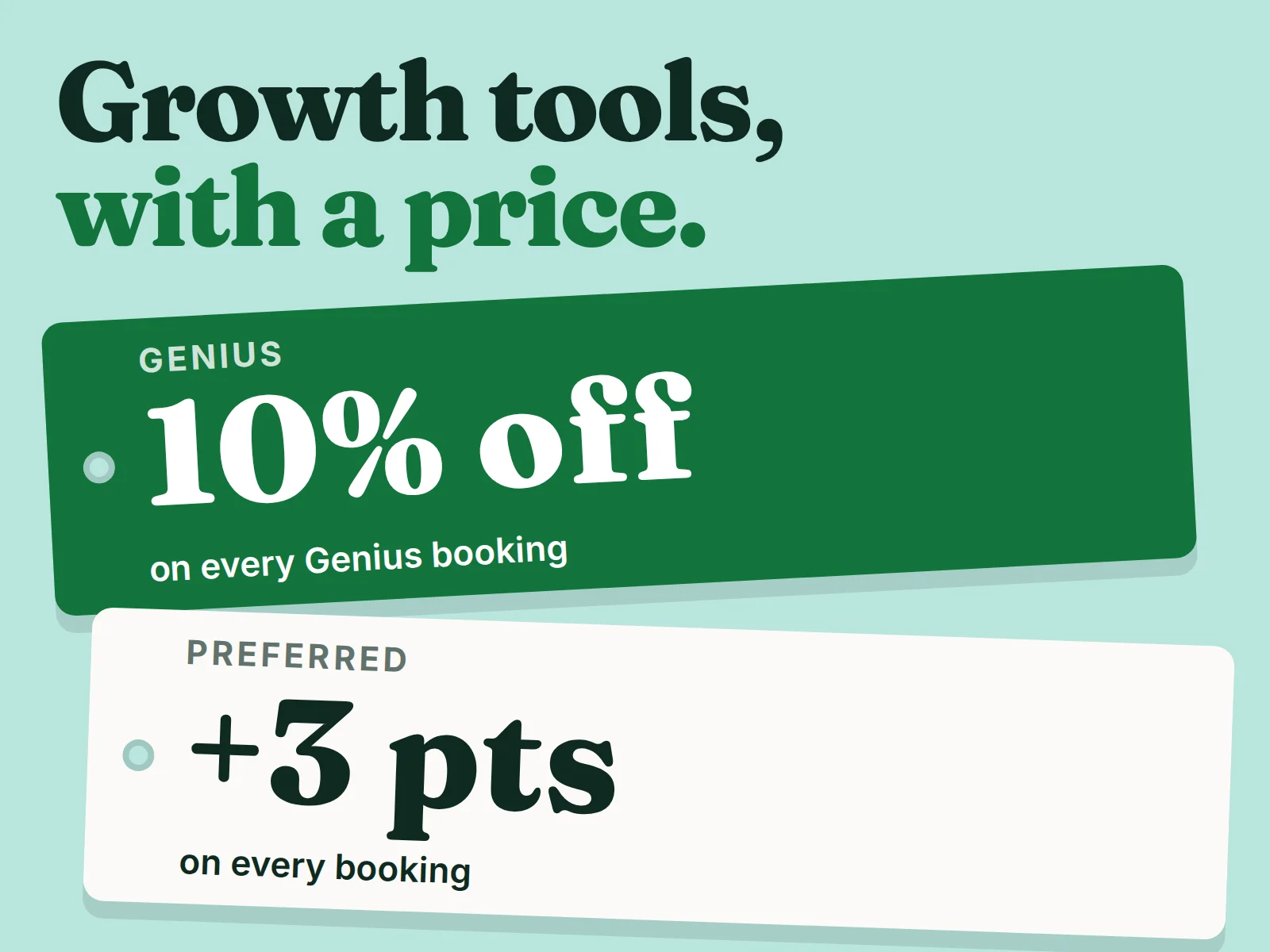
Booking.com Genius and Preferred Partner: what they really cost a small hotel
Genius and Preferred Partner are sold as growth tools. Both are also a price. Here is what each one costs an independent hotel, how to test whether it pays, and what to decide before 2027.
Tribii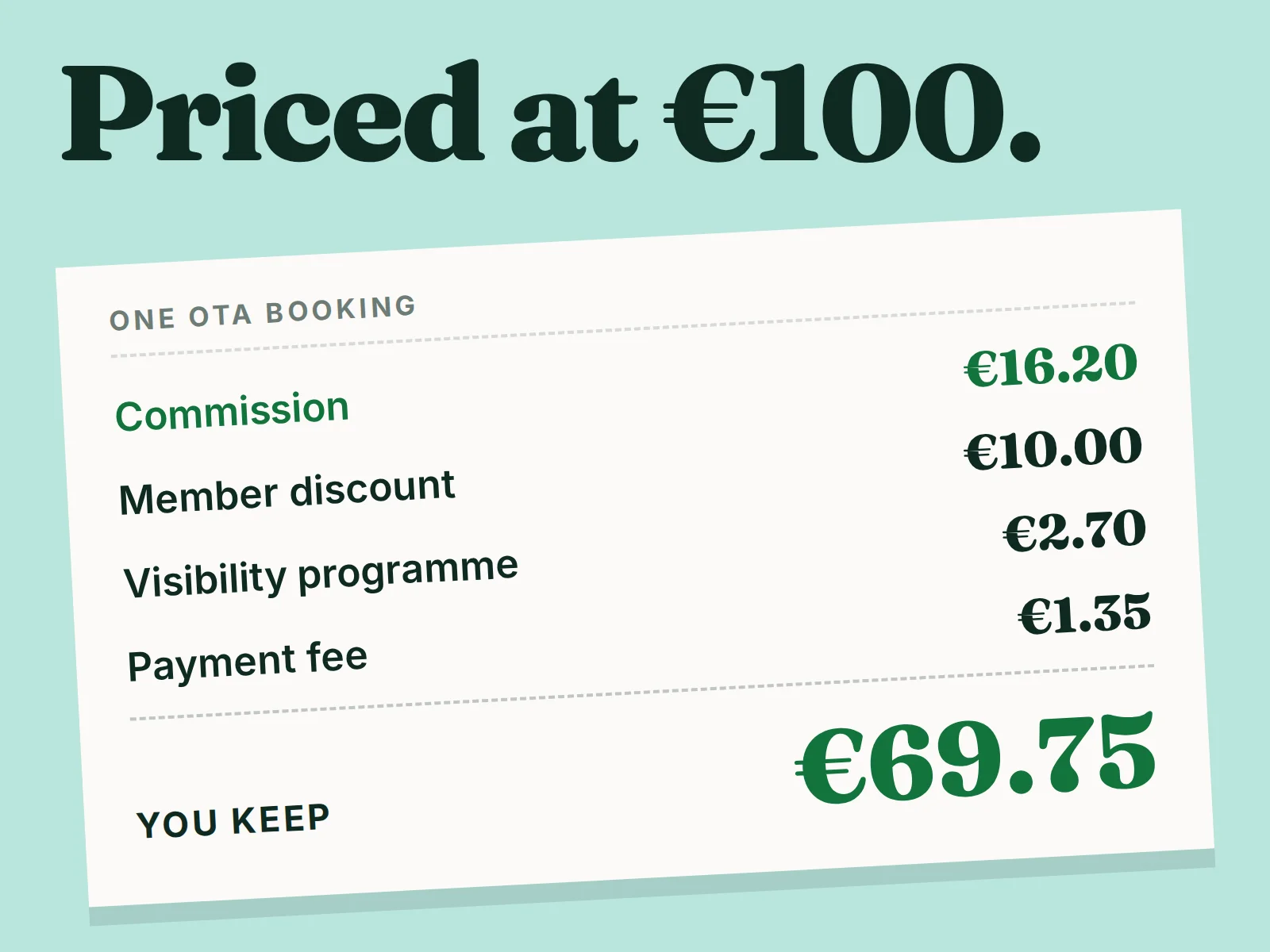
The real cost of an OTA booking: commission is only the first line
Most hoteliers know their commission rate. Few know their effective rate. Here are the other lines on every OTA booking, and how to work out what a room really costs you to sell in 2027.
Tribii