How much commission does Booking.com take, and how to pay less
The headline rate is only part of the bill. Here is what you actually pay, what you can change, and what you cannot.
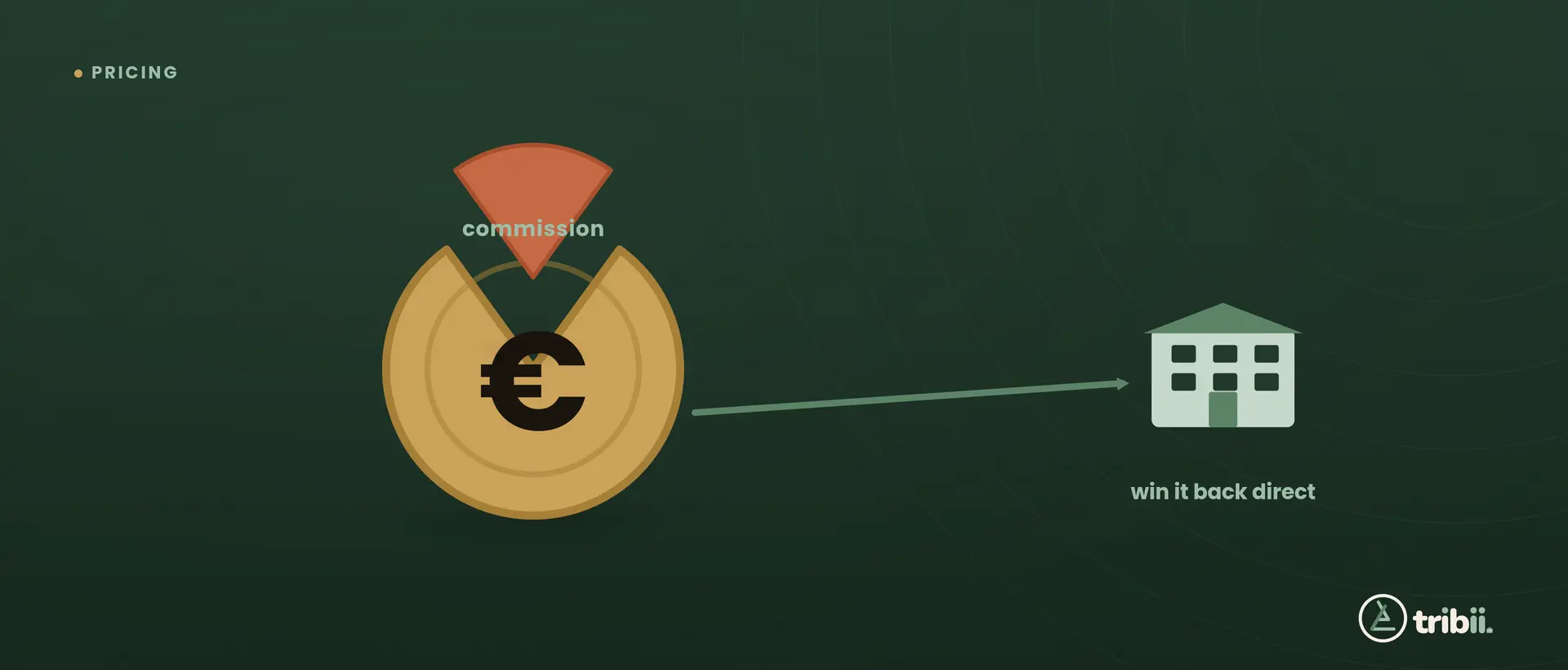
Most hoteliers can tell you their Booking.com commission rate to the nearest percent. Very few can tell you what they paid Booking.com last year in euros. The rate is abstract. The annual figure is a number that changes decisions.
Let us do both.
What the rate actually is
Booking.com's standard commission starts near 15% of each reservation. In practice most properties pay more than that, because the standard rate is the floor rather than the price.
The rate rises when you opt into visibility programmes. The Preferred Partner Programme adds a commission increment in exchange for higher placement and a thumbs-up icon. Genius, the loyalty scheme, requires a discount to a segment of guests, and stacking programmes stacks their costs. In aggregate, properties commonly end up in the 18 to 22% band once the programmes are switched on.
The exact figures depend on your country, your property type, and which programmes you have joined, and Booking.com publishes the terms in the partner portal rather than as a single public price list. Check your own contract and your extranet rather than trusting anyone's summary of it, including this one. Everything here reflects the structure as we reviewed it in July 2026.
For comparison, Expedia commonly runs 15 to 25% depending on the programme and rate plan. The exact number is less important than the shape: roughly one euro in five, on every reservation, forever. Our overview of OTA commission rates puts Booking.com, Expedia and Airbnb side by side.
The number that changes decisions
Take your annual OTA revenue and multiply by your real rate.
A guesthouse doing €180,000 through Booking.com at 18% pays €32,400 a year in commission. That is not a marketing cost, it is a salary. It is a bathroom refurbishment. It is the difference between a good year and a fine one.
Nobody sees this number, because it never appears as an invoice. It arrives as a slightly smaller payout, a thousand times, and the mind does not add up a thousand small subtractions.
Our OTA commission calculator does the addition for you: your yearly OTA revenue, your commission rate, and what the same bookings would have retained at 0% commission on your own site. It needs no account. The estimate is for illustration rather than a quote, but the order of magnitude is the point, and the order of magnitude is usually a shock.
What you can and cannot negotiate
Mostly fixed. The headline rate for your property type in your market. You are not talking Booking.com down from 15% because you asked nicely, and a small independent has no leverage that a chain does not have more of.
Entirely within your control. Whether you join Preferred Partner. Whether you enable Genius, and for which room types. Whether you accept the seasonal booster campaigns that arrive as a helpful email during a slow month.
Each of these is sold as a growth lever, and each is a rate increase in a growth costume. Sometimes the trade is worth it. A new property with no reviews genuinely needs the visibility, and paying for placement to get the first fifty reviews is a rational investment.
The mistake is leaving the programmes on forever. Visibility bought during your first year, when nobody had heard of you, is being repurchased every year afterwards at the same price, for guests who now search your name directly. Audit the programmes annually and switch off the ones whose job is finished.
Also within your control, and largest of all. The proportion of your business that arrives through the channel at all. This is the real lever and it is the one nobody frames as a commission decision.
The billboard effect, used properly
A meaningful share of guests who find a property on an OTA will then look up that property's own website before booking. They want the real photos, the actual room descriptions, and a sense that the place exists.
If your website has a booking button, some of those guests book with you and you keep the whole reservation. If it does not, they return to the OTA and complete the purchase there, and you pay 18% for a booking that had already made up its own mind.
This is the cheapest revenue available to a small hotel and it requires no marketing spend at all. It requires only that the guest who searched your name can finish the transaction. A free booking engine on the site you already have, taking payment through your own Stripe account with no per-reservation cut, converts that traffic instead of donating it.
Start there. It is not a growth tactic, it is the plugging of a leak.
The direct-channel playbook
Once you can take a direct booking, the work is shifting share. In rough order of return on effort:
1. Fix the path from your name to your booking button. Search your property. Whatever ranks, whatever the Google Business Profile shows, the path to your own booking page should be one click from all of it. Put your real website in the Google Business Profile website field, not a Booking.com link.
2. Make the direct rate the best rate you are allowed to offer. Rate parity clauses vary by market and by contract, and in much of the EU they are constrained by law. Read yours. Where parity applies to the public rate, it usually does not apply to closed group rates, member rates, or added value. Which leads directly to the next point.
3. Give value rather than discount. A guest choosing between €120 on the OTA and €120 on your site with late checkout, a welcome drink and free parking is not comparing prices, they are comparing offers. Value costs you a fraction of a commission point and it does not train your guests to wait for discounts.
4. Recapture the abandoned booking. Guests start a booking on your site and stop. Every one of those is a guest who wanted to book direct. An email with a link straight back to the reservation recovers a meaningful share of them. This is what Tribii's Direct Booking Booster does, along with member rates and a check on whether AI assistants can find and correctly recommend your property. It is a paid Pro tool, and honestly, one recovered booking usually covers it.
5. Reply to reviews, all of them. Guests read the replies more carefully than the reviews. A property that answers a two-star review with grace sells more rooms than one with a slightly higher average and nothing to say.
6. Ask at checkout. "If you come back, book on our site and we will take care of you." The highest conversion channel in hospitality is a person who has already slept in the bed.
What not to do
Do not delist from Booking.com in a fit of principle. For most independent properties the OTA is genuinely bringing guests who would never otherwise arrive, and the commission on incremental bookings is a fair price for reach you cannot buy.
Do not undercut your own OTA rate in violation of your contract. Read the contract, use the mechanisms it leaves open, and stay on the right side of it.
Do not treat this as a project with an end. Direct share is a ratio you manage, like occupancy. It goes up when you tend it and drifts down when you do not.
The honest summary
Booking.com's standard commission starts near 15% and commonly reaches 18 to 22% with the visibility programmes attached. The headline rate is largely fixed. The programmes are optional and should be reviewed every year. The proportion of business you send through the channel is entirely yours.
Work out what you paid last year in euros. Then decide how much of it you want to keep.
Commission structure reviewed July 2026 via Booking.com's partner materials. Rates vary by country, property type and programme: check your own contract. Tribii's booking engine carries 0% commission because guests pay through your own payment gateway.

Tribii
The free booking engine for independent hoteliers. Editorial notes.
More for the kitchen table.
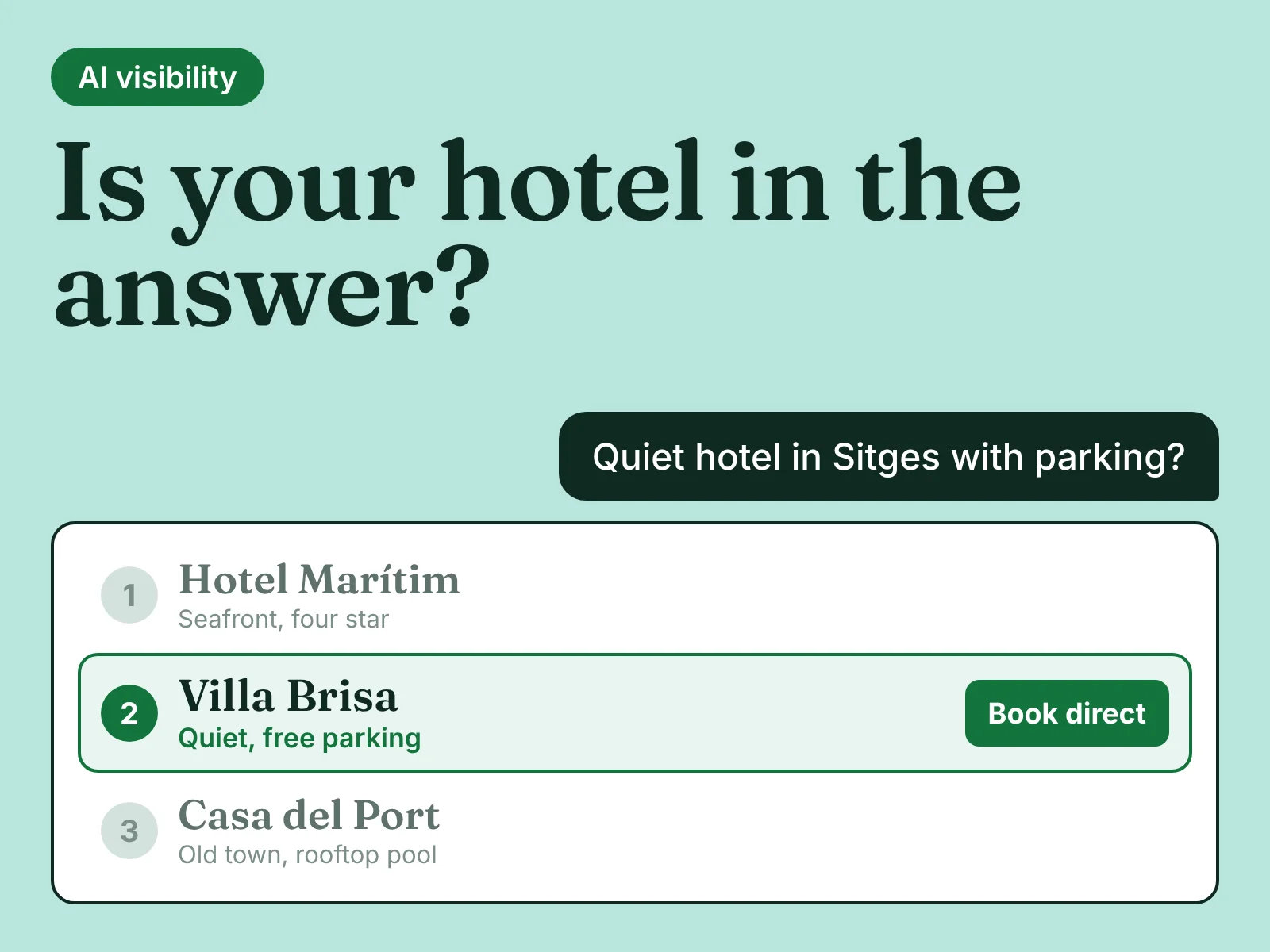
AI visibility for hotels: how to get your property recommended by ChatGPT, Gemini and Google
More guests now ask ChatGPT, Gemini or Google's AI Mode where to stay, and get a handful of names back. Most independent hotels are never one of them. Here is how AI picks hotels, and eight steps to get yours named and booked direct.
 Tribii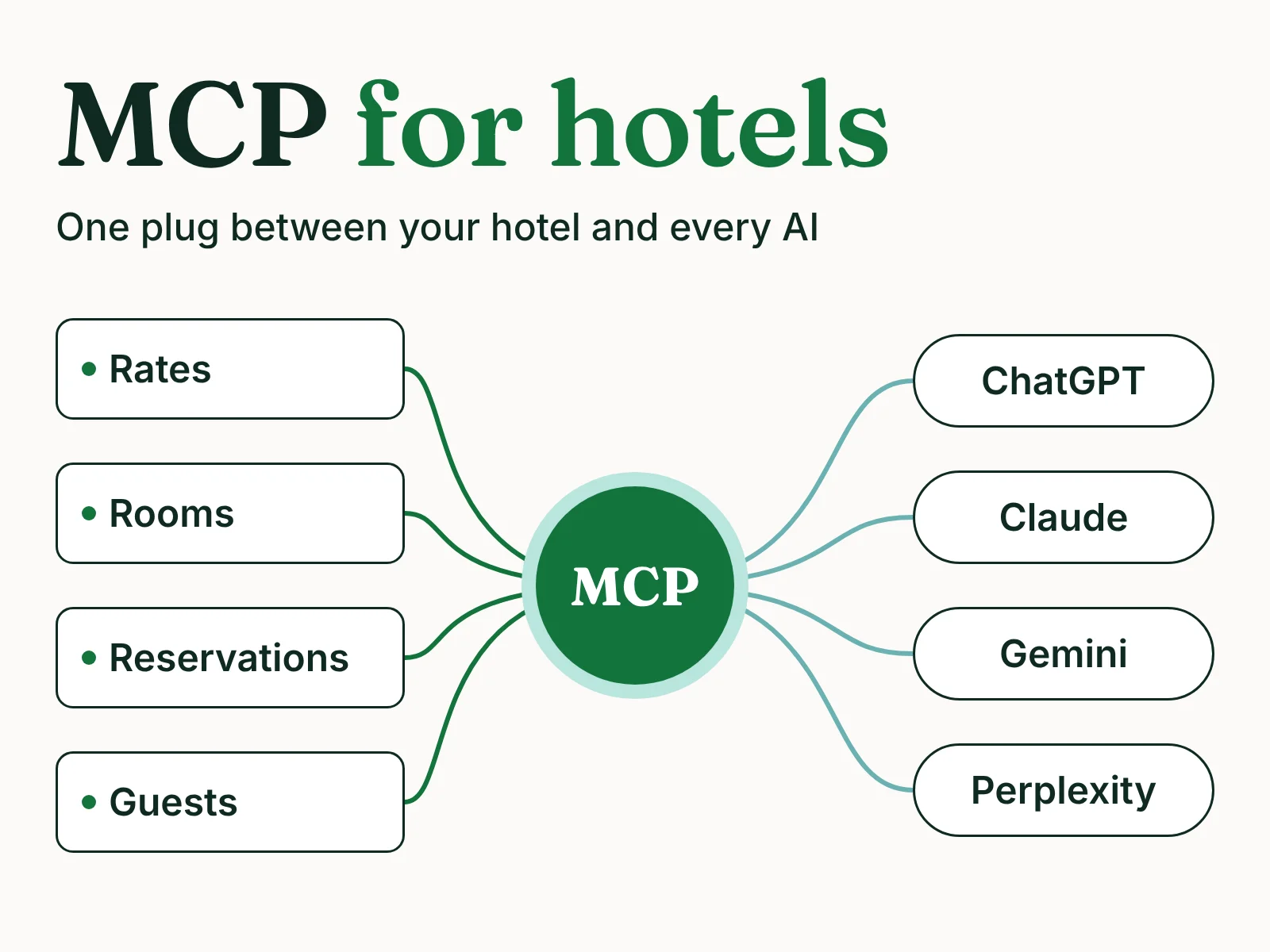
MCP for hotels: how AI assistants will find, sell and help run your property
ChatGPT, Claude and Google can now read live hotel prices, and some can take a booking. The standard behind it is called MCP. Here is what it is, what it changes for a small hotel's visibility and daily work, and what to do about it now.
Tribii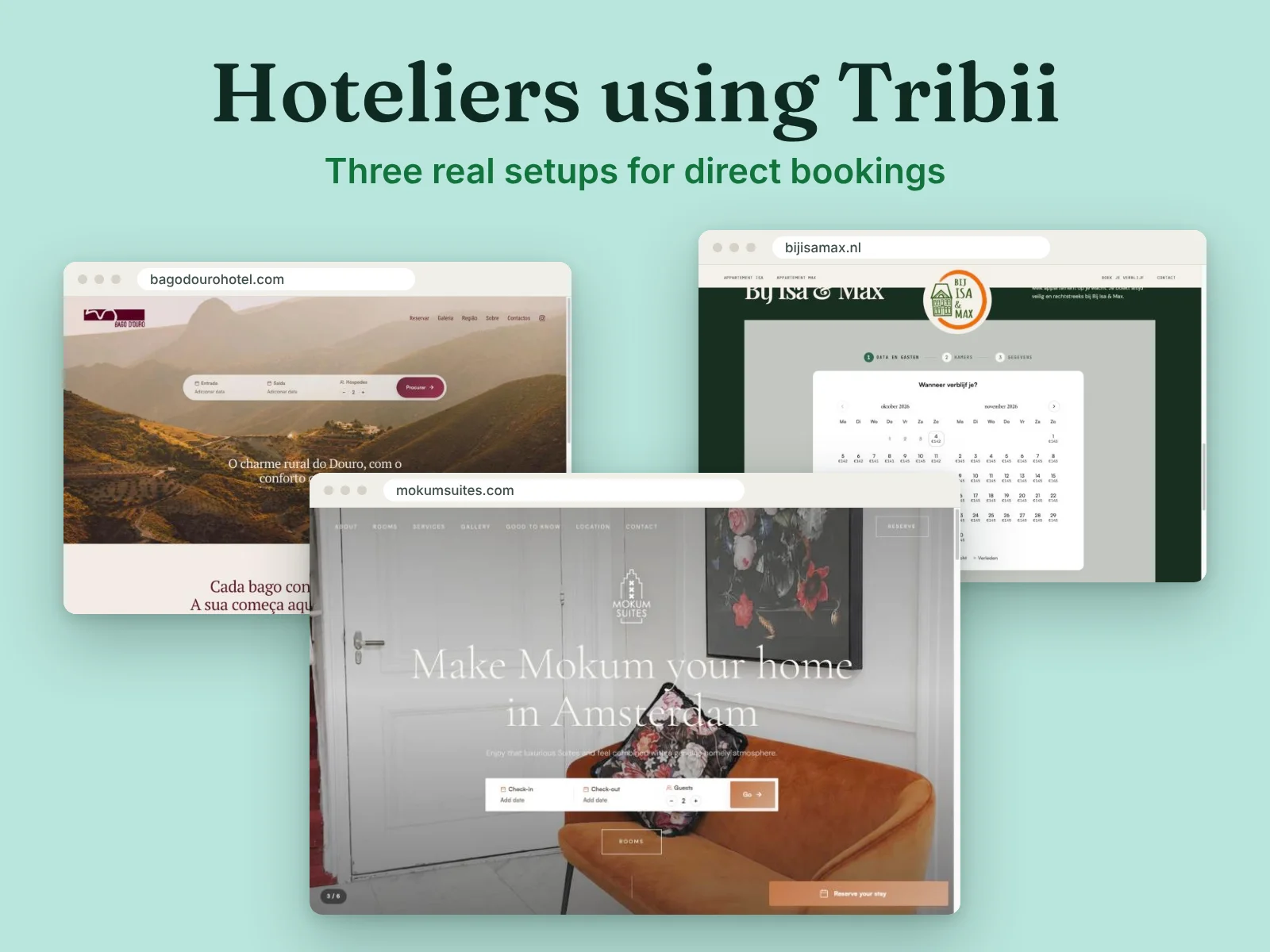
Hotels using Tribii: three real setups for direct bookings
A canal house in Amsterdam, a village guest house in the Douro and two apartments in Kampen all take commission-free bookings with Tribii. Each one set it up differently. Here is what they did, and how to choose the setup that fits your property.
Tribii