MCP for hotels: how AI assistants will find, sell and help run your property
ChatGPT, Claude and Google can now read live hotel prices, and some can take a booking. The standard behind it is called MCP. Here is what it is, what it changes for a small hotel's visibility and daily work, and what to do about it now.
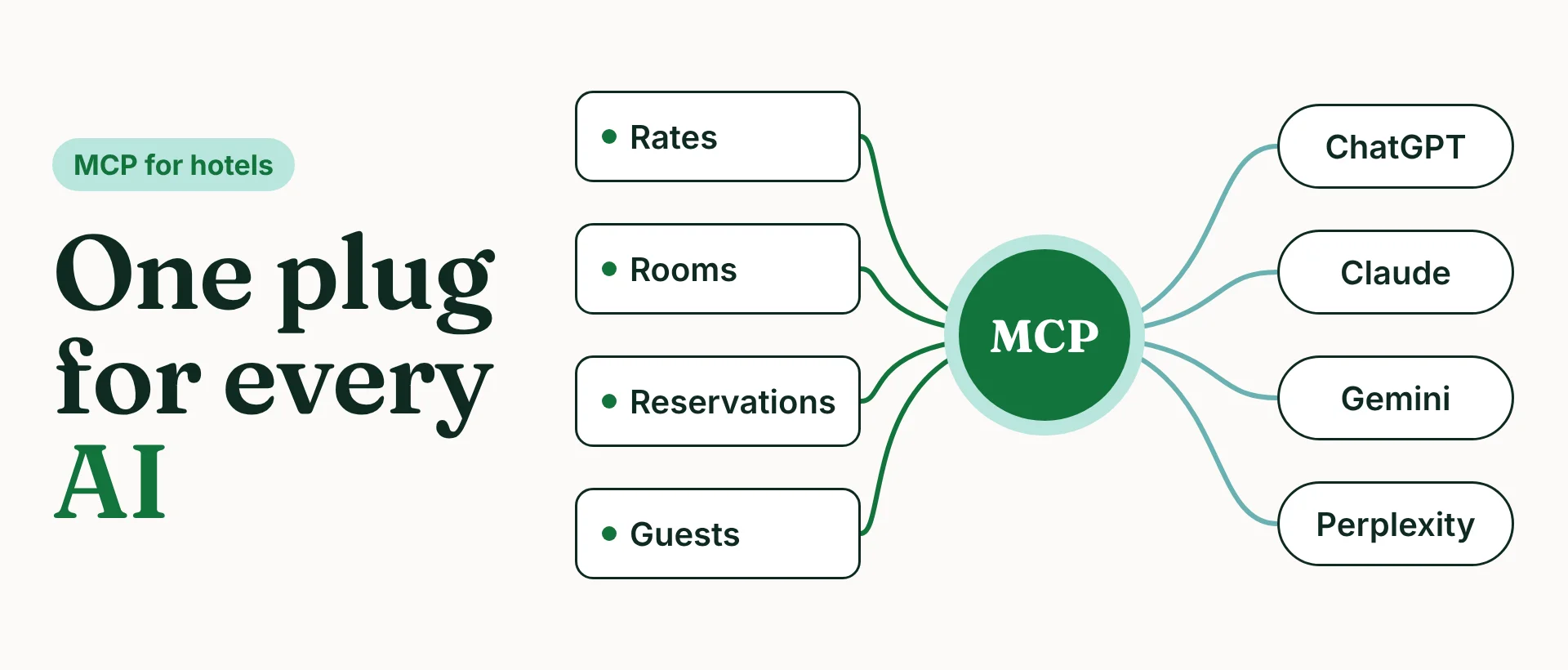
A guest in Rotterdam opens ChatGPT and types: a quiet hotel in Porto for three nights in May, with parking, under €150 a night. Not long ago the answer was a list of names pulled from the web, half of them out of date. Today the assistant can show live Booking.com prices inside the chat. In the United States, Google's AI Mode can take a guest all the way to a confirmed reservation.
The plumbing behind this has a name: the Model Context Protocol, or MCP. It may be the most important piece of hotel technology most hoteliers have never heard of.
This guide explains it without the jargon, shows what it changes for your visibility and for your daily operations, and lists what an independent property can sensibly do about it this winter.
The short answer
MCP is an open standard that lets AI assistants such as ChatGPT, Claude and Gemini connect to other software, read its data and use its tools.
For a hotel it works in two directions. Facing out, it lets a guest's AI assistant see your rates, availability and policies, and in some cases start a booking. Facing in, it lets your own AI assistant read your PMS, reservations and reports, so you can ask questions about your hotel in plain words and get answers from your real numbers.
You do not need to build anything yourself. MCP reaches you through your booking engine, PMS and channel tools. What you do need is clean information about your property, a direct booking channel that works, and software vendors who are moving.
What MCP actually is
Every hotel runs on several systems: a PMS for operations, a booking engine for direct reservations, a channel manager for the OTAs, maybe a revenue tool and a guest CRM. Each speaks its own language.
Until recently, connecting an AI assistant to any of them meant building a custom integration for that one assistant and that one system. Another assistant, another integration. Nobody was going to do that for a hotel with 18 rooms.
MCP replaces all of that with one shared plug. A system publishes an MCP server once, and every assistant that speaks MCP can use it. Think of how one charging cable now fits most phones and laptops.
An MCP server offers a set of tools: small, named actions such as "check availability", "list rate plans" or "show tomorrow's arrivals". When you ask the assistant something, it decides which tools to call, receives a structured answer, and uses it in its reply. The company that runs the server decides which tools exist and what each one is allowed to do. Some servers only answer questions. Others can also take actions, like creating a booking or changing a price.
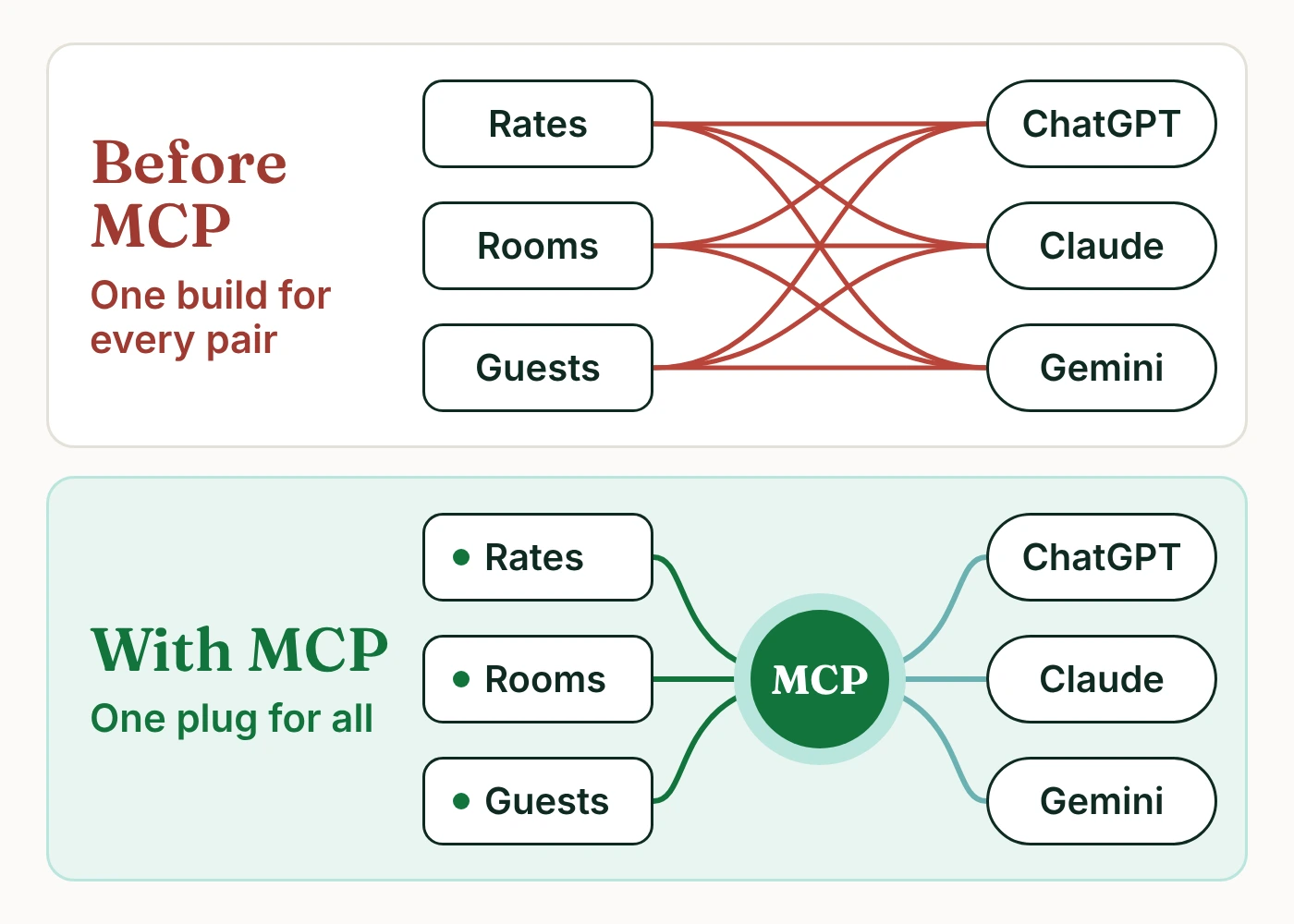
One connection instead of one per assistant.
One connection instead of one per assistant.
Anthropic introduced MCP as an open standard in November 2024. In December 2025 it handed the protocol to the Agentic AI Foundation, a new home under the Linux Foundation founded together with OpenAI and Block and supported by Google, Microsoft and AWS. By the middle of 2026 more than 10,000 MCP servers were running in production, and the developer kits were being downloaded around 97 million times a month.
For a hotelier, that history matters for one reason. No single company owns MCP, every major AI company supports it, and it is not going away next year. It is safe to plan around.
Why it matters for your visibility
More and more guests start their search inside an AI assistant. In an Ipsos poll for Allianz Partners this spring, 37% of Americans planning a summer trip were using AI to help plan it. Among experienced international travellers surveyed by Global Rescue, the share using AI rose from 22% in January 2026 to 36% by July. And in research by TakeUp, 78% of US travellers who use AI said they had booked a trip based mainly on an AI recommendation.
What an assistant says about your hotel depends on what it can read. Without live data, it guesses from old web pages and reviews, or it hands the guest to whoever does have live data. Right now, that is usually an OTA.
The big platforms moved first:
- Booking.com and Expedia were among the first apps inside ChatGPT in October 2025. Their apps run on MCP and show live prices and availability in the chat. The booking itself is finished on the OTA's own site.
- Google launched hotel booking inside AI Mode in the United States on 27 August 2026. Launch partners include Booking.com, Expedia, Hilton, Marriott and IHG. The hotel or the OTA stays the merchant of record and handles the payment and confirmation.
- Expedia has said it is preparing an MCP server so its business partners' AI agents can reach its inventory directly.
If this pattern feels familiar, it should. When the internet arrived, the OTAs showed up first and independent hotels have been paying commission on that head start ever since. The same thing can happen in AI. Our guide to the real cost of an OTA booking shows what that costs per room.
The difference this time is that MCP is open. The door is not reserved for companies with large engineering teams. The first hotel booking made through MCP, in September 2025, was not at a global chain. It was at Rose St. Gardens, a rental with five units in Roseau, Dominica. The guest asked ChatGPT for a family house, the request matched the property's live data, and the property itself was the merchant of record. No OTA in between.
Hotel software vendors are following. Aven Hospitality, formerly Sabre Hospitality Solutions, switched on MCP across its SynXis reservation system and booking engine in March 2026. Simple Booking, a booking engine used by more than 7,000 properties, made a suite of around twenty MCP tools generally available in June 2026, covering live pricing, availability and rate parity checks.
An honest caveat. Agentic booking is early. Most AI conversations still end with a link to a booking page, and even Google's version leaves the guest to choose the room and approve the payment. So today, being visible in AI mostly means three things: the assistant finds you, describes you correctly, and sends the guest to your own booking page at your own price.
Why it matters for your operations
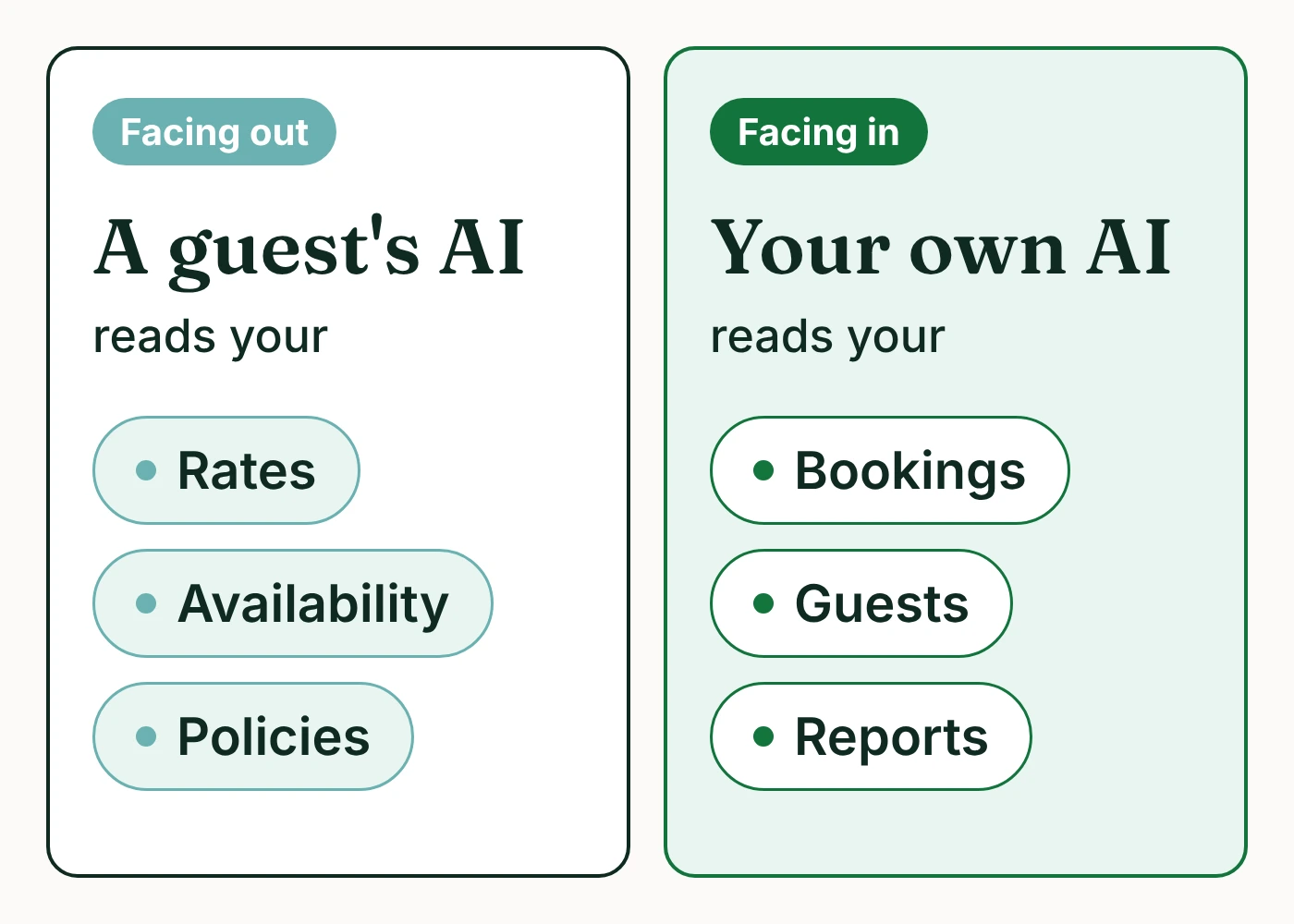
The same standard opens two doors: one for guests, one for you.
The same standard opens two doors: one for guests, one for you.
The second door gets less attention, but for a small hotel it is often the more useful one today. Here MCP connects your own AI assistant to your own systems.
Instead of opening five screens and exporting a spreadsheet, you ask:
- "Which nights in the next six weeks are below 60% occupancy, and what did we charge on the same nights last year?"
- "Who arrives tomorrow, which of them have stayed with us before, and who asked for an early arrival?"
- "How much commission did we pay each OTA last quarter, compared with what direct bookings cost us?"
- "Using our real availability and rates, draft a reply to this group request for twelve people in March."
- "Write a one page summary of September for the owners."
The assistant calls the right tools, reads the numbers and answers in a sentence or a table. The work it replaces is the work nobody went into hospitality to do: exports, report menus, copying figures between systems, checking OTA statements line by line.
Apaleo became the first PMS to launch an MCP server in September 2025, with citizenM among the hotel groups testing it. citizenM's CIO, Mike Rawson, called MCP "the great AI democratiser in hotel tech". The point he was making applies even more to a small property: you no longer need a developer to get answers out of your own data.
Two limits are worth keeping in mind. An assistant can misread a question or a figure, so check any number that drives a pricing or staffing decision. And keep a person in charge of anything that changes prices, availability or guest records.
The risks, in plain words
MCP is safe to use, but it is not risk free. Four things deserve your attention.
Permissions. An assistant can do whatever its connection allows. Security guidance from OWASP to the US National Security Agency says the same thing: give each connection only the access it needs. For most hotels, that means starting with connections that can read but not change.
Instructions hidden in text. A guest email, a review or a web page can contain text written to trick an AI assistant. If the assistant is allowed to take actions, that text could push it to do something you never asked for. Read only connections take most of the sting out of this.
Guest data. GDPR still applies when data passes through an AI service. Know which assistant your data goes to, check that your vendor has a data processing agreement in place, and do not connect guest records to tools you have not checked.
Wrong answers, said with confidence. If your own information is inconsistent, an AI will repeat the mistake to guests without hesitation. That is a data problem, not an AI problem, and it is the one you can fix today.
What an independent hotel should do now
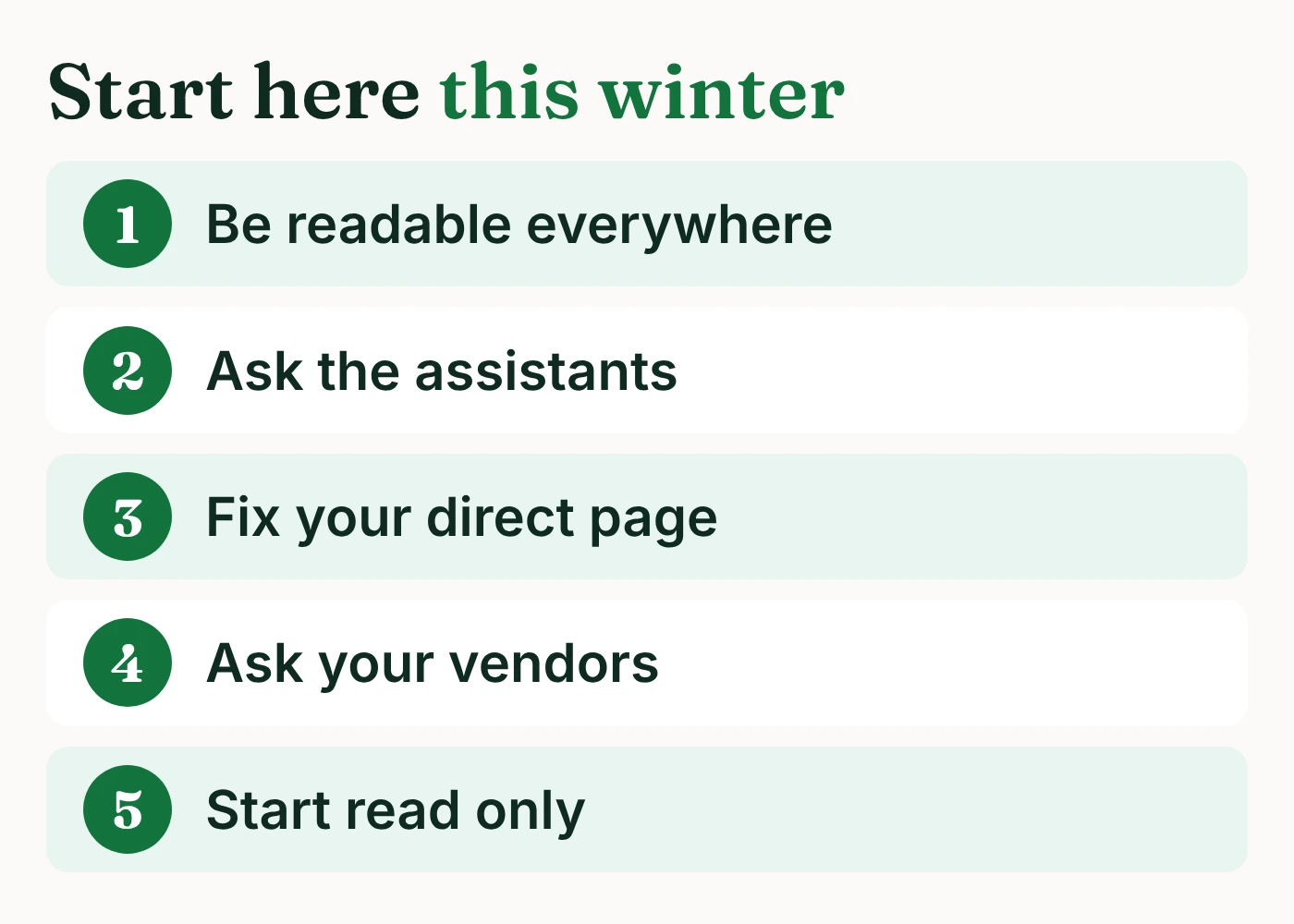
1. Make your property readable. Use the same name, address, room names, amenities and policies everywhere: your website, your Google Business Profile and every OTA. A pet policy buried in a PDF is invisible to an assistant. Make sure your website carries structured data, the hidden labels that tell machines what your hotel is, where it is and what it offers.
2. Ask the assistants about yourself. Open ChatGPT, Claude, Gemini and Perplexity and ask the way a guest would: "Recommend a quiet hotel in your town with parking." Then ask directly: "Tell me about your hotel in your town." Write down what is missing or wrong, and fix it at the source.
3. Make your direct booking page the easy destination. When an assistant recommends you, it links somewhere. Your booking page should load fast on a phone, show real prices and take a booking in a few taps. Our twelve ways to get more direct bookings cover the basics.
4. Ask your software vendors four questions. Do you offer an MCP server? Is it read only, or can it take bookings? Which assistants have you tested it with? What does it cost? A vendor without an answer in 2026 is a vendor to watch.
5. Start operations read only. Connect an assistant to your data and spend a month just asking questions. You will learn quickly what it gets right, and you will trust it on the things it does well.
6. Measure AI traffic. In Google Analytics, look at visits referred by chatgpt.com, perplexity.ai, gemini.google.com and claude.ai. The numbers are small for most hotels today. The trend is what matters.
7. Keep the OTAs for reach. MCP is not a reason to leave the platforms. It is a reason to stop being reachable only through them.
Where Tribii fits
Tribii works on both doors, and draws a deliberate line between them.
Facing out, the Direct Booking Booster on the Pro plan includes AI search visibility. It scores how complete your hotel's public information is for AI assistants against similar properties, and runs live checks to see whether ChatGPT, Claude, Gemini and Perplexity find and correctly recommend you. Every gap comes with a fix that links to the setting that owns it. When an assistant does send a guest your way, they land on the free booking engine: 0% commission, free up to 20 rooms, with payment going straight to your own Stripe account.
Facing in, Pro also gives every property its own MCP server. You connect Claude, ChatGPT or any other assistant that speaks MCP to your Tribii account, and ask about your reservations, rates, guests and reports in plain words. It is queryable, not bookable, by design: the assistant reads and reports, and it never takes a reservation or changes a price behind your back. On Max, the hotel AI assistant answers questions across the whole property and helps reconcile your OTA statements.
Pro costs €55 a month and Max €95, with everything on the pricing page. As always, the tool matters less than the principle: your data should be easy to read, the first connection should be read only, and your own booking channel should be the place every recommendation ends.
Common questions
What is MCP in hotels?
MCP, the Model Context Protocol, is an open standard that lets AI assistants connect to hotel software. Through it, an assistant can read live rates and availability, look up reservations and reports, and, where the hotel allows it, take actions such as starting a booking.
Does MCP replace my booking engine or channel manager?
No. MCP is a connector that sits on top of the systems you already use. Your booking engine, PMS and channel manager still do the work. MCP lets AI assistants talk to them.
Can ChatGPT book a room at my hotel directly?
In a few cases, yes, and the first such booking happened in 2025. In most cases today, the assistant shows options and sends the guest to a booking page to finish. That is why your own booking page matters more, not less.
Do I need a developer to use MCP?
No. MCP reaches hotels through their software vendors. Your job is to ask whether your booking engine and PMS offer it, and to connect the assistant you already use.
Is MCP safe for guest data?
It can be, if you start with read only access, use vendors with a proper data processing agreement, and only connect assistants you have checked. GDPR applies to AI services like any other.
Will MCP replace the OTAs?
No. The OTAs are already among the biggest users of MCP. What MCP changes is that independent hotels can now be found and booked in AI assistants on their own terms, not only through an OTA listing.
The honest summary
MCP is the standard that lets AI assistants read and use hotel software. It is open, every major AI company supports it, and it is already showing live hotel prices to guests.
The OTAs got there first, as they did with the internet. But this time the door is open to properties of every size. Make your hotel readable, keep your direct booking page in good shape, ask your vendors where they stand, and start using the inside door for your own work. The hotels that do this now will be the ones the assistants recommend later.
Facts reviewed in October 2026 from announcements by Anthropic, the Linux Foundation, OpenAI, Google, Expedia Group, Apaleo, Aven Hospitality, Simple Booking and Agentic Hospitality, and from surveys by Allianz Partners and Ipsos, Global Rescue and TakeUp. AI features and their availability change quickly and vary by country: check with your own vendors. This is not legal advice.

Tribii
The free booking engine for independent hoteliers. Editorial notes.
More for the kitchen table.
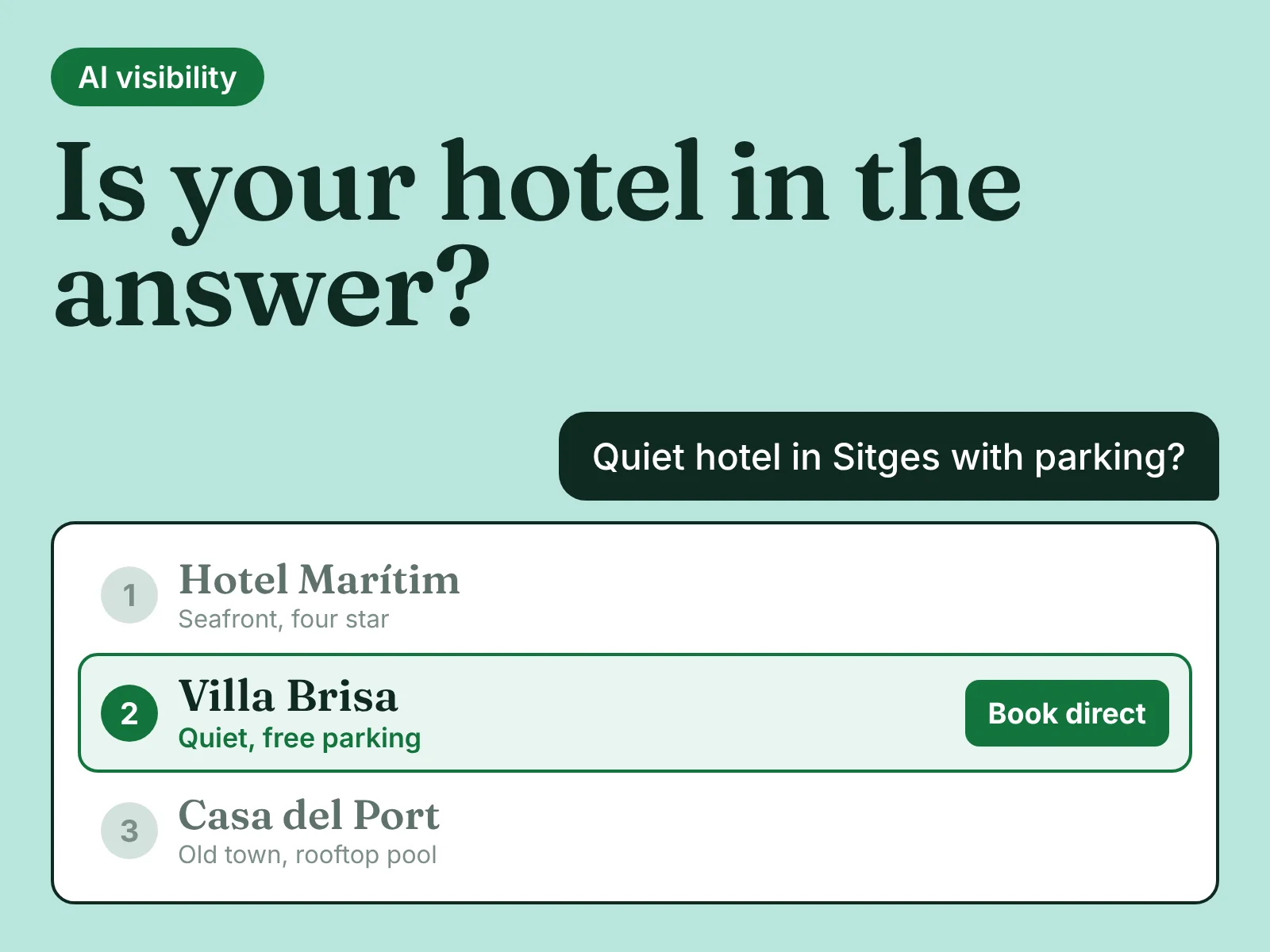
AI visibility for hotels: how to get your property recommended by ChatGPT, Gemini and Google
More guests now ask ChatGPT, Gemini or Google's AI Mode where to stay, and get a handful of names back. Most independent hotels are never one of them. Here is how AI picks hotels, and eight steps to get yours named and booked direct.
 Tribii
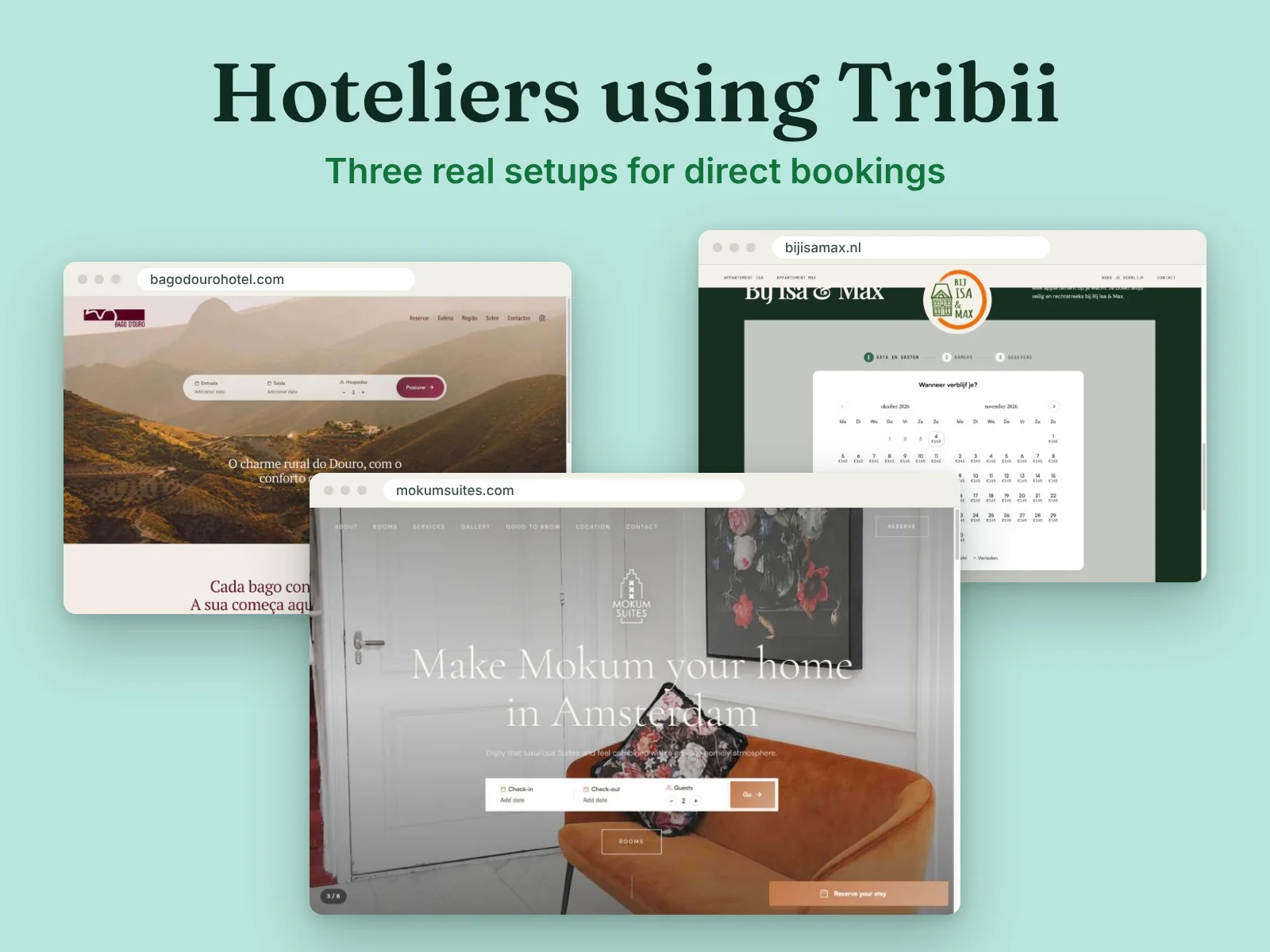
Hotels using Tribii: three real setups for direct bookings
A canal house in Amsterdam, a village guest house in the Douro and two apartments in Kampen all take commission-free bookings with Tribii. Each one set it up differently. Here is what they did, and how to choose the setup that fits your property.
Tribii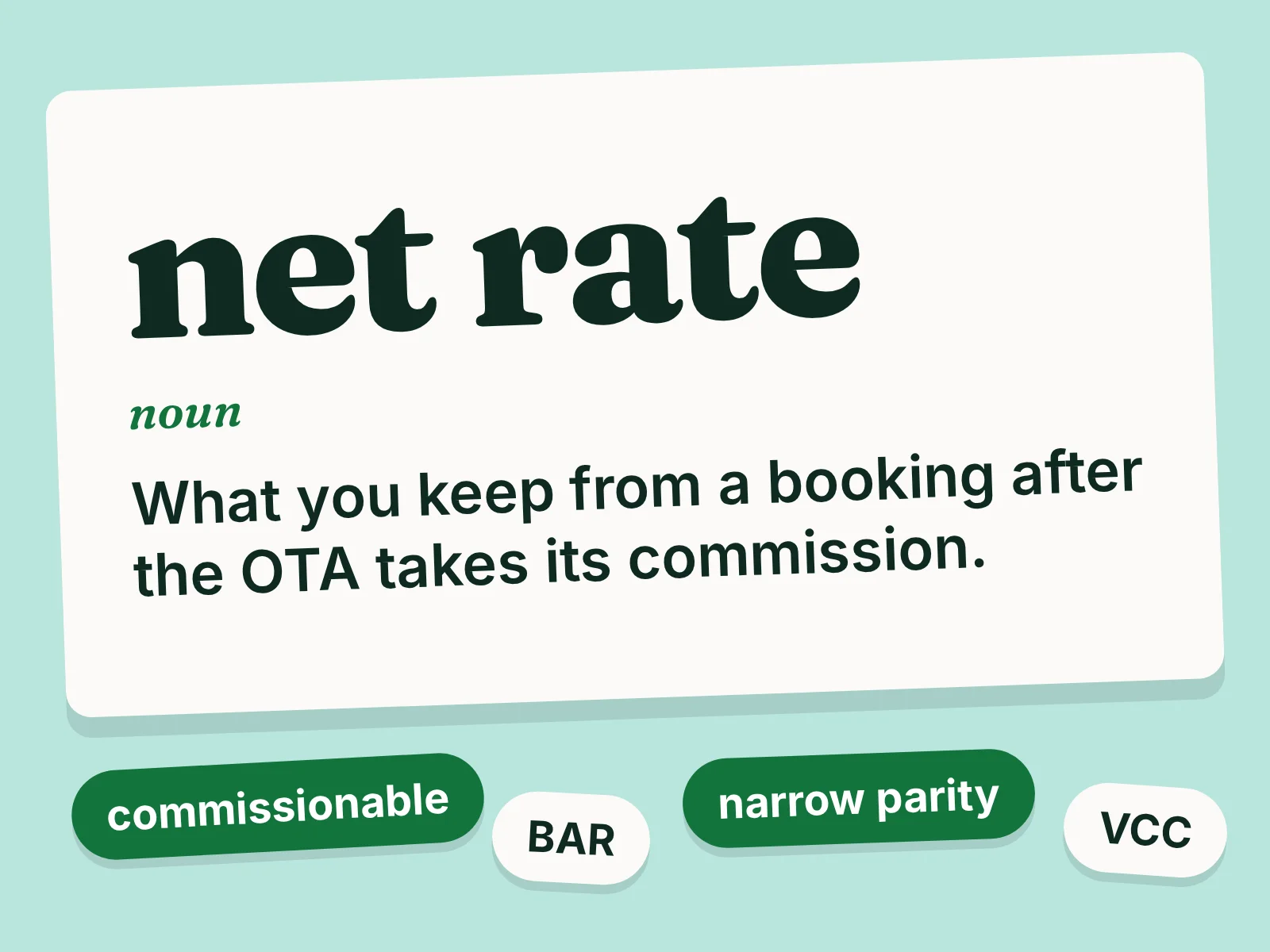
OTA terms explained: a plain-language glossary for independent hotels
Commissionable rate, net rate, merchant model, narrow parity. The words in your OTA contract, explained in plain language, with what each one means for your money.
Tribii