Twelve ways to get more direct bookings at a small hotel
Ordered by return on effort, not by how impressive they sound. Most of these cost nothing and several take an afternoon.
Direct share is a ratio you manage, like occupancy. It rises when you tend it and drifts down when you stop. What follows is ordered by return on the hour you spend, which means the boring ones come first. That is usually how it works.
1. Be bookable at all
Before anything else: can a guest on a phone, at 11pm, complete a reservation on your own website without speaking to a human? If the answer is no, nothing else on this list matters, because every tactic below funnels traffic to a door that does not open.
A free booking engine on the site you already have, with payment landing in your own account and no per-reservation cut, is the whole prerequisite. It is not a growth tactic. It is the plumbing that makes growth possible.
2. Fix your Google Business Profile website link
Search your property. In the panel on the right, the "Website" button is either pointing at your own site or at an OTA listing. If it is the OTA, you are paying commission for guests who searched your name.
Change the field to your own booking page. It takes two minutes and it is the single highest-return action in this article, because these are guests at the bottom of the funnel who already decided.
While you are there, fill the profile out properly: photos, amenities, check-in times, and replies to reviews.
3. Catch the guest who leaves the OTA to look you up
A meaningful share of guests who find a property on an OTA will search its name before booking, to see the real photos and confirm the place exists. This is the traffic already coming to your website with intent.
If your site converts them, you keep the whole reservation. If it does not, they return to the OTA and you pay commission on a decision that had already been made. Nothing on this list is cheaper than converting traffic you are already receiving.
4. Give value instead of discount
You may be constrained by rate parity clauses on the public rate. You are rarely constrained on what you include.
Late checkout. A welcome drink. Free parking. Breakfast for a room that does not include it. The guest comparing €120 on the OTA with €120 on your site plus late checkout is not comparing prices at all, and you have paid a fraction of a commission point for the difference.
Discounts train guests to wait. Value trains them to book direct.
5. Recapture abandoned bookings
Guests start a reservation on your site and stop. They were interrupted, or they wanted to check with their partner, or the page was slow.
Every one of them is a guest who chose direct and did not finish. An email with a link straight back into the reservation recovers a real share of them, and a timed sequence recovers more. This is one of the jobs of Tribii's [Direct Booking Booster](/product/direct-booking-booster), along with member rates and a check on whether AI assistants find and correctly recommend your property. It is a paid Pro tool, and one recovered booking usually covers its cost.
6. Make the site fast, especially on a phone
Speed is conversion. A booking page that takes four seconds to show a room loses guests who never tell you they left.
You do not need a rebuild. Compress the images, which are almost always the problem. Remove the plugins you stopped using. Confirm the booking widget loads without blocking the page. Our free website audit is read-only and checks exactly this, along with whether your rooms are actually bookable and how clearly your prices are shown.
7. Publish in the languages your guests speak
If a third of your guests arrive from a country whose language your site does not speak, you are converting them at a fraction of the rate you convert everyone else, and no analytics dashboard will ever show you the ones who left.
Multilingual pages, with real translated content rather than a browser widget, are among the highest-return changes available to a European property with international guests.
8. Reply to every review, especially the bad ones
Guests read the replies more closely than the reviews. A property that answers a two-star complaint with specificity and grace outsells a property with a higher average and nothing to say.
Reply within a week. Do not be defensive. Fix the thing if the thing is real, and say that you did.
9. Ask at checkout
The highest-converting channel in hospitality is a person who has already slept in your bed.
"If you come back, book with us directly and we will look after you." Say it at checkout, put it on the card in the room, put it in the thank-you email. Repeat guests booking direct is the cheapest revenue that exists, and almost nobody asks.
10. Make sure AI assistants can describe you correctly
Guests increasingly ask ChatGPT, Claude or Gemini where to stay. Those assistants read your website and whatever else they can find, and then either recommend you accurately, recommend you wrongly, or do not mention you.
You cannot buy placement here. You can make your property legible: clear descriptions in text rather than trapped in images, a page that says what kind of property you are and who it suits, prices and policies stated plainly, and a booking page an assistant can point at.
11. Audit your OTA visibility programmes once a year
This is not a direct-booking tactic, it is a commission tactic, and it belongs on the list because it is free.
Visibility programmes bought during your first year, when nobody had heard of you, are being repurchased every year afterwards at the same rate, often for guests who now search your name directly. Switch one off for a quarter and watch what happens. If nothing happens, you just gave yourself a raise.
Work out what you are paying first. Our OTA commission calculator turns your yearly OTA revenue and your real rate into the number that has never appeared on an invoice.
12. Put the booking button everywhere, and make it look like a button
The most common failure on a small hotel website is a "Book now" link that exists once, in the footer, styled like body text.
Main navigation, visually distinct. Bottom of every room page. Bottom of the location page, the restaurant page, the page about the family who bought the mill in 1998. Every page a guest can be reading when they decide, should be a page where they can act.
The order, if you only do three
- Fix the Google Business Profile link.
- Make the site bookable, on a phone, with payment into your own account.
- Ask returning guests to book direct.
Those three cost nothing, take an afternoon between them, and move the ratio more than any campaign you could buy.
The honest summary
None of this is a growth hack. It is the unglamorous work of making the channel you own as easy to use as the channel that charges you 18%.
The OTA spent a fortune making its checkout frictionless. You do not need to match that budget. You need a button that works on a phone, a price that is honestly the best available, and the nerve to ask.
*Tribii's booking engine and website builder are free for properties up to 20 rooms, with 0% commission because guests pay through your own Stripe account.*

Tribii
The free booking engine for independent hoteliers. Editorial notes.
More for the kitchen table.
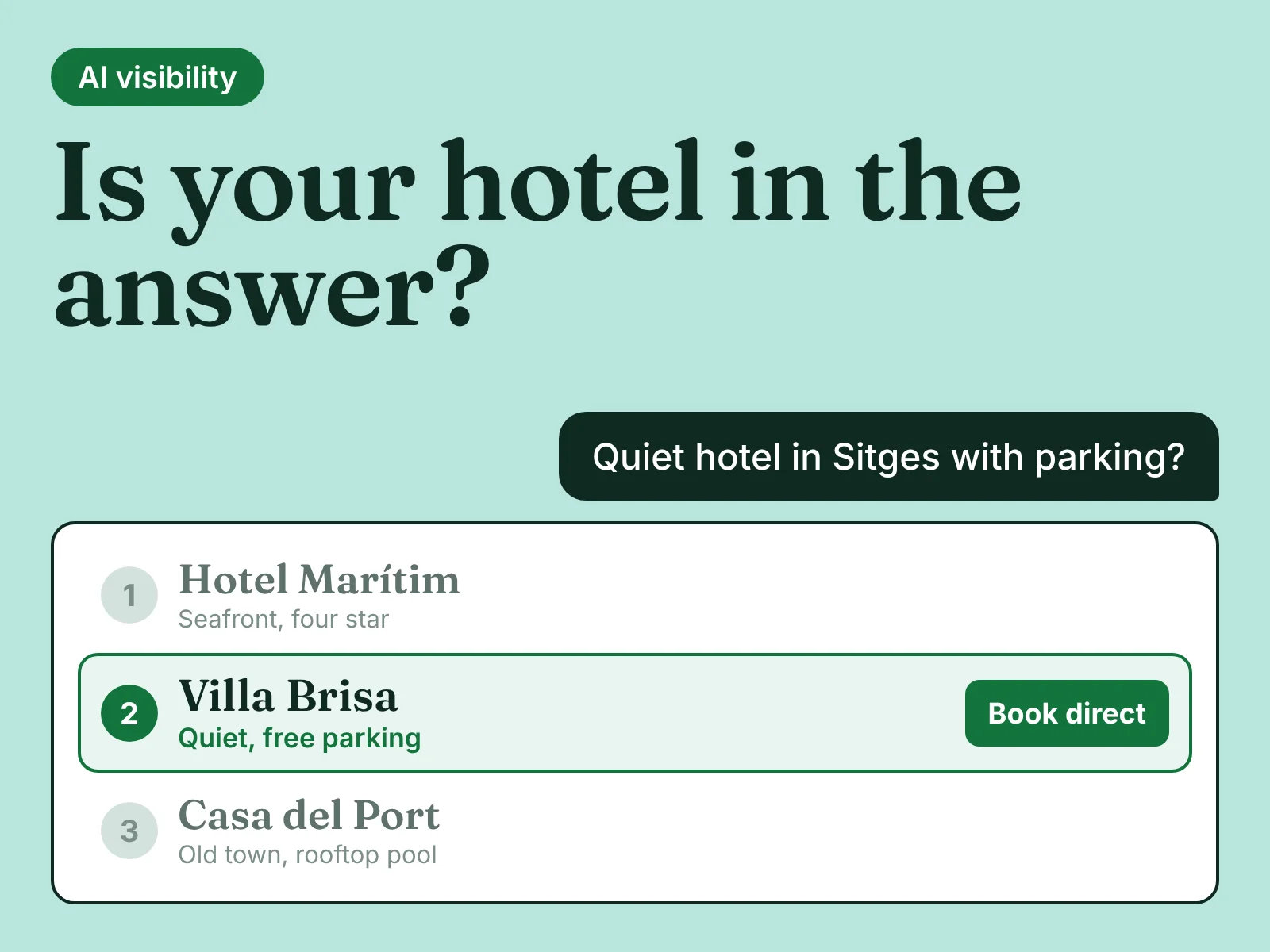
AI visibility for hotels: how to get your property recommended by ChatGPT, Gemini and Google
More guests now ask ChatGPT, Gemini or Google's AI Mode where to stay, and get a handful of names back. Most independent hotels are never one of them. Here is how AI picks hotels, and eight steps to get yours named and booked direct.
 Tribii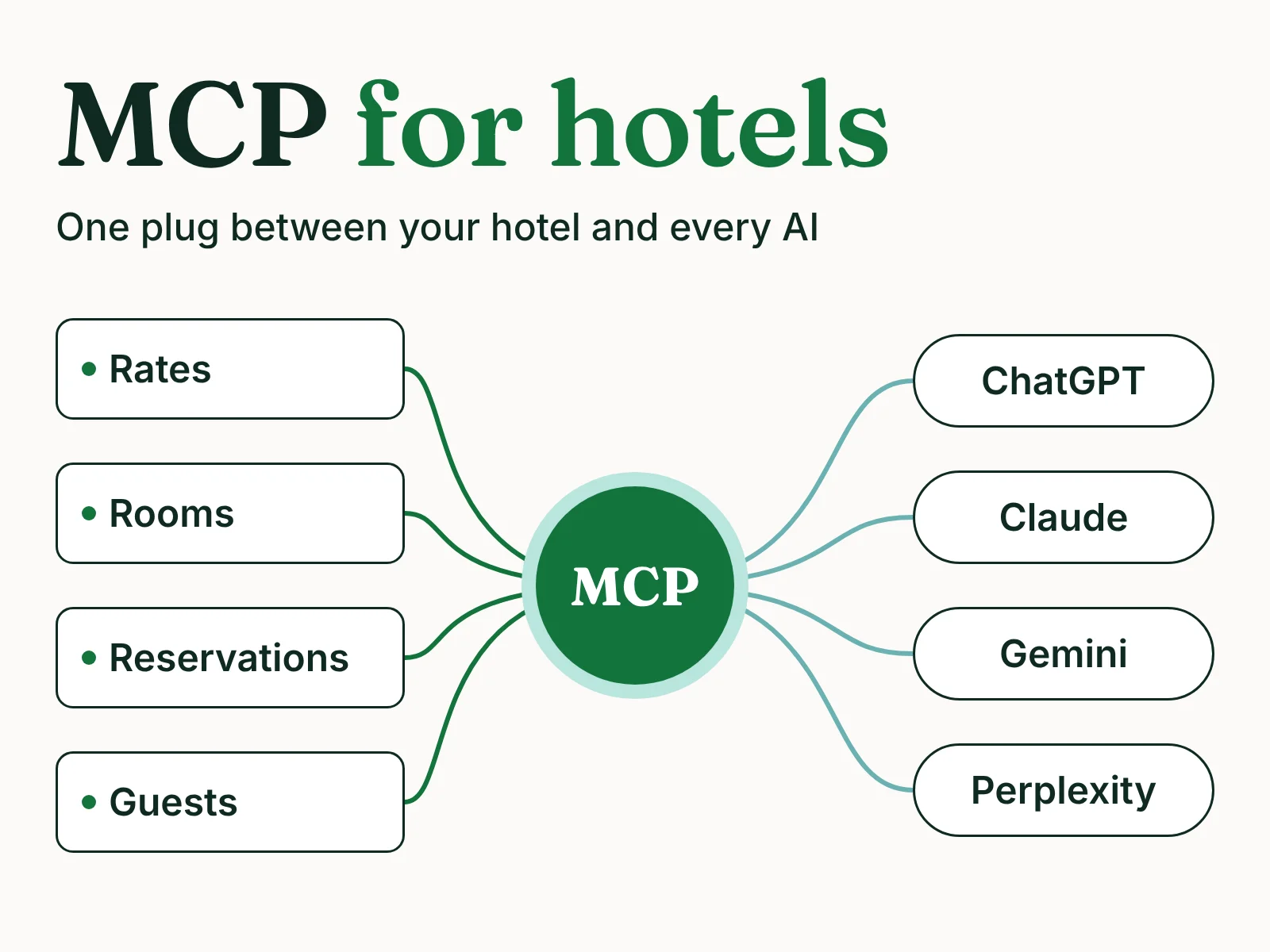
MCP for hotels: how AI assistants will find, sell and help run your property
ChatGPT, Claude and Google can now read live hotel prices, and some can take a booking. The standard behind it is called MCP. Here is what it is, what it changes for a small hotel's visibility and daily work, and what to do about it now.
Tribii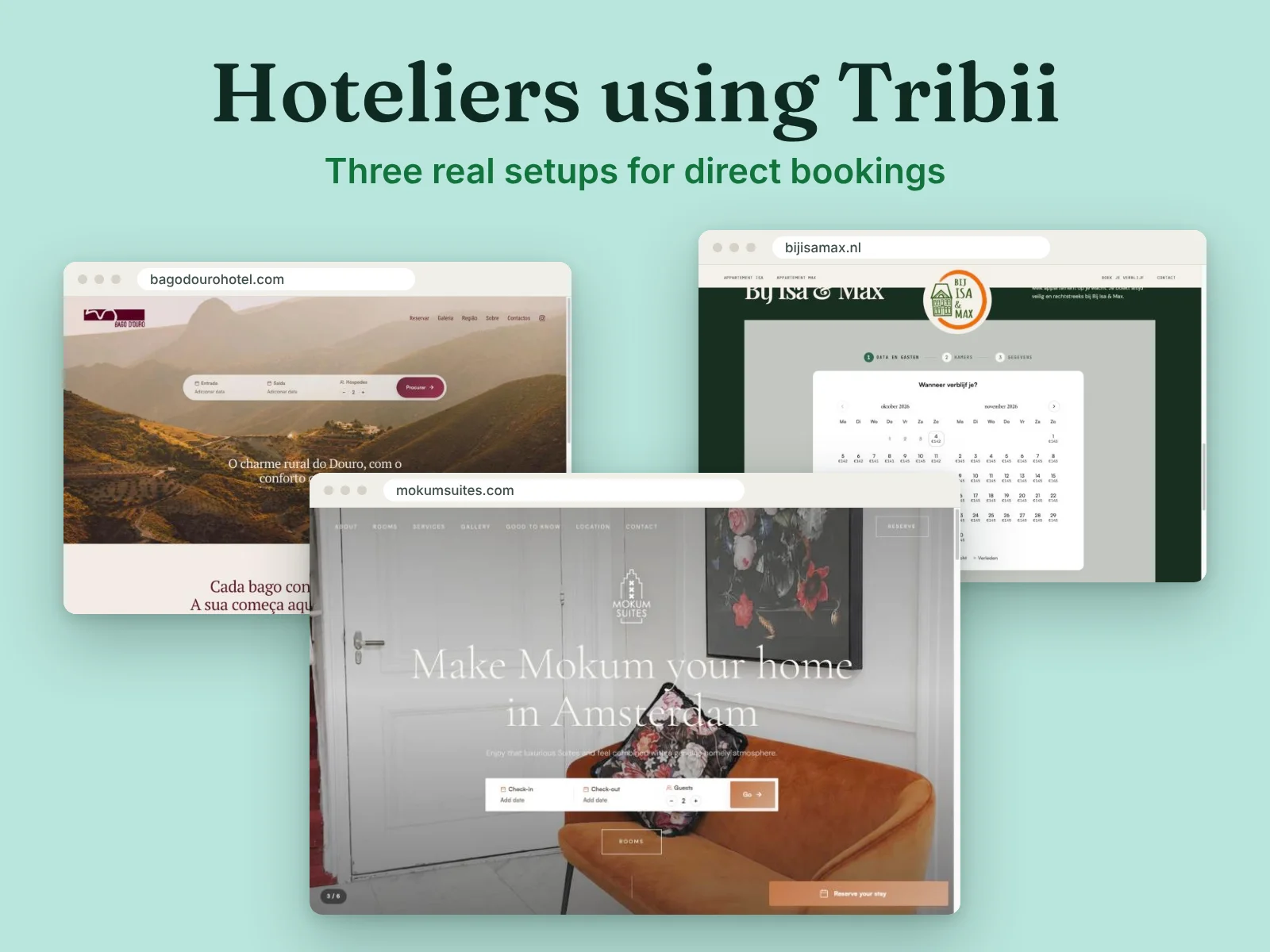
Hotels using Tribii: three real setups for direct bookings
A canal house in Amsterdam, a village guest house in the Douro and two apartments in Kampen all take commission-free bookings with Tribii. Each one set it up differently. Here is what they did, and how to choose the setup that fits your property.
Tribii