AI visibility for hotels: how to get your property recommended by ChatGPT, Gemini and Google
More guests now ask ChatGPT, Gemini or Google's AI Mode where to stay, and get a handful of names back. Most independent hotels are never one of them. Here is how AI picks hotels, and eight steps to get yours named and booked direct.
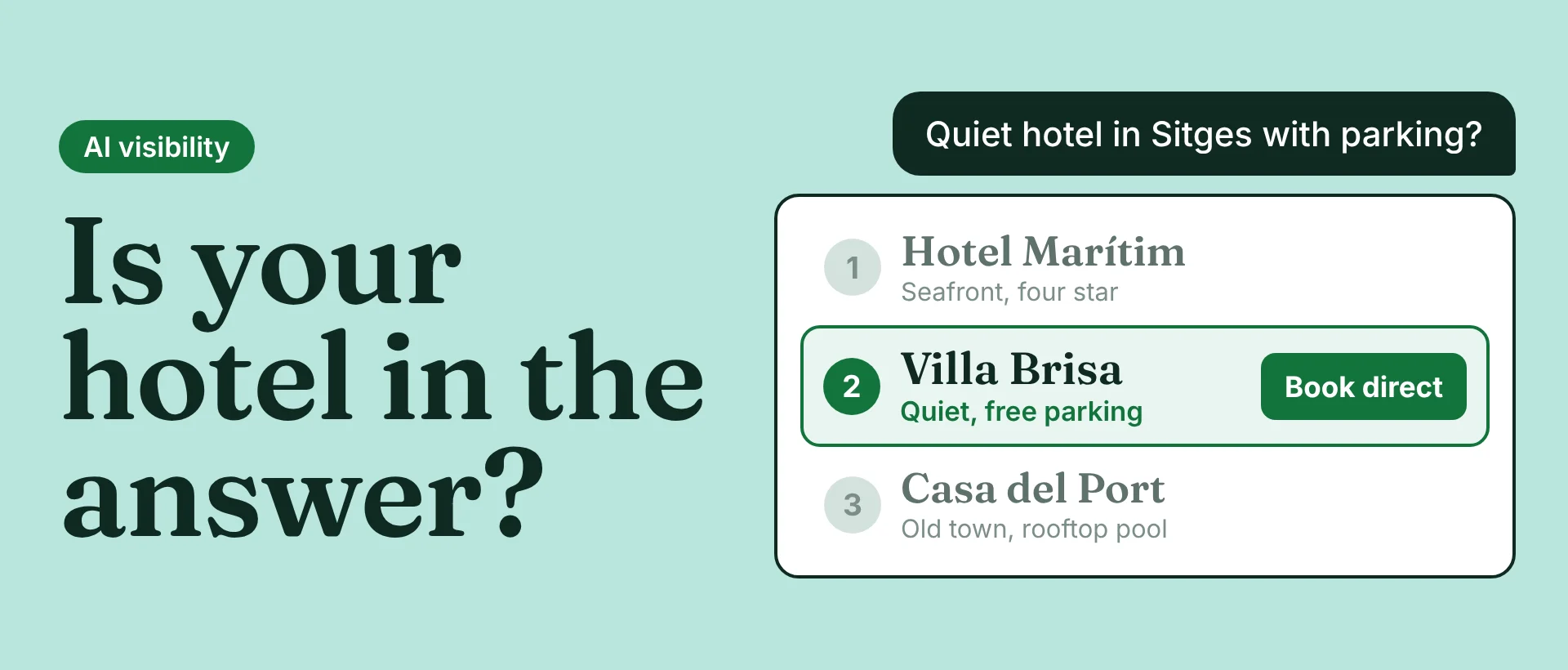
A couple planning a long weekend in May opens ChatGPT and types: "a quiet hotel in Sitges with parking, close to the beach, for two nights." A few seconds later they have four names, a line about each, and a link. They never open Booking.com. They never see the other places in town.
If your property was not one of the four, you did not lose on price or on reviews. You were not in the conversation at all. That is what AI visibility is about, and for most independent hotels it is now an important channel they have never looked at.
This guide explains how AI assistants pick hotels, what the research from 2026 shows, what does not work, and a plan in eight steps you can start this week.
What AI visibility means for a hotel
AI visibility is whether AI assistants such as ChatGPT, Gemini, Claude, Perplexity, Copilot and Google's AI Mode bring up your property when a traveller asks where to stay. It has three parts, and you need all of them.
Named. Your property appears in the short list the assistant gives back.
Described correctly. The assistant gets the facts right: that you have parking, that dogs are welcome, that breakfast is included, that the pool is open in May.
Booked direct. The link next to your name leads to a page where the guest can book with you, not to a platform that charges you commission.
A hotel can be strong on one and missing on the others. Plenty of properties are named with outdated facts, or named with a link that sends the guest to an OTA.
Why it matters now
The shift from searching to asking has moved faster than most hoteliers expected. In a September 2026 survey of 4,000 travellers in the US, the UK and Australia, commissioned by Aven Hospitality, 67% said they had used AI tools such as ChatGPT, Claude, Copilot or Gemini in their travel searches. Three in four said they would trust AI to make hotel recommendations. Only 14% would trust it to book a stay on its own.
That last number matters. Guests use AI to build the shortlist, and then they go and book. Whoever is on the shortlist gets considered. Whoever is not, never does.
In Europe, this is not limited to people who open a chatbot. Google rolled out AI Mode across most of the EU in October 2025, and AI Overviews and AI Mode reached France in July 2026. A guest searching on Google itself now often reads an AI answer before any list of links. And those answers are short: usually a handful of hotels, often four or five.
Most hotels are invisible by default
Lighthouse, the hotel data company, fed 4,545 hotel questions into ChatGPT across nine destinations this year. The assistant named hotels 49,707 times, but only 2,721 different properties ever came up. In Paris, a city of roughly 2,000 hotels, ChatGPT surfaced 13% of them. In Tokyo, 10%.
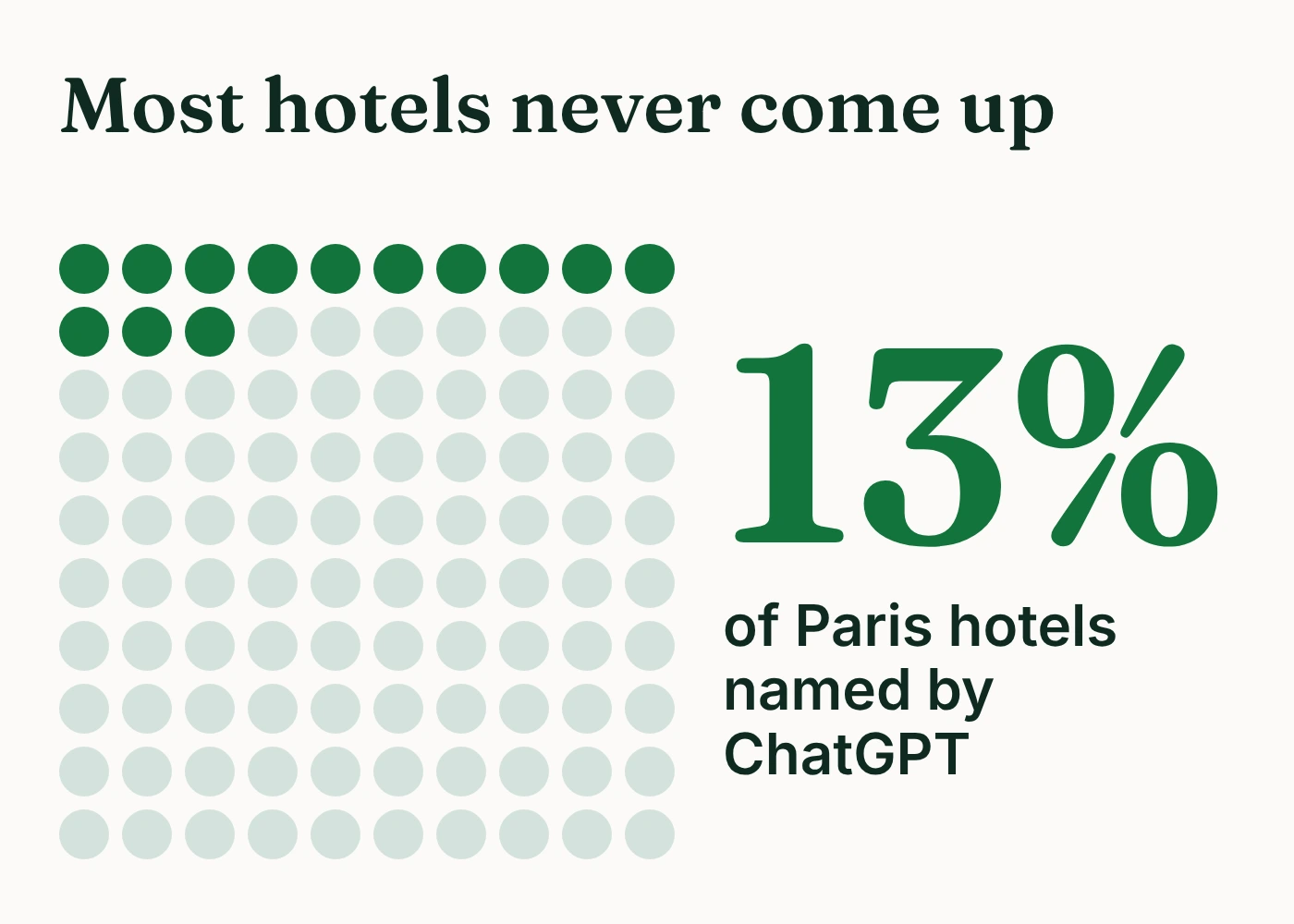
Across 4,545 questions, ChatGPT named only 13% of the hotels in Paris. Source: Lighthouse, 2026.
Across 4,545 questions, ChatGPT named only 13% of the hotels in Paris. Source: Lighthouse, 2026.
Independents do worse than their numbers suggest. Brussels has more independent hotels than chain hotels, yet independents got only 28% of the mentions there. Paris was the only market in the study where independents edged ahead of chains, and only narrowly.
The good news is in the same research. When ChatGPT did recommend a hotel, most of the links a traveller could actually click went straight to the hotel's own website, not to an OTA. An AI recommendation is one of the few discovery channels that can hand you a guest with no commission attached.
How AI assistants decide which hotels to name
No assistant keeps a list of hotels it likes. It reads what the web says about you and repeats the patterns it finds. Three findings from this year's research explain most of what you will see.
AI reads about you mostly on other sites. In the Lighthouse study, 82% of the sources ChatGPT drew on came from two groups: OTA and metasearch platforms, and travel editorial such as guides and magazines. In a June 2026 study by Tharro of 695 hotel searches in the Algarve, Mallorca and Rhodes, the hotel's own website was the cited source less than 10% of the time.
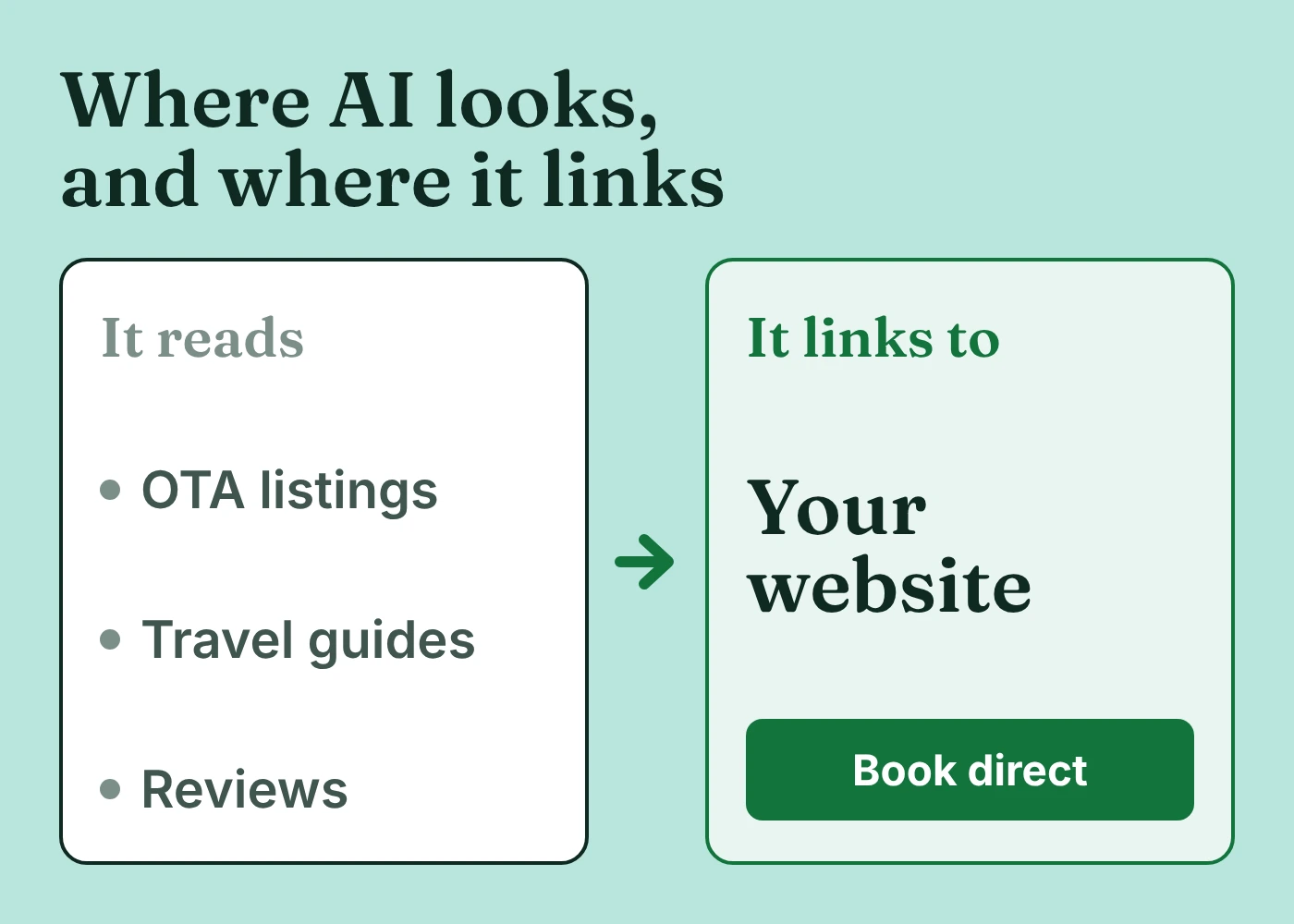
Assistants learn about you mostly on other sites, but the links they show usually point to your own.
Assistants learn about you mostly on other sites, but the links they show usually point to your own.
Review volume and star class beat review score. Tharro found that the number of reviews and the star category predicted AI recommendations better than the average guest rating. Established hotels with decent scores and many reviews were named more often than small places with excellent scores and few reviews. Lighthouse saw the same thing: the link between a hotel's Booking.com score and its ChatGPT visibility was weak.
Every assistant is a different channel. In the Algarve, Mallorca and Rhodes searches, ChatGPT named 3,151 different hotels and Google's AI Mode named 1,286. Only 691 hotels, around 18%, appeared on both lists. AI Mode leans on Google Maps data, prominence and distance, while ChatGPT leans on editorial lists and travel guides. Showing up in one tells you little about the other.
Two more things are worth knowing. A good Google ranking helps, but it does not decide: in the same European study, 48 to 56% of the hotels the assistants recommended did not appear in Google's normal results for the same search. And words matter. Lighthouse found that ChatGPT responds to intent: business questions surfaced more hotels in business districts, family questions more places close to nature. The way your listings, reviews and website describe you teaches the assistant which travellers to send your way.
What does not change the answer
AI visibility has attracted the usual wave of quick fixes. Most of them do not do what they promise.
An llms.txt file. In June 2026 Google updated its guidance to say plainly that Google Search does not use llms.txt or similar AI text files, including for AI Overviews and AI Mode, and that keeping one neither helps nor harms. None of the other big assistants has said it uses the file to decide what to recommend.
Special AI markup. Google's guide to its AI features says structured data is not required for them and there is no special schema to add. It still recommends structured data as part of normal SEO. Treat it as the clearest way to state your facts, not as a lever that gets you picked.
Rewriting your site for robots. Google also says there is no need to chop content into small pieces or write in a special style for AI. Write for your guests.
Buying mentions. Google lists chasing inauthentic mentions among the tactics to ignore, and its spam systems are built to catch them. Planted forum posts and paid fake roundups are a risk, not a shortcut.
One study puts this in perspective. Americas Great Resorts looked at 148 luxury hotels in six US markets that ChatGPT, Gemini and AI Mode had already recommended, and found no detectable link between how often a hotel was named and whether its website had schema markup or an llms.txt file. What did line up was the independent record: Forbes Travel Guide ratings and Michelin Keys. AI repeats what trusted, independent sources say about you. Your own website's job is to make your facts easy to confirm, and to turn the click into a booking.
How to boost your hotel's AI visibility: eight steps
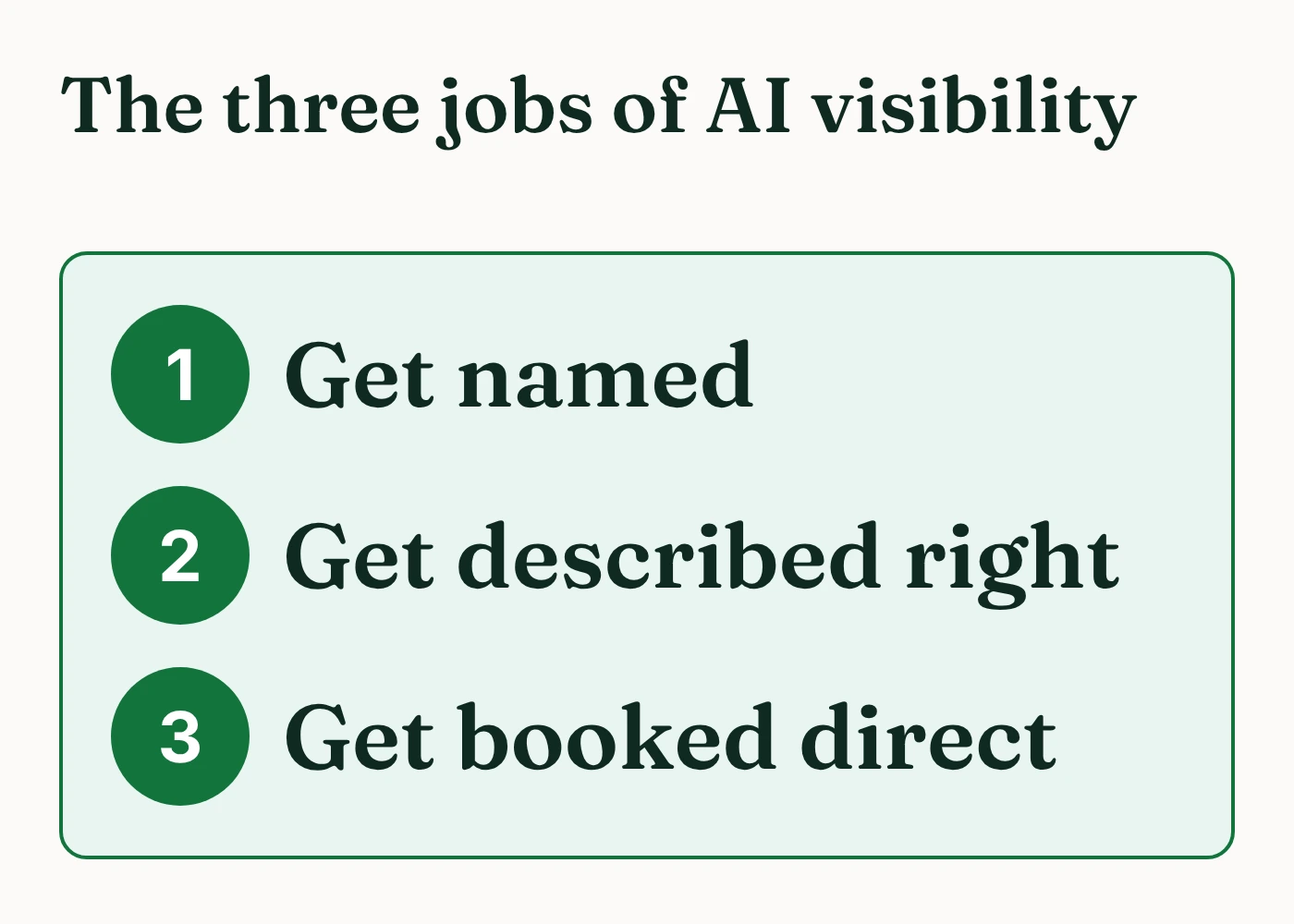
AI visibility has three jobs. Miss one and the booking goes somewhere else.
AI visibility has three jobs. Miss one and the booking goes somewhere else.
1. Ask the assistants what they already think
Before you change anything, find out where you stand. Write down ten questions the way your guests would ask them, and run each one in ChatGPT, Gemini, Google's AI Mode, Claude and Perplexity, in a private window or logged out. Mix three kinds:
- Open questions: "Where should we stay in [your town] for a weekend?"
- Specific questions: "A hotel in [your town] with free parking and a pool." "Somewhere quiet near the old town that takes dogs."
- Direct questions: "Tell me about [your property's name]."
For each answer, note three things: were you named, were the facts right, and where did the link go. That sheet is your starting point. Answers change from one run to the next, so look for patterns across several runs, not single results.
2. Fix your facts where AI reads them first
Start with the places assistants check most.
Your Google Business Profile. Google's AI Mode leans on Maps data, so this may be the most important listing you have. Check the category, address, amenities, photos and, above all, the website field. We often see small properties with that field left empty, which leaves an assistant nowhere to send a guest but an OTA.
Your OTA listings. Booking.com, Expedia and the other platforms are among the most cited sources in hotel answers. Fill in every amenity, policy and room detail. An assistant cannot say you have parking if no source it trusts says so.
Tripadvisor and Bing Places. Tripadvisor is a frequent source for several assistants, and Perplexity has used Tripadvisor data in its hotel results since 2025. Bing Places is Microsoft's version of a business profile, and Microsoft's Copilot is built on Bing search.
Keep your name, address and phone number exactly the same everywhere. Small differences make it harder for a machine to be sure two listings are the same place.
3. Make your own website say it plainly
Your site is cited less often than the OTAs, but it is where assistants go to confirm a fact, and where the link usually lands. Make your facts impossible to miss:
- A page or a clear section for each room type: size, beds, view, how many it sleeps.
- Amenities and policies in plain text, not hidden in images or PDFs: parking, pets, accessibility, breakfast, check in and check out times, cancellation.
- A short FAQ with the questions guests actually email you about.
- A few lines on your location with real distances, such as "eight minutes on foot to the beach".
- Your content in the languages your guests speak.
- Structured data for your hotel and rooms, with address, map coordinates, amenities and check in times.
Then describe yourself in the words your best guests would use. If you are the place for cyclists, for families or for a quiet weekend away, say so on your website, in your OTA descriptions and in your replies to reviews.
Our free website audit checks your structured data, speed, languages and booking flow in under a minute, on any website.
4. Let the right crawlers in
Assistants that search the web send their own crawlers. If your robots.txt file or your hosting firewall blocks them, you cannot be cited, however good your content is. Ask whoever runs your website to check that these are allowed: OAI-SearchBot for ChatGPT search, Claude-SearchBot for Claude, PerplexityBot for Perplexity, plus Googlebot and Bingbot. OpenAI says sites that block its search crawler will not appear in ChatGPT search answers.
You can still say no to AI training. OpenAI, Anthropic and Google use separate names for training (GPTBot, ClaudeBot and Google-Extended), and blocking those does not remove you from search answers.
5. Grow your review count, everywhere
Because volume counts for more than score, a steady habit beats the occasional push. Ask every guest for a review a day or two after checkout, with a direct link. Spread the requests across Google, Tripadvisor and your main OTA. Reply to reviews, too. When guests mention specific things like the breakfast, the quiet street or the free parking, those details become part of how assistants describe you.
6. Earn mentions in places AI trusts
Travel editorial is the other big source for AI answers, and you do not need a Michelin Key to be in it. Look closer to home:
- Your city or regional tourism board's accommodation listings.
- Local press and regional travel magazines, especially "where to stay" pieces.
- Travel writers and bloggers who cover your area. Invite them.
- Awards and quality labels that publish a public list of the properties that hold them, such as sustainability labels.
- Honest answers on forums where travellers ask about your area, posted under your own name.
Lighthouse put it bluntly: PR is now a distribution channel. One line in a respected "best small hotels in the Algarve" piece can do more for your AI visibility than another month of tweaking your website.
7. Make the click count
When an assistant does send a guest, they usually land on your website. That visit is worth more than most: the guest arrives already half convinced. Make sure the page loads fast on a phone, shows real prices with taxes included, and lets them book in a few taps on your own booking engine. If it does not, they open a second tab and book you on an OTA anyway. We wrote about that habit in the second tab, and our twelve ways to get more direct bookings cover the basics.
8. Measure it every month
Three places show you whether it is working.
- Your question sheet from step 1. Run the same questions once a month and track how often you are named, and in which position.
- Google Analytics. Look at visits referred by chatgpt.com, gemini.google.com, perplexity.ai, claude.ai and copilot.microsoft.com. For most small properties the numbers are low today. Watch the trend.
- Google Search Console. Its Generative AI performance report shows how often your pages appear in AI Overviews and AI Mode. Google says it is now available to sites worldwide, though smaller sites may not have enough data to see it yet, and it counts impressions, not clicks.
How long it takes
Some fixes work within weeks: a complete Google Business Profile, corrected OTA facts and an open robots.txt are picked up quickly. Reviews and editorial mentions build over months. Nobody can guarantee a place in an AI answer, so be wary of anyone who promises one. What you can do is make sure every source an assistant checks says the same correct thing about you, and that the click lands somewhere a guest can book.
Where Tribii fits
The Direct Booking Booster, part of the Pro plan, includes an AI visibility tool built around the work in this guide.
It scores your public information. The Booster gives your property a completeness score out of 100 for the details AI assistants rely on, compared with the average for similar properties. Every gap comes with a fix that links straight to the setting that owns it, such as your map coordinates, your description or the floor size of each room.
It asks the assistants for you. The Booster runs live checks in ChatGPT, Claude, Gemini and Perplexity, phrased the way a guest would ask, for example "recommend a hotel in Sitges with a swimming pool and free parking", and shows whether each one lists you and in which position. It is step 1 of this guide, done for you, and you can run it again every time you change something.
It makes the click pay. When an assistant sends a guest your way, they book on the free booking engine: 0% commission, free up to 20 rooms, with payment going straight to your own Stripe account. If they leave halfway, the Booster's abandonment recovery emails them a link back to the booking they started.
On the website side, the free Tribii website is multilingual with booking built in. Pro adds a page for every room, an AI SEO audit with suggestions you apply in one click, questions and answers that Google and AI assistants can quote, and Google Search Console and Analytics connected in minutes. Pro is €55 a month, and Tribii never takes a cut of a booking. See all plans.
Pro also gives every property its own MCP server, so you can ask an assistant about your own bookings and rates. We explain how in MCP for hotels, and where AI booking is heading next in UCP for hotels.
Common questions
What is AI visibility for a hotel?
It is whether AI assistants like ChatGPT, Gemini, Claude, Perplexity and Google's AI Mode name your property when a traveller asks where to stay, describe it correctly, and link to a page where the guest can book with you.
Is AI visibility the same as SEO?
They overlap, but they are not the same. Google says its AI features run on its core search systems, so good SEO helps there. ChatGPT and other assistants lean more on OTA listings, reviews and travel guides. In one European study, around half of the hotels AI recommended did not appear in Google's normal results for the same search.
Do I need an llms.txt file?
No. Google says its search, including AI Overviews and AI Mode, does not use it, and no major assistant has said it uses one to choose which hotels to recommend. Your time is better spent on your Google Business Profile, your OTA listings and your reviews.
Which AI assistant matters most for a hotel in Europe?
Google's AI Mode and AI Overviews reach the most people, because they sit inside Google Search, and they lean on Google Maps data. ChatGPT is the biggest assistant on its own. The two pick hotels differently, so check both.
Should I leave the OTAs to be more visible in AI?
No. OTA listings are one of the main sources assistants read, so a complete, accurate listing helps you get named. The difference is what happens next: when an assistant links to your own website, the booking can come to you without commission.
How long does it take to improve AI visibility?
Listing and website fixes can show up within weeks. Reviews and mentions in guides and press take months. Measure once a month and look at the trend, not at single answers.
Can a small hotel compete with the big chains in AI answers?
Yes, though it takes steady work. Chains and luxury brands get far more AI mentions than their share of rooms would suggest. But assistants answer specific questions with specific facts. A small property that is clearly described, well reviewed and mentioned in local guides can win the questions that fit it, like a quiet place near the trails that takes dogs.
In short: more and more guests ask an AI assistant where to stay, and book from the short list it gives them. Most independent hotels are never on it, because assistants mostly repeat what OTAs, reviews and travel guides say. Get your facts right everywhere, grow your reviews, earn local mentions, let the right crawlers in and make your own booking page easy to use. Then check what the assistants say about you, every month.
Tribii
The free booking engine for independent hoteliers. Editorial notes.
More for the kitchen table.
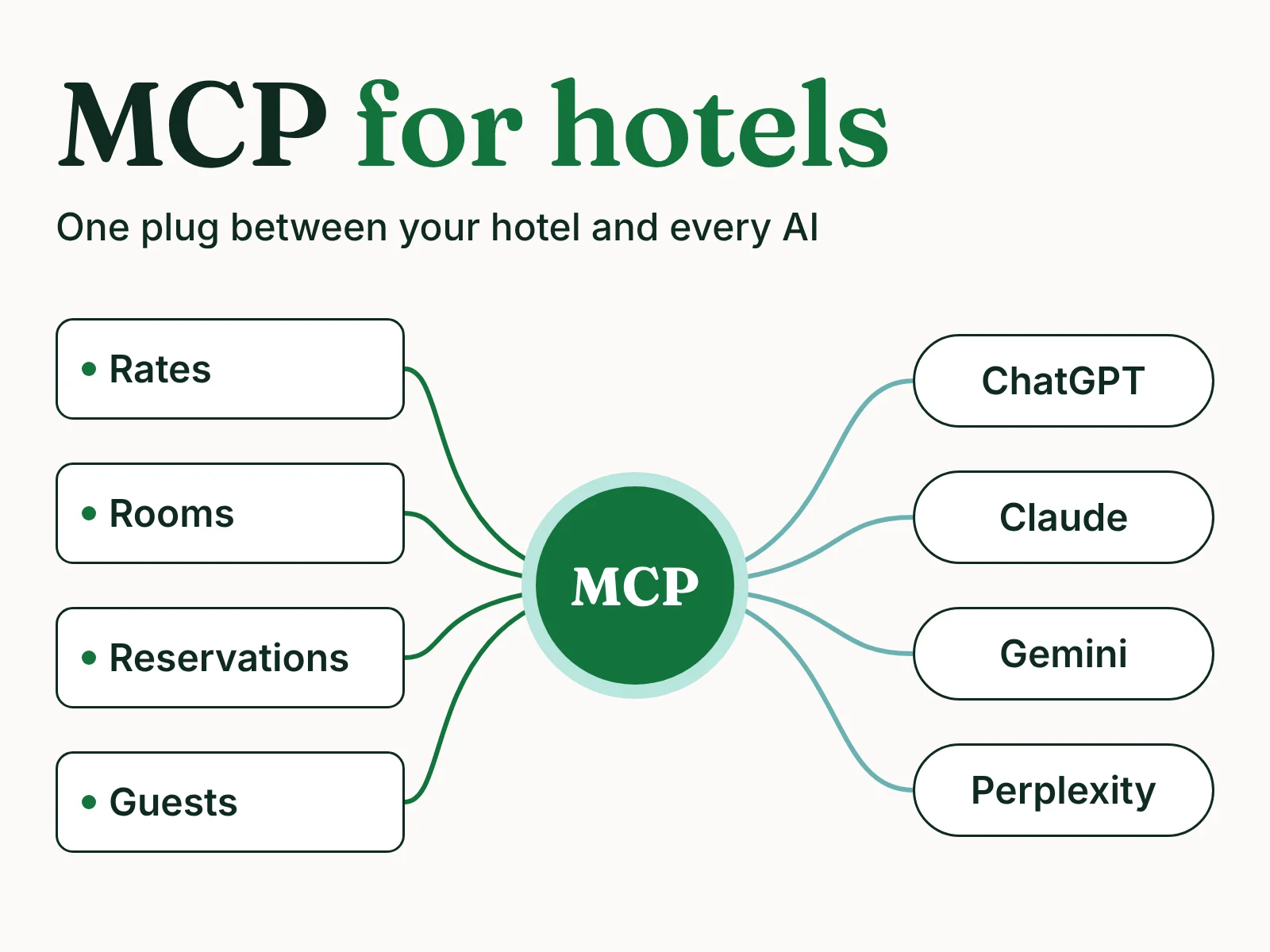
MCP for hotels: how AI assistants will find, sell and help run your property
ChatGPT, Claude and Google can now read live hotel prices, and some can take a booking. The standard behind it is called MCP. Here is what it is, what it changes for a small hotel's visibility and daily work, and what to do about it now.
 Tribii
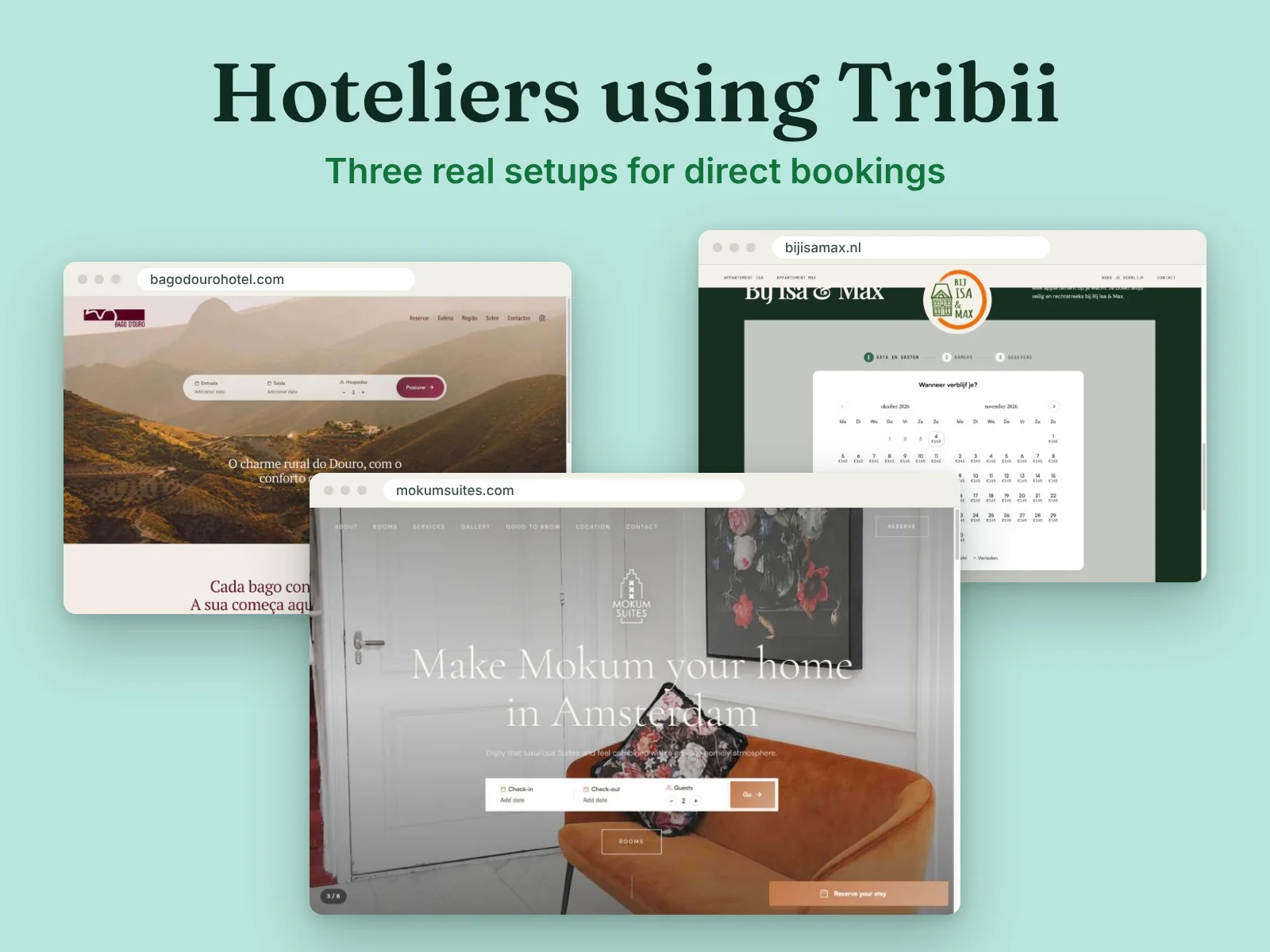
Hotels using Tribii: three real setups for direct bookings
A canal house in Amsterdam, a village guest house in the Douro and two apartments in Kampen all take commission-free bookings with Tribii. Each one set it up differently. Here is what they did, and how to choose the setup that fits your property.
Tribii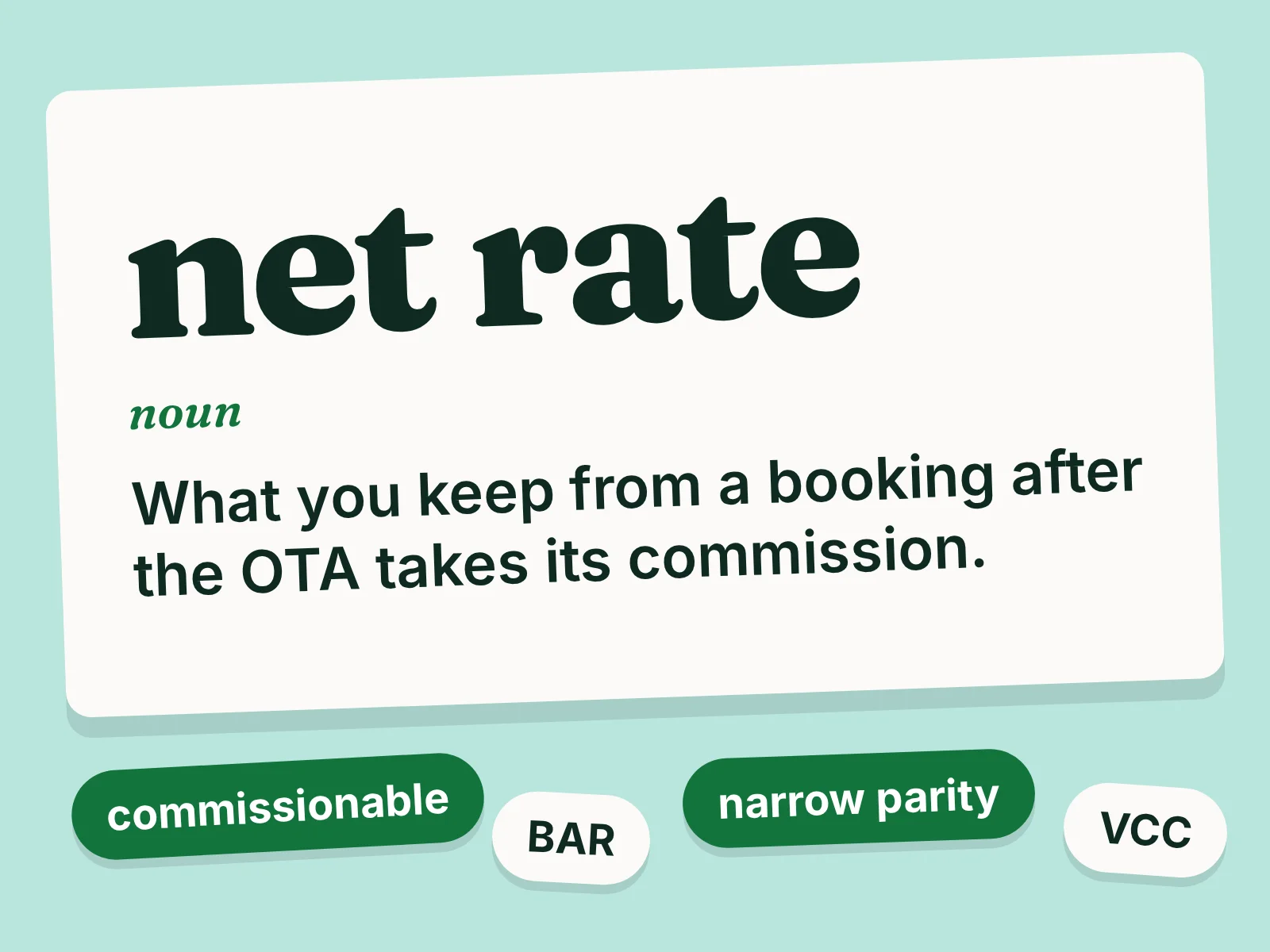
OTA terms explained: a plain-language glossary for independent hotels
Commissionable rate, net rate, merchant model, narrow parity. The words in your OTA contract, explained in plain language, with what each one means for your money.
Tribii