UCP for hotels: the Universal Commerce Protocol and the future of online booking
Google and the biggest names in travel have written a shared language that lets AI assistants book a hotel room inside a conversation. It is called UCP. Here is what it is, who keeps the guest, and what independent hotels should do before it reaches Europe.
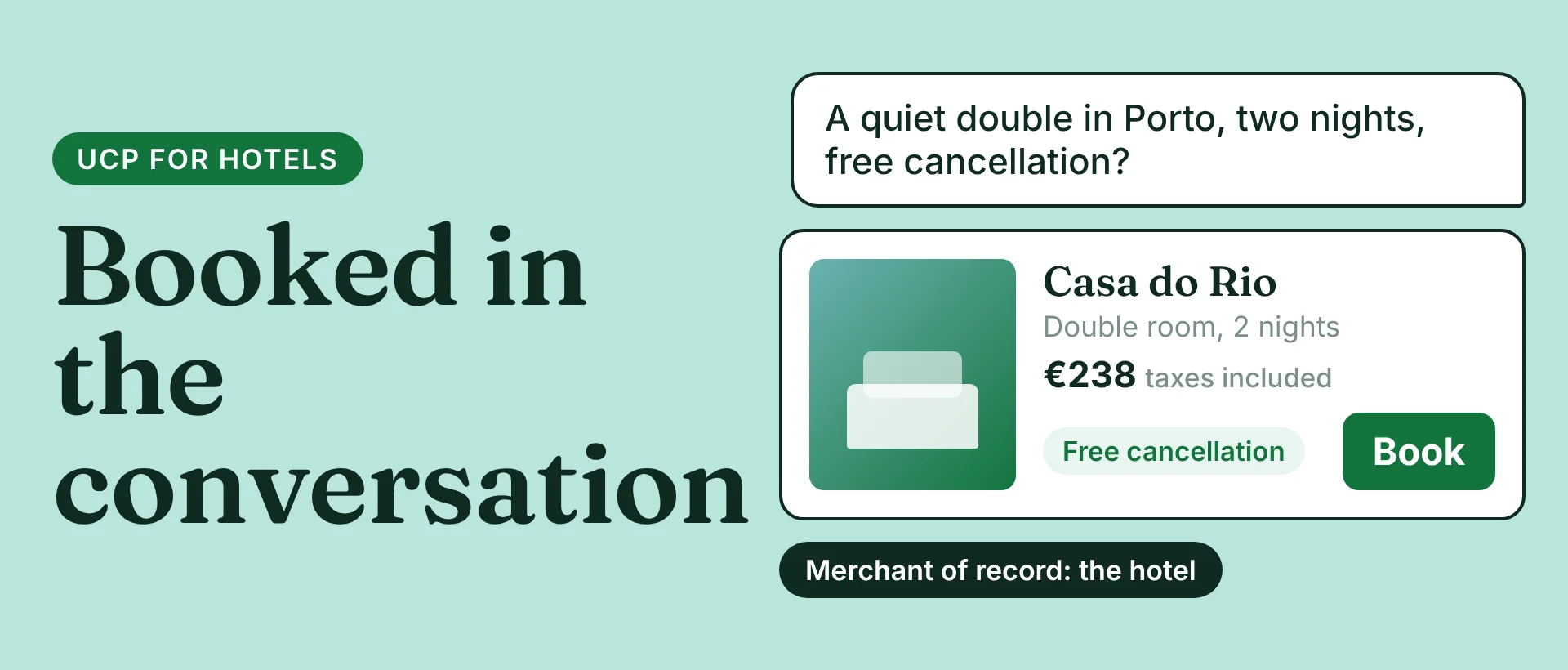
For 25 years, booking a hotel online has followed the same path. Search, compare, click through to a website, fill in a form, pay. Every step is a place where a guest can drift off to another tab, and more often than not, that tab belongs to an OTA.
A new standard is designed to fold that whole path into a single conversation. It is called UCP, the Universal Commerce Protocol. On 25 September 2026, the group behind it published the first draft of how an AI assistant books a hotel room. Google's developer documentation says it will use that standard to power hotel booking in AI Mode over the coming months.
This piece explains what UCP is, how it reached hotels, who keeps the guest when an assistant makes the booking, and what an independent property should do while the standard is still being written.
The short answer
UCP is an open, shared language between AI assistants, businesses and payment providers. For hotels, it lets an assistant check a live price and availability, collect the guest's details and complete the booking inside the chat, while the business that takes the booking stays the merchant of record.
It is early. Agentic hotel booking in Google's AI Mode is live only for users in the United States, in English, through ten large chains and booking platforms. The hotel specification is a draft. Nothing is live in Europe yet.
That makes the coming year a time to prepare, not a time to panic.
What UCP actually is
Google launched UCP on 11 January 2026 at NRF, the big American retail show. It was developed together with Shopify, Etsy, Wayfair, Target and Walmart, and backed at launch by more than twenty companies, including Visa, Mastercard, Stripe, Adyen and American Express. In April, Amazon, Meta, Microsoft, Salesforce and Stripe joined the council that steers the standard.
The idea is simple. Before UCP, every AI assistant that wanted to sell something needed its own integration with every shop. UCP replaces that with one common contract. A business publishes a short profile that says what it supports, such as checkout, a cart, a catalogue or account linking. Any assistant that speaks UCP reads that profile and knows how to ask for a price, take payment and confirm the sale, over an ordinary web connection, over MCP or between two agents.
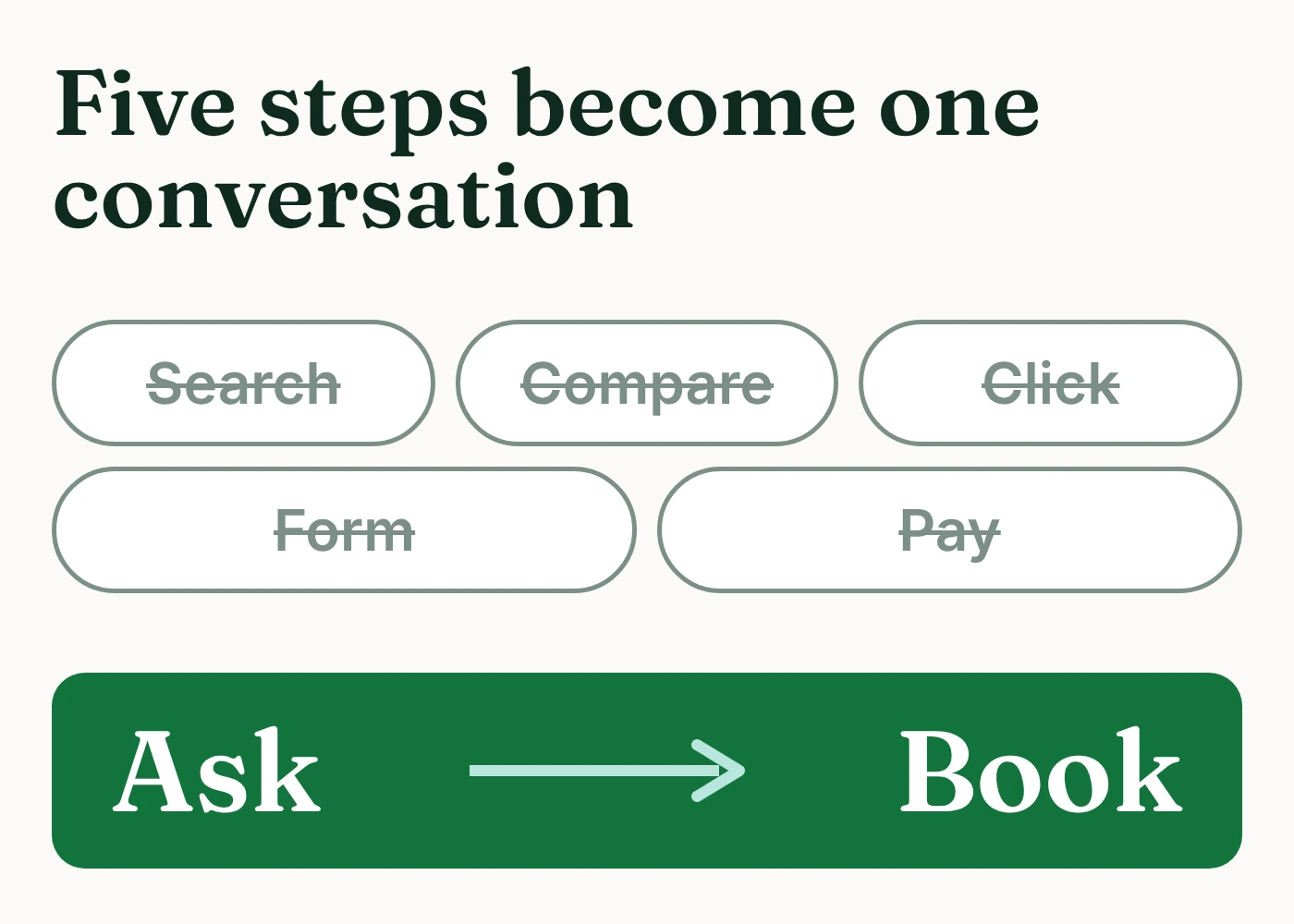
The steps don't disappear. The assistant does them for the guest.
If you read our piece on MCP for hotels, the difference is easy to hold on to. MCP is how an assistant reads and uses a system. UCP sits on top of it and sets the rules of the shop counter: how a price is quoted, how payment is taken, what the confirmation looks like and who is responsible afterwards. When an agent pays on its own, within limits a person has set, a third standard comes in: AP2, the Agent Payments Protocol.
One lesson from the first year is worth keeping in mind. OpenAI opened checkout inside ChatGPT in September 2025, built on its own protocol with Stripe. By March 2026 it had pulled the feature and was sending shoppers back to the retailer's own site to pay. Walmart said purchases inside ChatGPT converted three times worse than on its own website. Standards with broad support tend to last. Individual buying experiences inside one assistant come and go.
How UCP reached hotels
Retail came first. Hotels followed within a year.
- November 2025. Google said that guests would eventually be able to finish hotel and flight bookings inside AI Mode.
- May 2026. At its developer conference and its Marketing Live event, Google said UCP would expand to hotel booking and local food delivery.
- 7 August 2026. Google confirmed a limited test of agentic hotel booking in the United States. Booking Holdings said it was among the first partners.
- 11 August 2026. A Lodging Technical Council was formed with Amadeus, Booking.com, Expedia, Google, Hilton, Marriott and Trip.com.
- 27 August 2026. Hotel booking started rolling out in AI Mode for US users in English, with Booking.com, Expedia, Hotels.com, Priceline, Trip.com, Choice Hotels, Hilton, IHG, Marriott and Wyndham. Guests choose a room, read the cancellation policy and pay with Google Pay without leaving the conversation.
- 25 September 2026. The first draft of the hotel booking specification was published for public feedback.
Read that list again. Every company on it is a global hotel chain or a global travel giant. That is the part an independent hotel should think about most.
What the hotel draft covers
By industry standards the draft is short and readable. In plain words, it sets out six things.
- A live check before the Book button. The price and availability are confirmed with the hotel's own system at the moment of booking, not taken from a feed that may be hours old.
- The guest's details. Names, number of guests, dates of stay and special requests.
- How the money moves. Deposits, a balance paid later, split payments, and a cancellation policy tied to the booking itself.
- The full price. The guest must see the complete cost of the stay, taxes and fees included, and which part is paid now and which at the property.
- A person in charge. A human confirms the booking on a trusted screen. Only a separate payment extension lets an agent pay on its own.
- One room at a time. Google's first milestone covers a single room per booking. More rooms may come later.
The draft warns that details can still change. It is a first version, published so that the industry can comment on it.
Who keeps the guest
This is the question that decides whether UCP is good or bad news for an independent hotel, and Google's answers are clearer than many expected.
According to its developer FAQ, the business that takes the booking is the merchant of record. It keeps the customer relationship, the booking data and the experience after the stay. Its own terms and conditions govern the reservation, and the guest accepts them during the booking. Bookings made through Google's AI surfaces can be told apart from bookings on the hotel's own website. And opting in to UCP does not change how Google ranks a property or its rates. It only adds the option to book without leaving the conversation.
Compare that with a normal OTA booking. As we wrote in Own your guests, an OTA hands you a stay but keeps the person, and charges 15 to 25% commission for the privilege.
There is a catch, and it sits in the words "the business that takes the booking". The merchant of record is whoever's connection carries the booking. If a guest books an independent hotel in AI Mode today, that booking runs through Booking.com or Expedia, because they are the ones connected. The OTA is the merchant. The OTA keeps the guest. The protocol is open, but the door is only as open as the connections behind it.
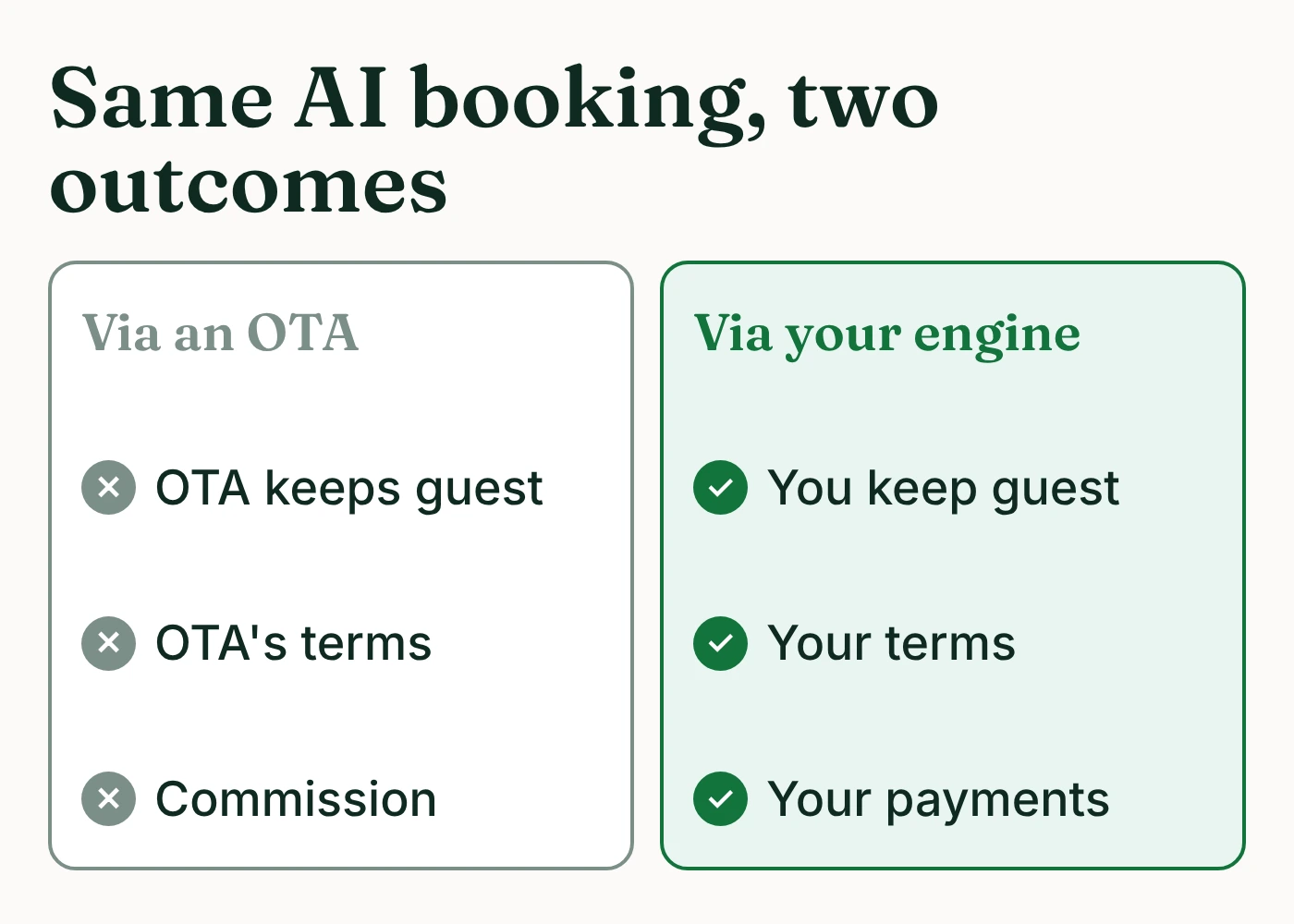
The merchant of record is whoever's connection carries the booking.
So the real question for independent hotels is not whether AI will sell their rooms. It is whose connection the AI will use when it does.
What nobody knows yet
Several important questions are still open, and anyone who tells you otherwise is guessing.
What it costs. Google has not published a fee for hotel bookings made through UCP. The protocol itself charges nothing. What the platforms that use it will charge, if anything, is undecided.
Who gets in. For now, Google points interested hotels and booking platforms to a waitlist, with onboarding instructions promised as "coming soon".
When it reaches Europe. AI Mode hotel booking is live in the United States only, and Google already keeps some AI Mode travel features out of the European Economic Area. Europe is also where the rules are strictest. On 23 July 2026, the European Commission fined Google €460 million under the Digital Markets Act for favouring its own services in Search, hotels among them. In September, Google redesigned travel results across the EU, Iceland, Liechtenstein and Norway, with one unit for OTAs and other aggregators and a reduced unit for hotels themselves, without date filters or live prices. Google says those changes extend to AI Overviews and AI Mode. How agentic booking will arrive under those rules is still an open question.
How many guests want it. Booking Holdings says bookings that come through AI assistants are still below 1% of its room nights. The intent, though, is growing fast. Phocuswright found that 56% of US travellers used AI for at least one trip in the past year, and close to nine in ten travellers in the UK, France and Germany who use AI say it shaped a real trip decision. Around 40% of US travellers and 28% of UK travellers say they would let an AI assistant book their flights and hotels.
Small today, then. But the demand is forming, and the plumbing is being laid now.
The future of online booking
Here is how we read where this goes. It is our view, not a promise anyone can make.
Booking splits into two places. The decision moves into the conversation, wherever the guest happens to be talking to an assistant. The booking itself still runs in a hotel system somewhere. UCP is the line between the two.
The booking page stays, as one checkout among several. Plenty of guests will still click through, especially for families, long stays and anything complicated. OpenAI's retreat shows that buying inside a chat is not automatic. But a hotel that can only take bookings on its own page will miss the ones that happen elsewhere.
Clean data becomes visibility. An agent cannot sell what it cannot read. Clear room names, a correct maximum occupancy, the full price with tax, cancellation rules a machine can follow. These used to be good housekeeping. They become the way you get chosen.
The fight moves to the merchant of record. The OTAs became gatekeepers in the 2000s partly because they were the easiest place for a computer to read hotel inventory. History is ready to repeat itself, with the OTAs first in line again. The difference this time is that the standard is open. A booking engine for a guest house with eighteen rooms can speak the same language as Marriott's.
Loyalty travels with the guest. UCP includes account linking, so a guest's membership and member prices can follow them into the assistant. A good direct member rate could matter more, not less.
What an independent hotel should do now
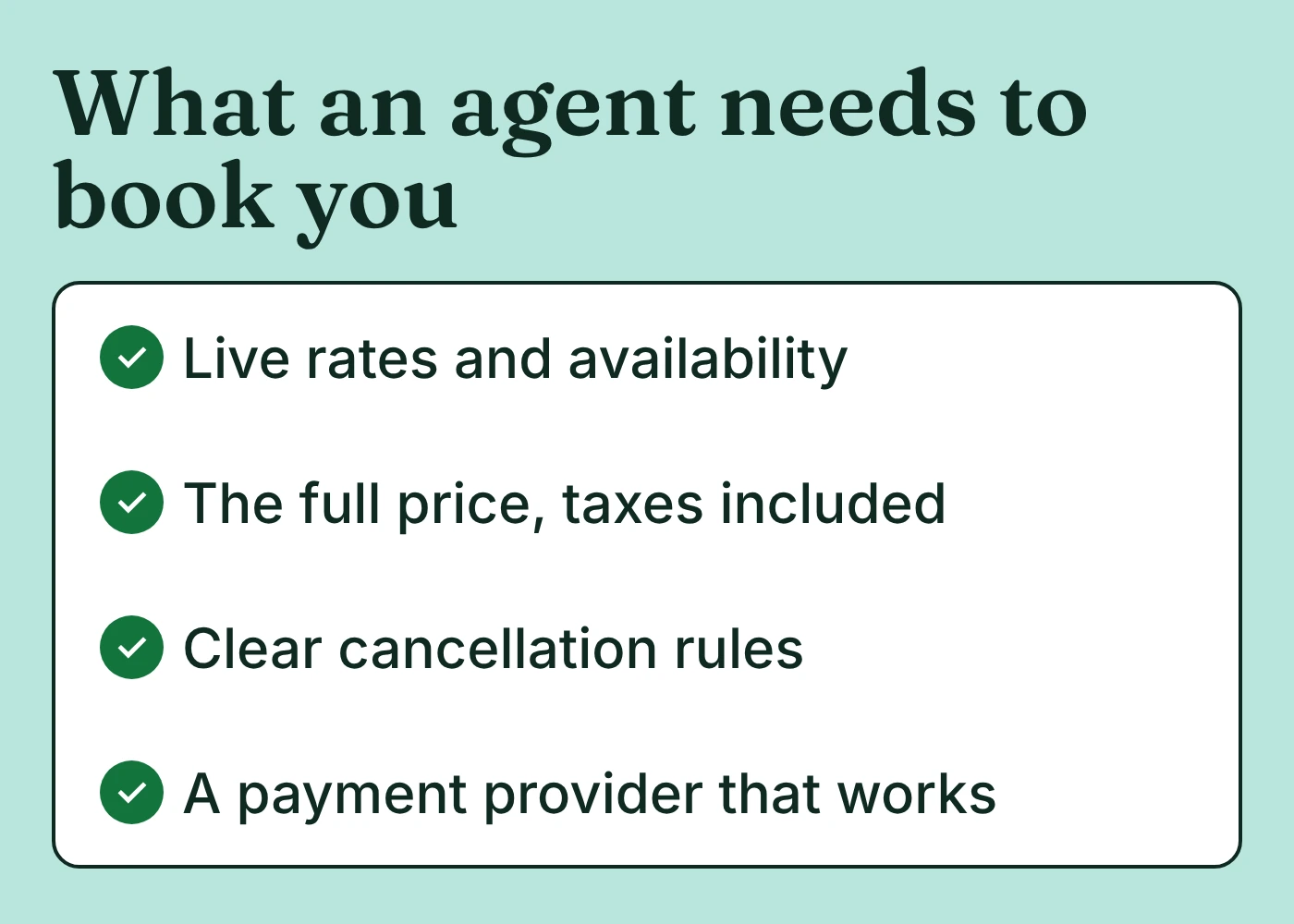
None of this needs a developer. All of it needs to be right.
Most hotels will never touch UCP directly. They will reach it through their booking engine, channel manager or PMS, the same way they reached Google Hotels. What they can do now is make sure there is something worth connecting.
1. Make your rooms readable. Use the same room names, occupancy, amenities and policies on your website, your Google Business Profile and every OTA. Put your website and booking link on your Google Business Profile. A surprising number of properties leave that field empty.
2. Show the full price. City tax, cleaning fees, breakfast, all of it. The UCP draft requires the complete cost of the stay, and guests prefer it anyway.
3. Write your rules once, clearly. Cancellation, deposit and payment terms should live in your booking system as settings, not in a PDF or a paragraph on the contact page.
4. Keep your direct rate the best rate. In the EEA you are free to sell cheaper on your own channel than on Booking.com, as our rate parity guide explains. When an assistant compares prices, a better direct offer is a reason to pick you.
5. Ask your booking engine vendor three questions. Do you plan to support UCP? On those bookings, will we be the merchant of record, or will you? Can our payment provider process Google Pay?
6. Know what each channel costs you. Agentic bookings that run through an OTA still carry commission. Our breakdown of the real cost of an OTA booking shows how to put a number on it.
7. Don't pay for "UCP readiness" yet. The hotel specification is a draft and onboarding has not opened. Anyone selling a finished UCP integration to a small hotel today is selling ahead of the standard.
Where Tribii fits
We are watching UCP closely, and we intend to support it as soon as it is possible to do so.
Tribii exists so that a small property can sell direct on equal terms with the big platforms. For most of the internet's history that was hard, because the big platforms owned the connections. UCP is the first booking standard where the hotel stays the merchant of record by design. That is the principle Tribii is built on.
Our plan is to build UCP support into the free booking engine, so that any assistant that speaks the standard can book a Tribii property directly: on the property's own terms, with payment going to its own Stripe account, and with the guest landing in its own guest list. We will ship it as the hotel specification settles and onboarding opens beyond the waitlist, and we will report on our progress here in Product diaries. To be clear, no Tribii property can be booked through UCP today.
Much of the groundwork is already in place.
- Live rates and availability in the booking engine, the first thing an agent checks before it shows a Book button.
- Payments through your own Stripe account, so the money never passes through us. Stripe already processes Google Pay.
- An MCP server on the Pro plan, which lets Claude, ChatGPT and other assistants read your reservations, rates and reports. It is queryable, not bookable, by design, and MCP is one of the connections UCP runs over.
- AI visibility checks in the Direct Booking Booster, which test whether ChatGPT, Claude, Gemini and Perplexity find and correctly recommend your property, and point you to the setting that fixes each gap.
The booking engine is free for up to 20 rooms, with 0% commission. Pro and Max are on the pricing page.
Common questions
What is UCP in hotels?
UCP, the Universal Commerce Protocol, is an open standard that lets AI assistants book hotel rooms for a guest. The assistant checks live prices and availability, collects the guest's details and completes the booking inside the conversation, while the hotel or booking platform that takes the booking stays the merchant of record.
Is UCP the same as MCP?
No. MCP, the Model Context Protocol, connects an AI assistant to a system so it can read and use it. UCP defines how buying works: the quote, the payment, the confirmation and what happens after. UCP can run over MCP.
Can guests book my hotel in Google AI Mode today?
Only in the United States, in English, and only through Google's launch partners. If your hotel is listed on Booking.com or Expedia, a US guest may already be able to book you in AI Mode, but the OTA takes the booking and keeps the guest.
Is UCP available in Europe?
Not for hotel booking yet. Google has given no date, and the Digital Markets Act shapes how Google can show hotels in the EEA.
Will I pay commission on UCP bookings?
The protocol itself is free. Google has not published fees for hotel bookings in AI Mode. If a booking runs through an OTA, the OTA's commission still applies.
Will UCP replace the OTAs?
No. The OTAs are among its first users and sit on the council that writes the hotel specification. What UCP changes is that an independent booking engine can, in principle, connect on the same terms.
Do I need a developer to use UCP?
No. Hotels will reach UCP through their booking engine or channel manager. Your part is clean data, a full price, clear rules and a vendor with a plan.
The honest summary
UCP is the shared language that lets AI assistants book hotels inside a conversation. Google is building its hotel booking around it, the biggest names in travel helped write it, and the hotel stays the merchant of record by design.
It is a draft, it is American for now, and the first bookings run through the same OTAs that dominate everything else. Independent hotels have time. They should use it to make their data clean, their prices complete and their direct offer the best one on the table, so that when the door opens, they can walk through it themselves.
Tribii
The free booking engine for independent hoteliers. Editorial notes.
More for the kitchen table.
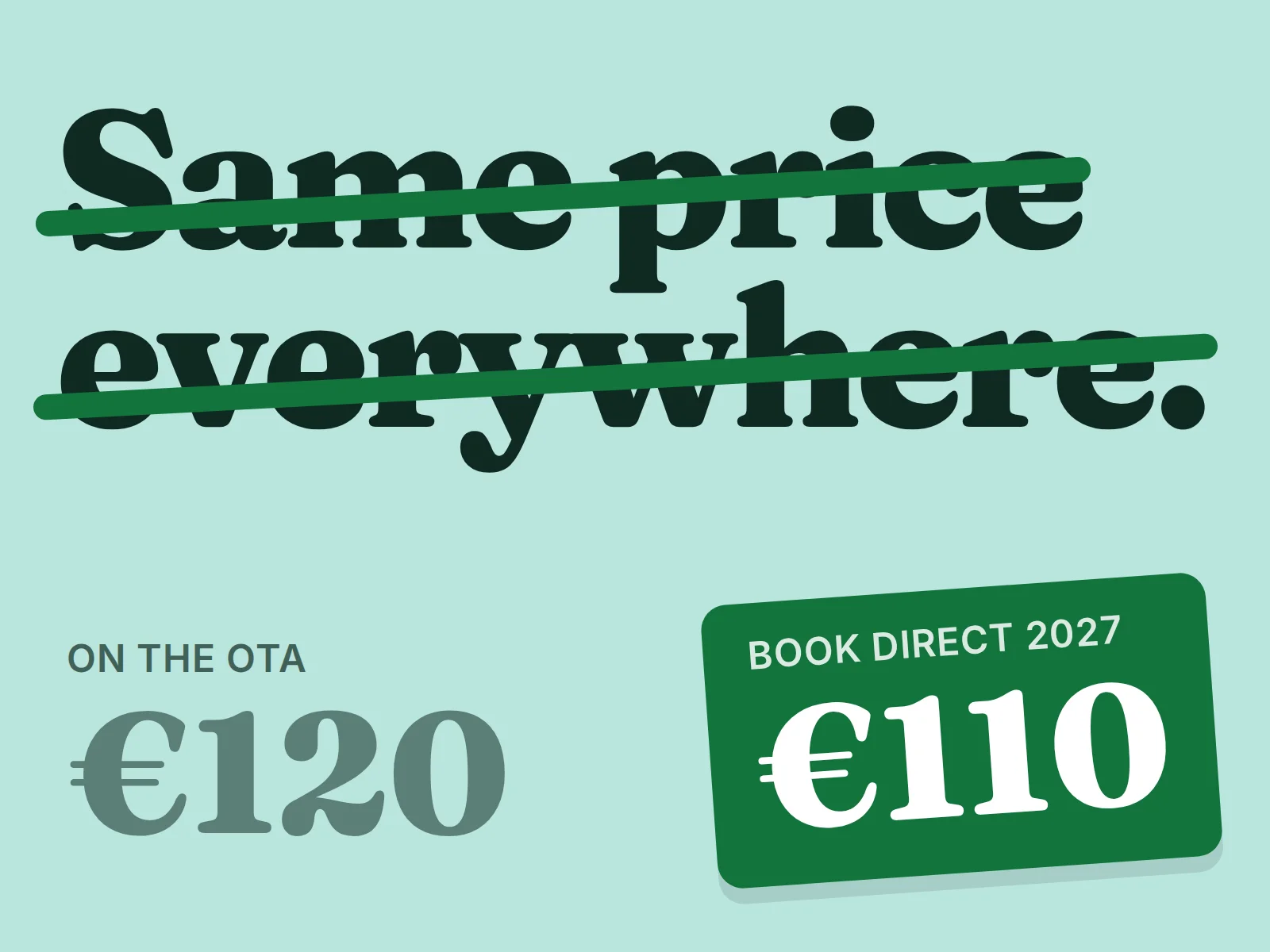
Rate parity is gone in Europe. How to price your direct rate for 2027
Booking.com can no longer make you match its price on your own website. Most small hotels still do. Here is what the law allows, what the algorithm might not, and how to set a direct rate for 2027 that pays.
 Tribii
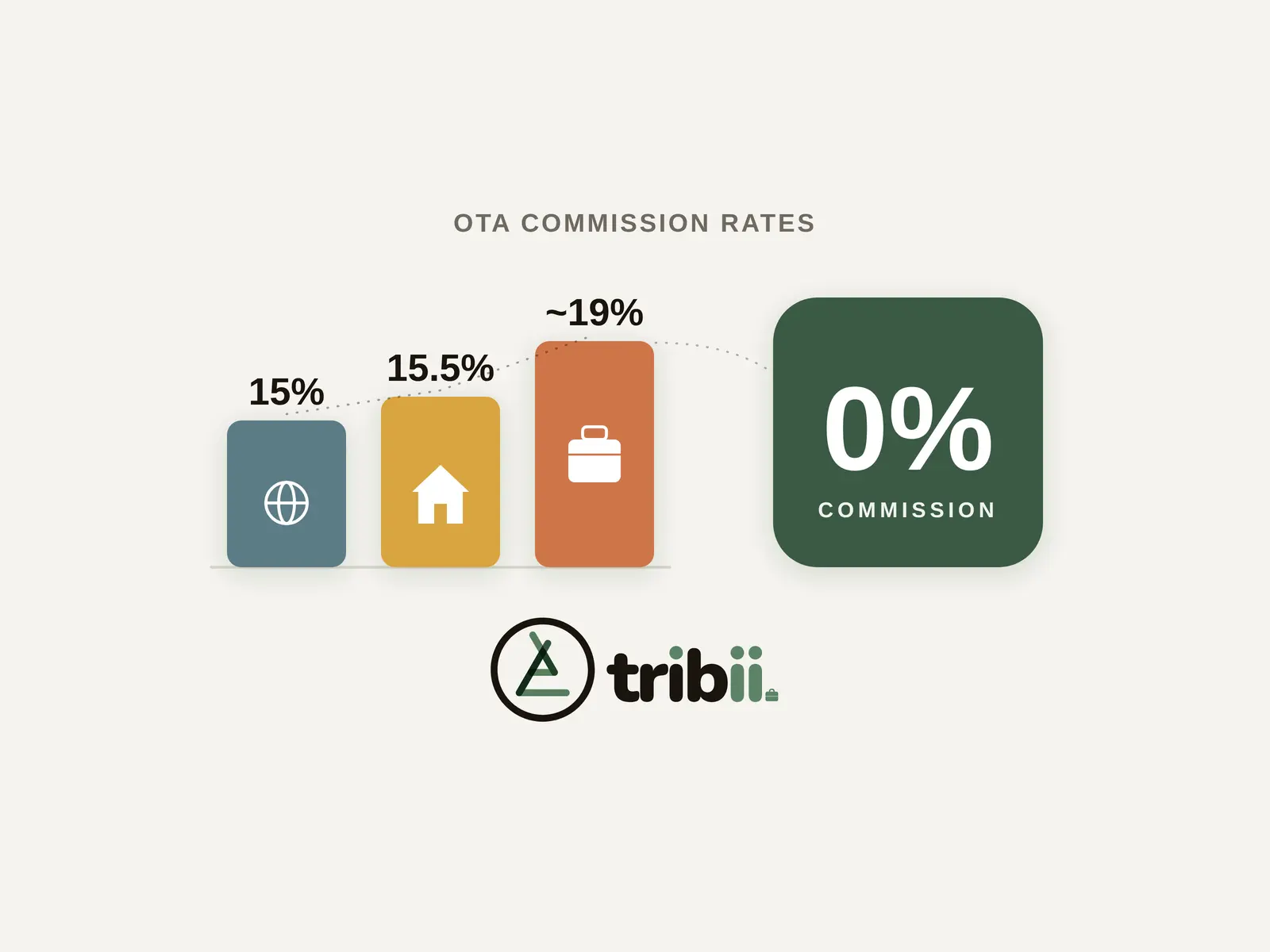
OTA Commission Rates: What Booking.com, Expedia and Airbnb Really Charge
A plain-English breakdown of what the big booking sites really take, the fees they do not advertise, and how much a year of OTA bookings actually costs you.
Tribii
The Second Tab: Why Guests Find You on Booking.com and Book Somewhere Else
Most guests who book you directly found you on an OTA first. Here is what that second tab is worth, and why, after the EU killed rate parity, independent hotels can finally win it.
 Daniel Vidal