OTA Commission Rates: What Booking.com, Expedia and Airbnb Really Charge
A plain-English breakdown of what the big booking sites really take, the fees they do not advertise, and how much a year of OTA bookings actually costs you.
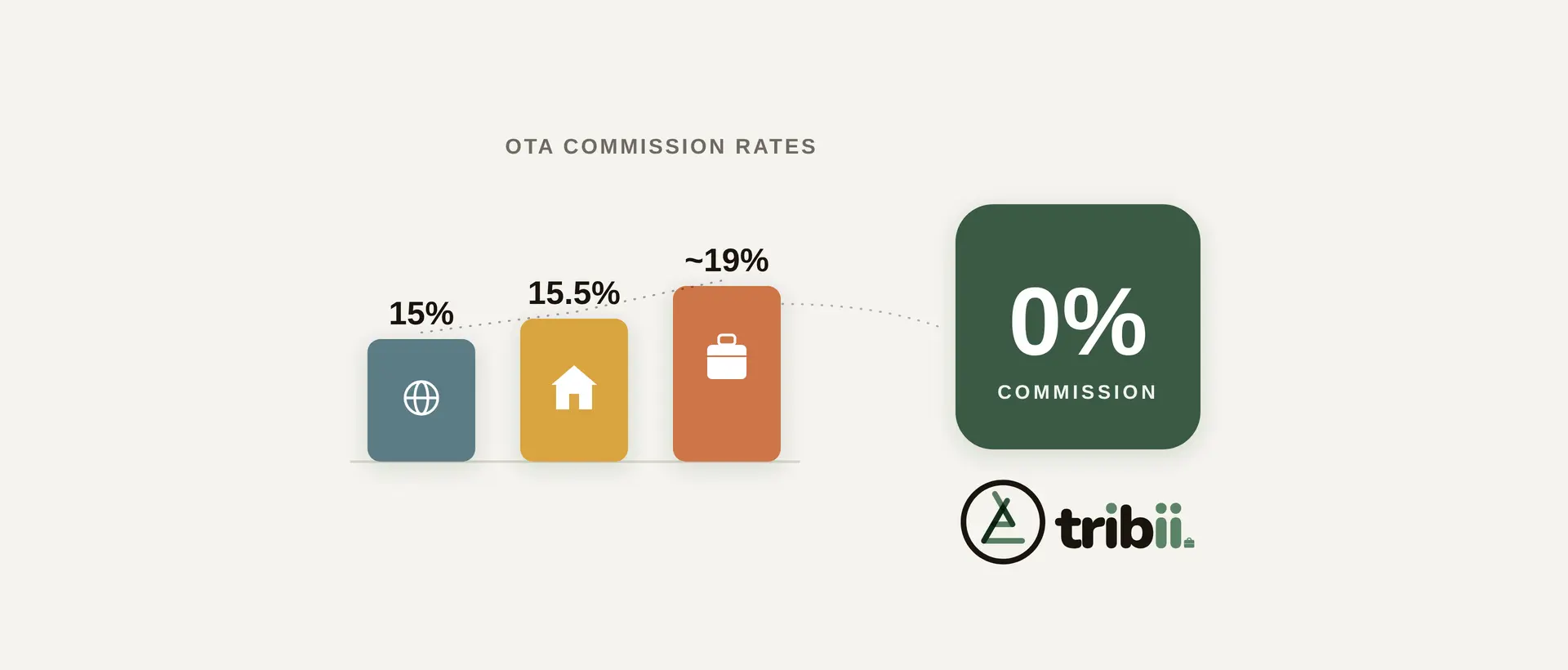
Every booking that arrives through an online travel agency (OTA) arrives with a bill attached. For most independent hotels that bill is the single largest variable cost in the business: larger than housekeeping, larger than payment processing, often larger than the utilities. Yet the exact figure is strangely hard to pin down, because no OTA publishes one flat rate and every guide quotes a different number.
Here is the honest version, with the ranges, the country differences, and the add-on fees that rarely reach the headline number.
The short answer
Across the industry, commission on a hotel booking in 2026 lands somewhere between 15% and 25% of room revenue, with a rough market average near 15% to 18%. A decade ago that average sat closer to 10%, so the direction of travel is clear. Niche and regional OTAs can go as low as 4%, and the largest chains negotiate rates the rest of the market never sees.
Those are guide-level figures. Your actual rate is set property by property inside each OTA's extranet, and it depends on your country, your property type, your cancellation policy, and whether you have opted into paid visibility programmes. Treat the numbers below as the starting line, not the finish.
Booking.com, Expedia and Airbnb at a glance
PlatformTypical rateHow it is chargedBooking.com | 15% base in most of Europe (10% to 25% worldwide) | Commission on the full stay value, billed monthly
Expedia | Around 18% to 20% standard (15% to 30% range) | Commission per completed booking
Airbnb (host-only) | Around 15.5% flat (16% in Brazil) | Deducted from each payout; guest pays no separate service fee
The headline rate is rarely the whole cost, so the rest of this piece explains what sits underneath each number.
Booking.com: the 15% that is often more than 15%
Booking.com's base commission is 15% across most European markets, easing to around 12% or rising towards 17% in a handful of countries. Worldwide the band runs from roughly 10% to 25%, and the UK sits at the 15% base. What catches operators out is everything stacked on top:
- Preferred Partner programme: roughly 3% extra commission in exchange for higher placement in search results. It is optional, but once competitors in your area join, opting out costs you visibility.
- Payments by Booking.com: a processing fee of about 1.1% to 3.1% when you let Booking.com collect the guest's card.
- Genius and campaign discounts: the loyalty and deal programmes cut the price the guest pays, not the base your commission is calculated on, so a 10% or 15% Genius discount comes straight out of your margin on top of commission.
Stacked together, a 15% property running Preferred Partner and Booking.com's own payments can be handing over closer to 20% of room revenue, sometimes more, before it ever sees the money. Your own figure still depends on your market and the programmes you join. For the full breakdown, and how to pay less, see our guide to Booking.com commission.
Expedia: higher headline, similar reality
Expedia's standard commission sits around 18% to 20% for traditional hotels, with the full range spanning roughly 15% to 30% depending on the participation level you choose. Expedia sells commission tiers: pay more to climb the sort order and unlock package and loyalty demand, or pay the floor rate and sit lower in results. Because Expedia also feeds Hotels.com, Vrbo and its partner network, one agreement can distribute your rooms across several sites at that rate.
For most independents the practical gap between Booking.com and Expedia is smaller than the headline numbers suggest, once Booking.com's add-ons are counted. The bigger difference is demand mix: Booking.com dominates European direct-to-consumer, while Expedia is stronger in North American and package travel. Our guide to Expedia commission covers the tiers, the two payment models and how to pay less.
Airbnb: a real change is underway
Airbnb deserves its own paragraph, because its fee model is actively changing. Historically Airbnb used a split fee: the host paid about 3% and the guest paid a separate service fee of roughly 12% to 14%. That is being retired in favour of the host-only fee, a flat 15.5% (16% in Brazil), taken from the host payout with no separate charge to the guest.
The transition is well underway. Since 27 October 2025 the host-only model has been mandatory for any host connected through a property-management system. For everyone else it becomes mandatory on 15 September 2026 for non-EU hosts and 13 October 2026 for EU hosts. The practical effect for many small operators is that Airbnb has moved from feeling like a low-cost channel to sitting in the same 15%-plus bracket as the traditional OTAs. As with the others, the rate that applies to you depends on your region.
Why the rate changes by country and property
There is no single global rate, because each OTA prices for local competition and demand. A few patterns hold today:
- Europe clusters around Booking.com's 15% base, with smaller markets a point or two either side.
- North America leans more on Expedia and its brands. On the short-let side, Vrbo's rate for US and Canadian hosts (around 8%) undercuts Booking.com's equivalent.
- Regional and niche OTAs covering a single country or segment sometimes run as low as 4% to win supply, though with far less volume.
Property type matters too: a city hotel, an apartment and a bed and breakfast can be quoted different rates on the same platform in the same city.
What a year of OTA bookings actually costs
Percentages feel abstract until you annualise them. Take a small property doing 200,000 in room revenue a year, with 60% of that arriving through OTAs at a blended 18%, a realistic figure once add-ons are counted:
- 200,000 revenue at 60% via OTAs = 120,000 of OTA-sourced revenue.
- 120,000 at 18% = 21,600 paid in commission in a single year.
That is a full year of commission on one modest property, and it recurs every year the mix stays the same. Shifting even a fifth of those bookings to a direct, commission-free channel puts several thousand back on your bottom line annually. And commission is only the first line: discounts, payment fees and lost guest data push the real cost of an OTA booking higher still.
If you want the figure for your own property rather than this worked example, our free OTA commission calculator takes your revenue and channel mix and shows what you are handing over, and what you would keep by moving bookings direct.
Can you negotiate, and what is a fair rate?
Rates are negotiable, but leverage tracks volume. Large chains and high-producing independents do secure lower commissions or better placement for the same rate. A single small hotel usually cannot argue the base rate down, so the realistic levers are narrower:
- Opt out of paid visibility add-ons you cannot prove are paying for themselves.
- Handle your own payment processing instead of the OTA's, where your rate allows it.
- Keep rate parity rules in mind, and use every channel you control, your own site, phone and walk-ins, to shift the mix towards bookings that carry no commission at all.
A fair rate, in practice, is whatever keeps the OTA delivering bookings you genuinely could not have won yourself. Paying commission on incremental demand is not the problem. Paying 15% to 25% on guests who would have booked you anyway is.
The cheapest booking is the one you own
Every strategy for controlling OTA cost ends in the same place: a healthy share of direct, commission-free bookings, so the OTAs compete for your business instead of the other way round. That does not mean leaving the OTAs. It means not depending on them.
This is the reason Tribii exists. Our booking engine is free and takes no commission on the direct reservations it captures, so a booking that would have cost you 18% on an OTA carries no OTA commission through your own site. Pair it with revenue management to price those rooms well, and clear reporting to see your true cost per channel, and the annual bill above starts to shrink instead of compound.
Start with the calculator to see your number, then decide how much of it you would rather keep.
Sources: figures compiled from 2026 platform documentation and industry commission guides (Cloudbeds, Rield, Preno, Smoobu, Hostaway), current as of July 2026. Rates are set per property in each OTA's extranet and may differ.

Tribii
The free booking engine for independent hoteliers. Editorial notes.
More for the kitchen table.
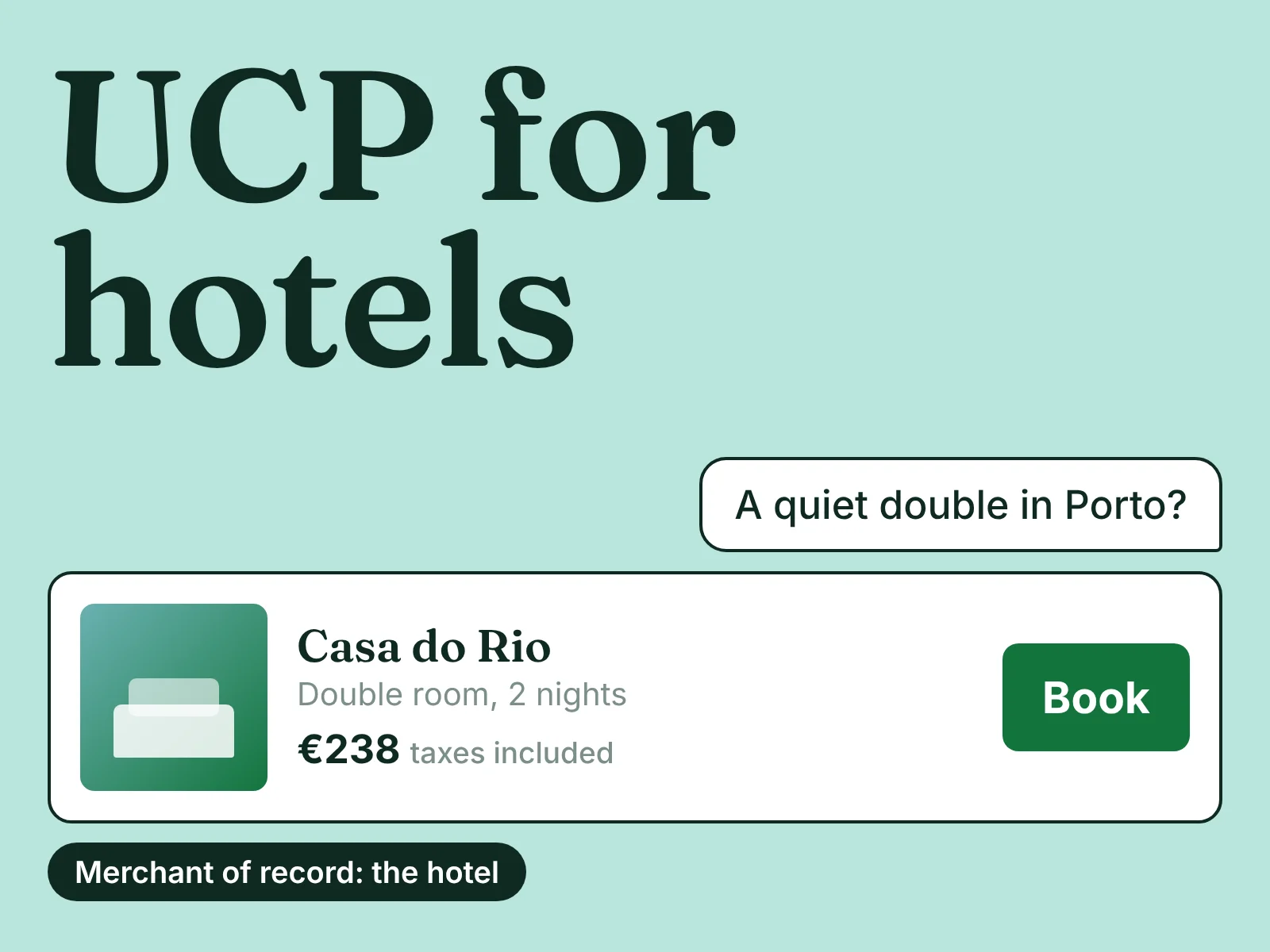
UCP for hotels: the Universal Commerce Protocol and the future of online booking
Google and the biggest names in travel have written a shared language that lets AI assistants book a hotel room inside a conversation. It is called UCP. Here is what it is, who keeps the guest, and what independent hotels should do before it reaches Europe.
 Tribii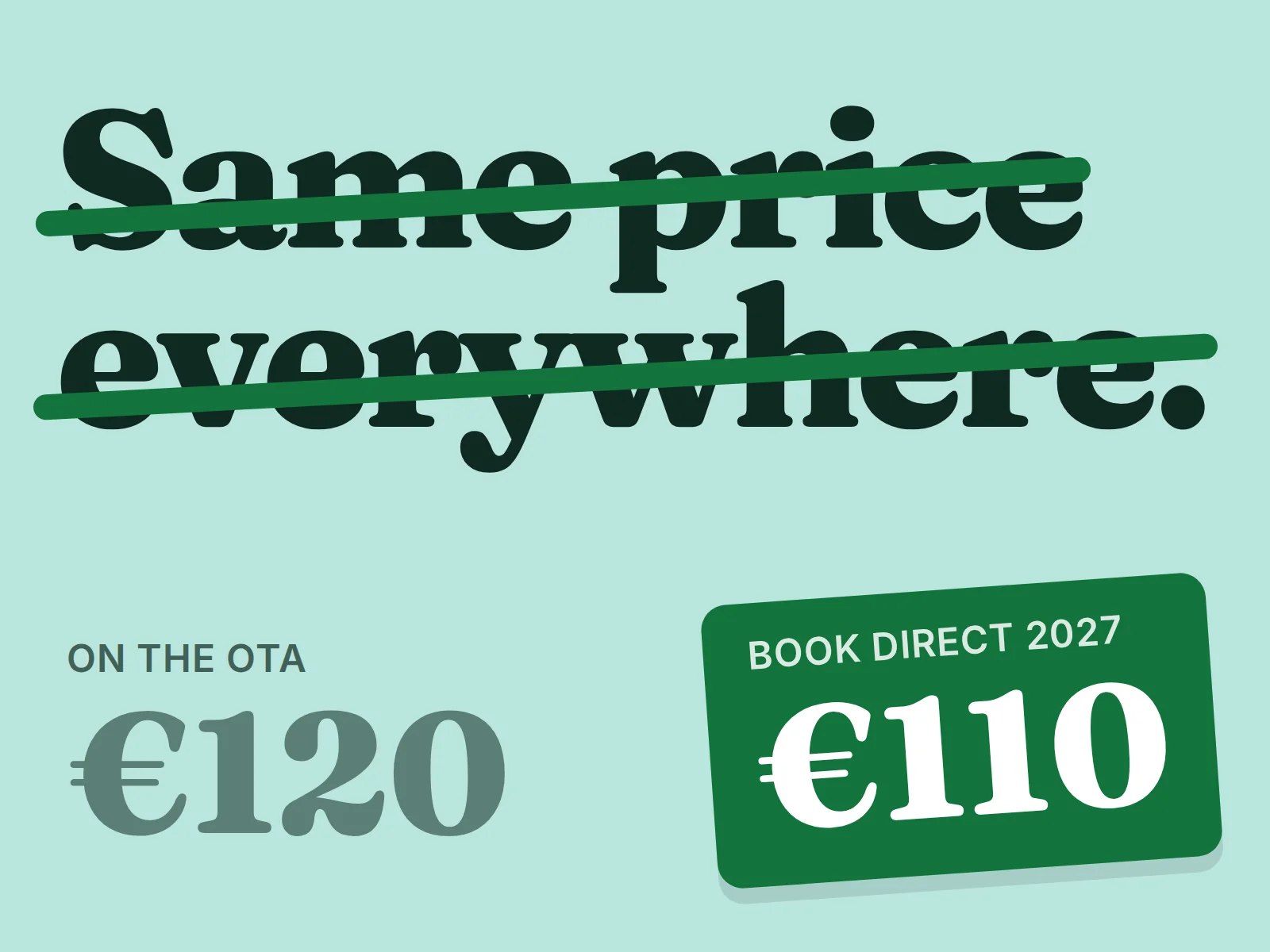
Rate parity is gone in Europe. How to price your direct rate for 2027
Booking.com can no longer make you match its price on your own website. Most small hotels still do. Here is what the law allows, what the algorithm might not, and how to set a direct rate for 2027 that pays.
Tribii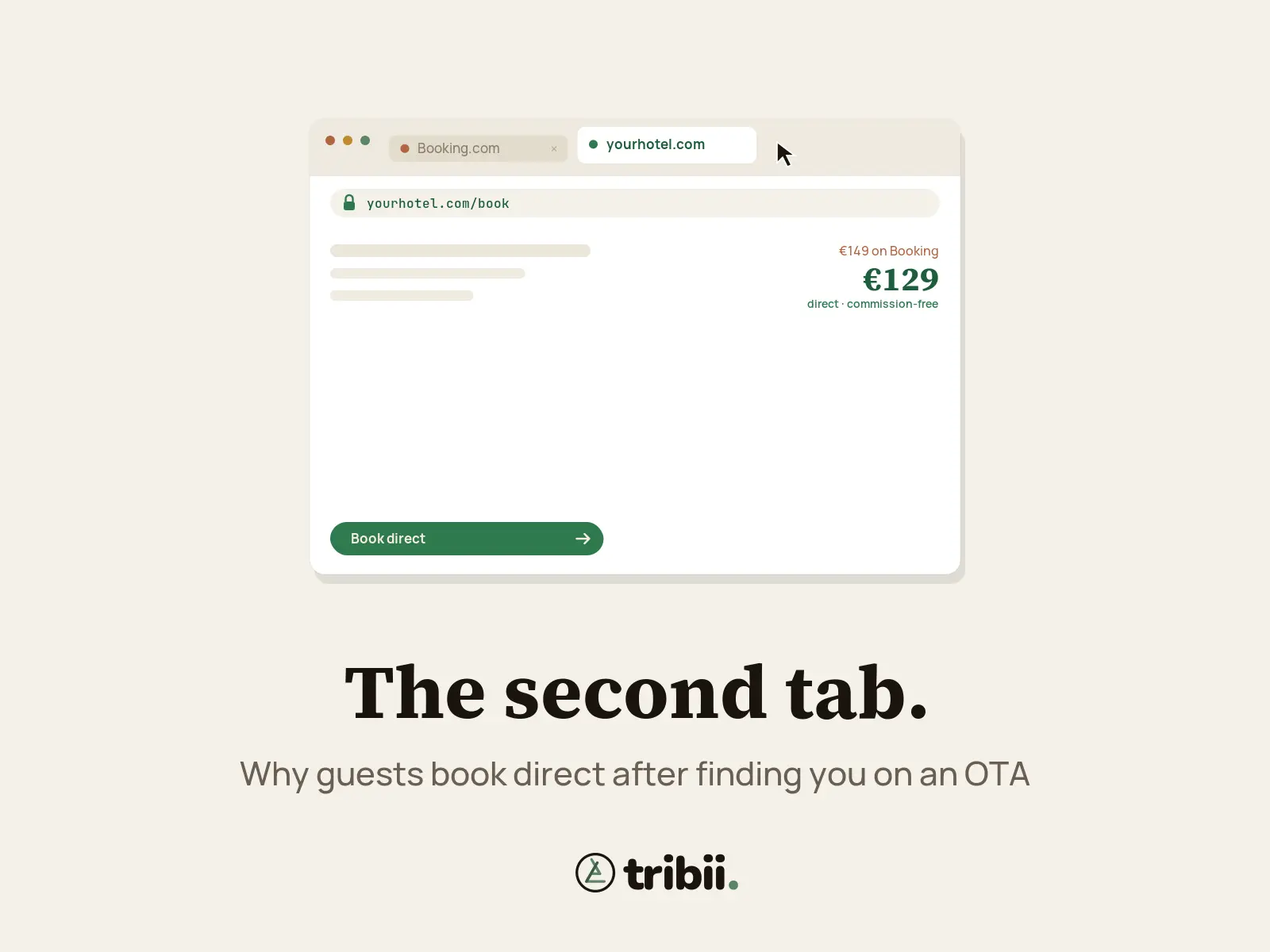
The Second Tab: Why Guests Find You on Booking.com and Book Somewhere Else
Most guests who book you directly found you on an OTA first. Here is what that second tab is worth, and why, after the EU killed rate parity, independent hotels can finally win it.
 Daniel Vidal