The Second Tab: Why Guests Find You on Booking.com and Book Somewhere Else
Most guests who book you directly found you on an OTA first. Here is what that second tab is worth, and why, after the EU killed rate parity, independent hotels can finally win it.

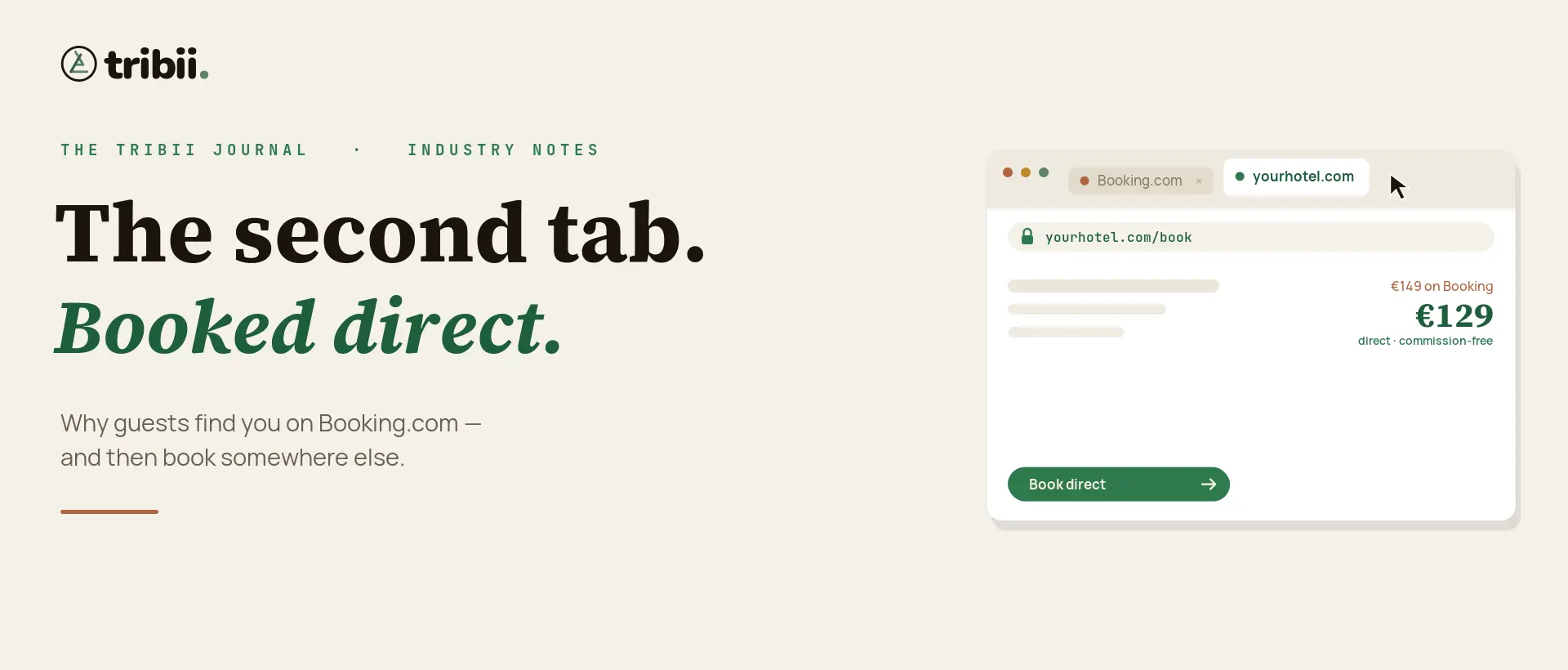
There is a small, silent moment that decides a surprising share of your revenue, and it happens on a screen you will never see.
A traveller is planning a weekend in your town. She opens Booking.com, filters by neighbourhood and budget, and scrolls. She finds your place: the photo of the courtyard, the 8.9 review score, the line about fresh bread in the morning. She likes it. And then she does something the platform would rather she didn't: she opens a second tab, types your hotel's name into Google, lands on your own website, and books there instead.
That second tab is where the modern hotel business is quietly being won and lost. The guest used the OTA as a catalogue and your website as the till. Nobody paid a commission. She probably got a better rate, or a perk, or just the reassurance of dealing with you directly. Multiply that single decision across a season and you are looking at the difference between a property that merely survives the OTAs and one that actually owns its margin.
The industry has a name for this: the billboard effect. It is one of the most studied and least exploited dynamics in hospitality, and for independent hoteliers in Europe it has, after a decade of being trapped, finally started to tilt your way.
The behaviour, and how widespread it really is
The billboard effect was first measured by Chris Anderson at Cornell University, who ran a clean experiment: list a group of hotels on Expedia, then remove them in alternating weeks, and watch what happens to bookings made off the platform. Being visible on the OTA increased a hotel's own reservations by 9% to 26% over being hidden: bookings the hotel captured directly, on top of whatever it sold through Expedia itself. The OTA, in other words, was working as advertising whether the hotel wanted it to or not.
That was 2009. The behaviour didn't fade as the web matured; it intensified. A 2011 study found that roughly 75% of consumers who reserved with a major hotel brand had visited an OTA beforehand. Anderson's 2017 follow-up, pointedly titled The Billboard Effect: Still Alive and Well, found that even in a messier funnel of metasearch, SEO and ads, around 30% of people who book direct still begin their search on an OTA. More recent industry data puts the number even higher at the discovery stage: roughly 52% of travellers visit a hotel's own website after first finding it on an OTA.
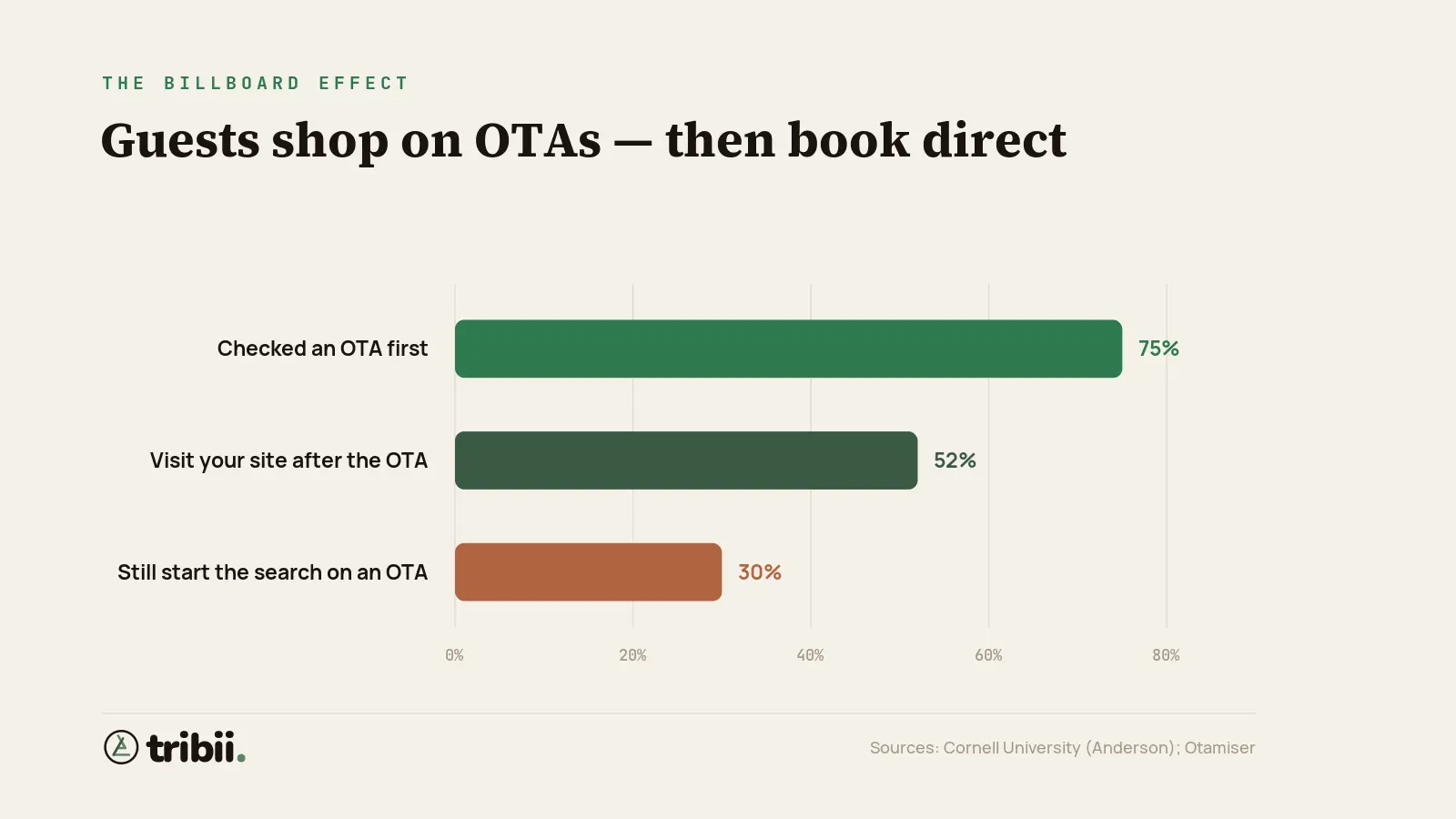
Read those numbers the way an operator should. The OTA is not just a sales channel. For a large slice of your guests it is the top of the funnel, the place they discover you exist, and your own website is where a meaningful share of them would prefer to finish, if you give them a reason to.
What the second tab is actually worth to you
Here is why that handoff matters so much, and it has nothing to do with vanity and everything to do with the P&L.
Every booking that comes through Booking.com or Expedia carries a commission. Booking.com's base sits around 15%, climbing toward 18% or higher once you opt into the visibility programmes that, in practice, you need to compete. Expedia tends to run higher, averaging closer to 20% and reaching as high as 30% for some properties and programmes. Taken together, the real-world range a hotel pays an OTA runs from roughly 15% to 30% of the room rate. And the commission line is only the visible part of the cost.
When Kalibri Labs modelled the total cost of acquiring a guest (commissions, plus the fees, plus the loyalty and rebooking value you never capture), it found hotels spend a large slice of a night's room rate to win an OTA guest, versus only a fraction of that to win one directly. A useful benchmark: typical direct acquisition costs land around 3% to 8% of the room rate, meaning OTA business can demand up to 6.5 times the acquisition investment of a direct booking. A quick word on that direct figure, because it's easy to misread: it represents the industry's normal cost of running a direct channel through third-party providers: a booking engine subscription, your own marketing, and card-payment processing. It is not what Tribii charges. Tribii takes no commission on the bookings it brings you; the only unavoidable cost on a direct sale is the payment processing every channel incurs anyway. The point of the chart below is the gap, not the small print: direct is dramatically cheaper than the OTA almost however you run it, and commission-free cheaper still.
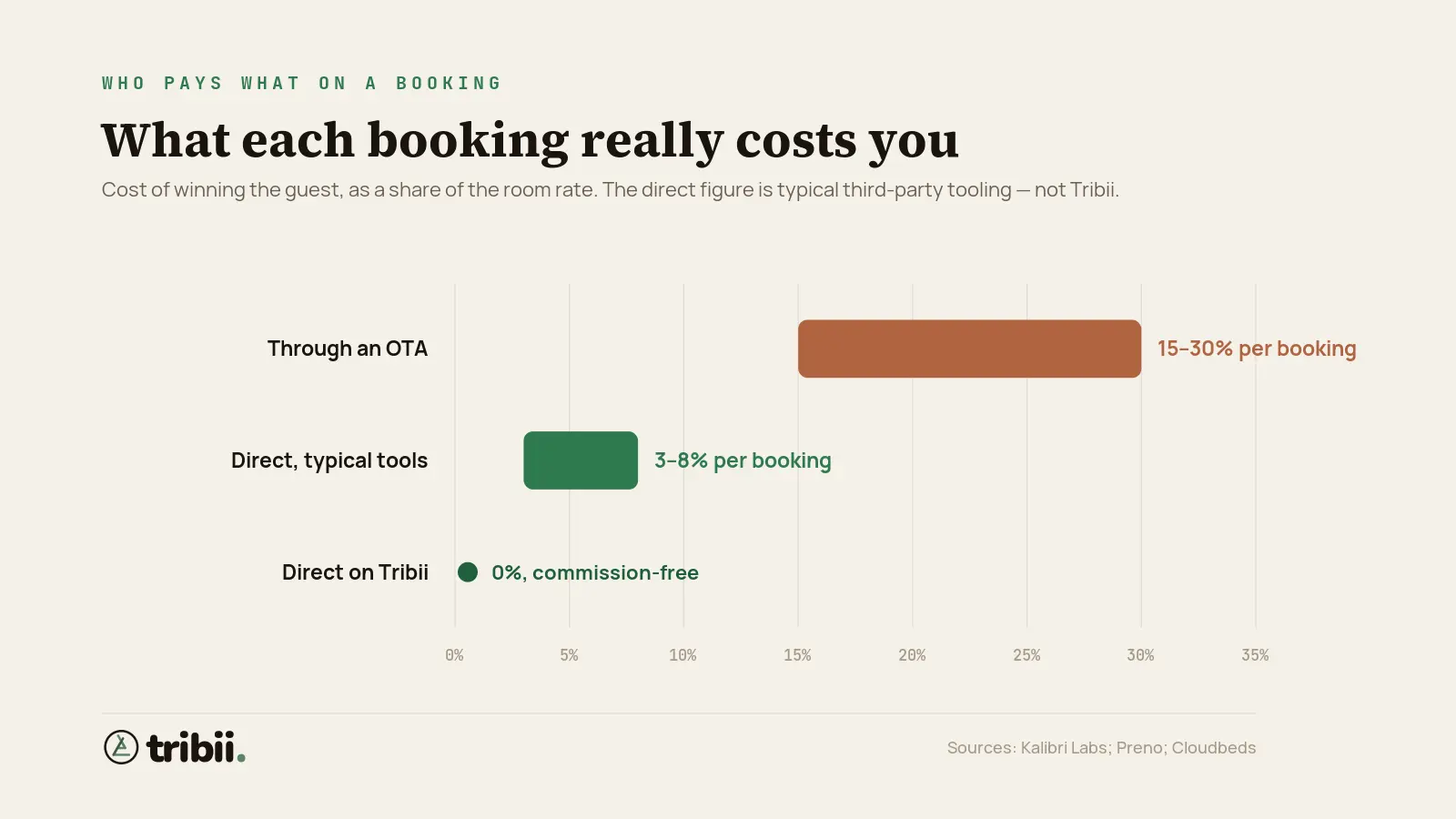
That gap compounds into the number that should be pinned above every front desk. On an average direct booking, a hotel keeps about 93% of what the guest pays. On an average OTA booking, it keeps closer to 83%. Ten points of every euro, gone to the middleman, before you've washed a single towel.
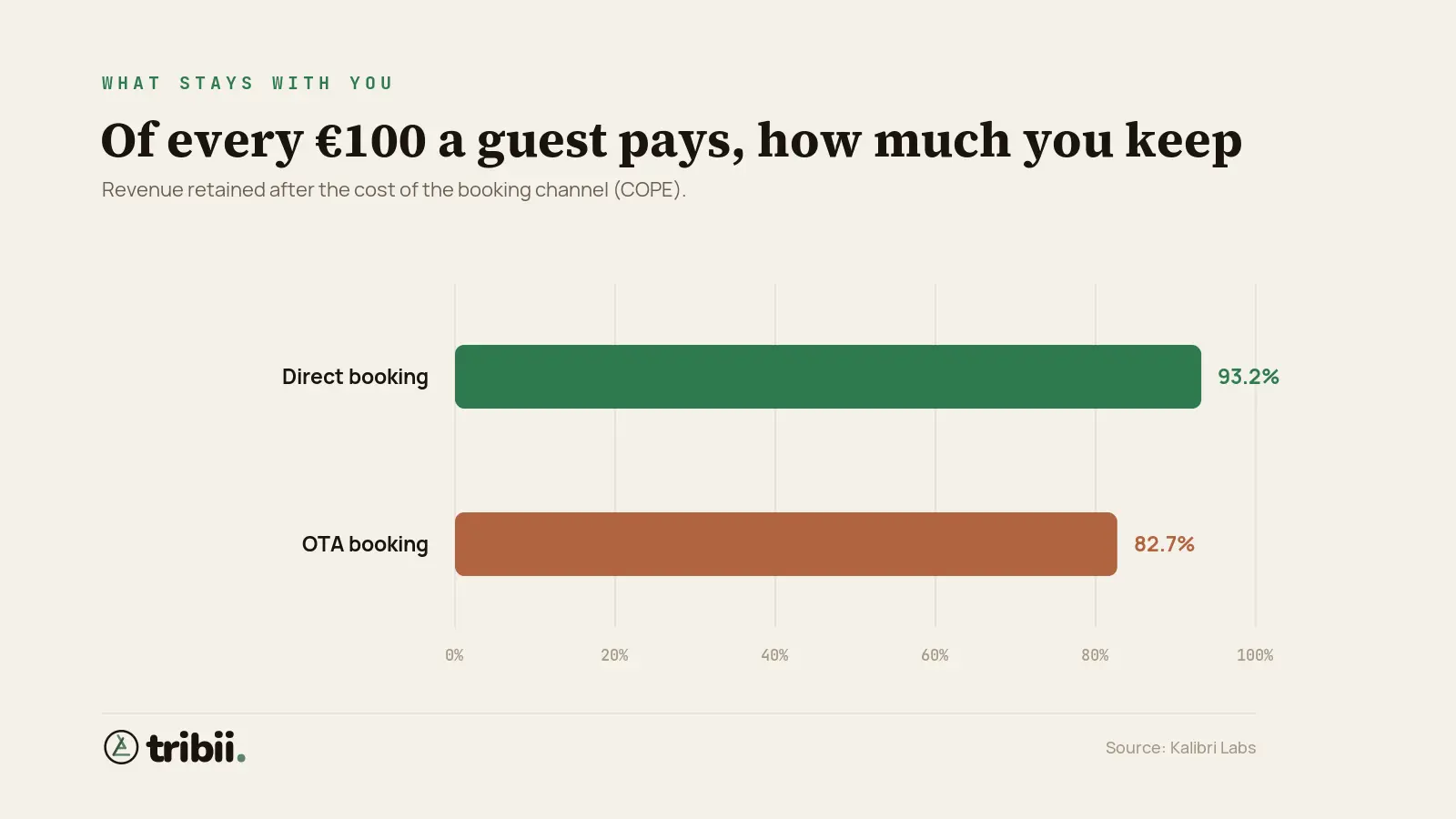
Revenue kept per booking: 93.2% on a direct booking versus 82.7% through an OTA.
And the OTA guest is not just more expensive to acquire; they are less reliable once acquired. Cancellation rates on OTA bookings run far hotter than on direct ones, approaching 50% in some markets, against the 18% to 20% typical of guests who booked with you directly. A platform that makes cancelling frictionless is wonderful for the platform's conversion rate and miserable for your occupancy forecast.
None of this means OTAs are the enemy. They are an extraordinary, expensive billboard with a global audience you could never buy your way in front of alone. The mistake is treating the billboard as the destination: paying a 20% finder's fee on guests who found you, looked at you, and would have booked you anyway.
The grip you're trying to loosen
It's worth being honest about why this is hard, because the deck has genuinely been stacked.
In Europe, the OTA market is not a competitive marketplace so much as a near-monopoly with a runner-up. Booking.com commands roughly 71% of the European OTA market; Expedia Group sits somewhere in the low-to-mid teens; everyone else fights over the scraps.
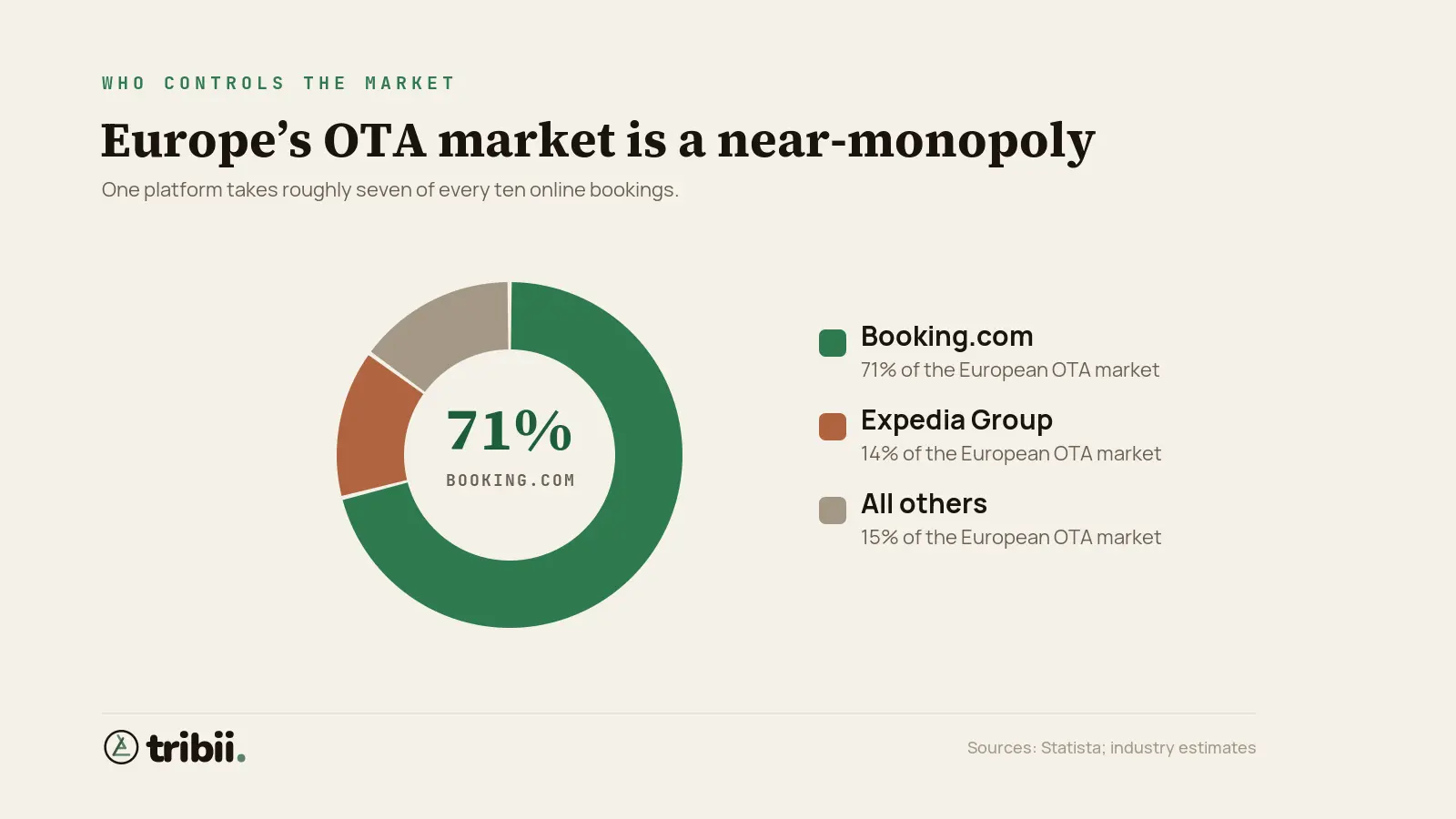
Booking Holdings won Europe by reading European hoteliers correctly. It offered the "agency" model (the guest pays you at the property, you remit commission afterwards) which suited cash-strapped independents far better than the upfront merchant model. It built the best-converting booking flow on earth. And then, for years, it locked the arrangement in place with rate parity clauses: contract terms forbidding you from offering a lower price on your own website than you showed on Booking.com. The billboard effect was real, but parity ensured the guest who walked from the OTA to your site found no reward waiting for her. Why open the second tab if the price is identical?
That is the trap independent hotels have lived in. High dependency, high commission, and a contract that defused the one weapon, a better direct price, you might have used to fight back.
The floor just moved
Then the legal ground shifted, and this is the part every European independent should understand cold.
In May 2024, the European Commission designated Booking.com a "gatekeeper" under the Digital Markets Act, formally recognising it as a dominant platform subject to stricter rules. The DMA's Article 5(3) prohibits a gatekeeper from stopping its business users from offering better terms, including lower prices, on their own channels. Booking.com removed its parity clauses across the European Economic Area, effective 1 July 2024. In September 2024, the European Court of Justice put the matter beyond argument, ruling that the parity clauses had been anti-competitive all along and were never essential to the platform's business.
The contract that kept your direct price handcuffed to theirs is gone. You are now legally free to be cheaper on your own website, and the data shows hotels are starting to use that freedom. Mirai's tracking of the EU market found that the rate at which Booking.com undercuts a hotel's own direct price, its "lose rate" for the hotel, fell from around 20% in 2023 to about 15% by September 2025. The gap is closing, and it is closing in your favour.
The fight isn't over. More than 10,000 European hotels have brought a collective damages claim against Booking.com over the years of parity clauses, and regulators are still watching how the platform's ranking responds to hotels that price lower elsewhere. But the headline is simple: for the first time in over a decade, the rules let an independent hotel reward the guest who opens the second tab.
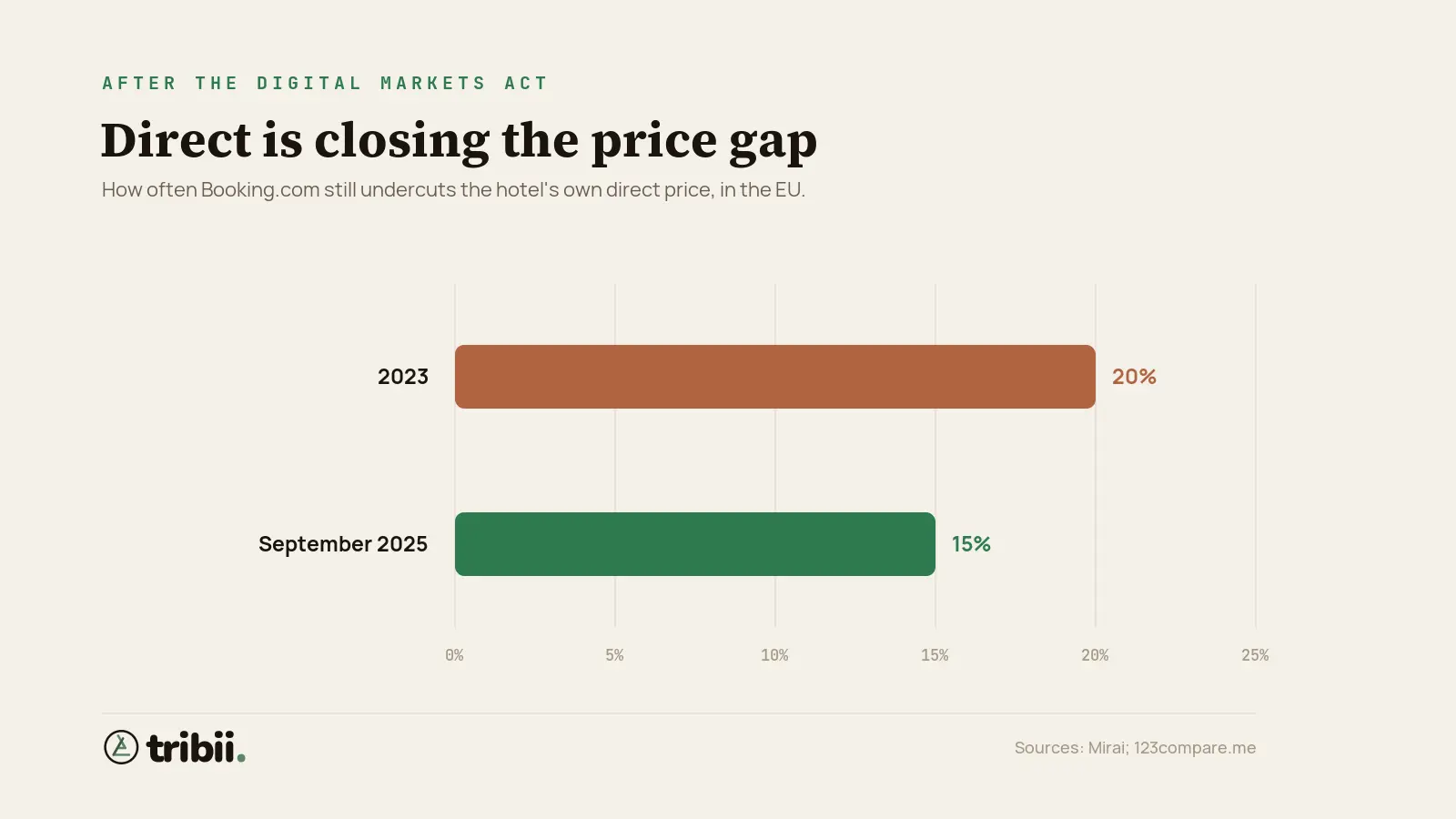
Booking.com's EU lose rate fell from 20% in 2023 to 15% by September 2025.
Why the guest is better off there too
This is not only a hotelier's argument. The guest who books direct is, in most cases, genuinely better served, and increasingly they know it.
When SiteMinder surveyed 12,000 travellers across 14 countries for its Changing Traveller Report 2026, the top reasons people gave for booking direct were flexibility to change or cancel (66%), direct communication with the property (61%), and better prices and package deals (57%).
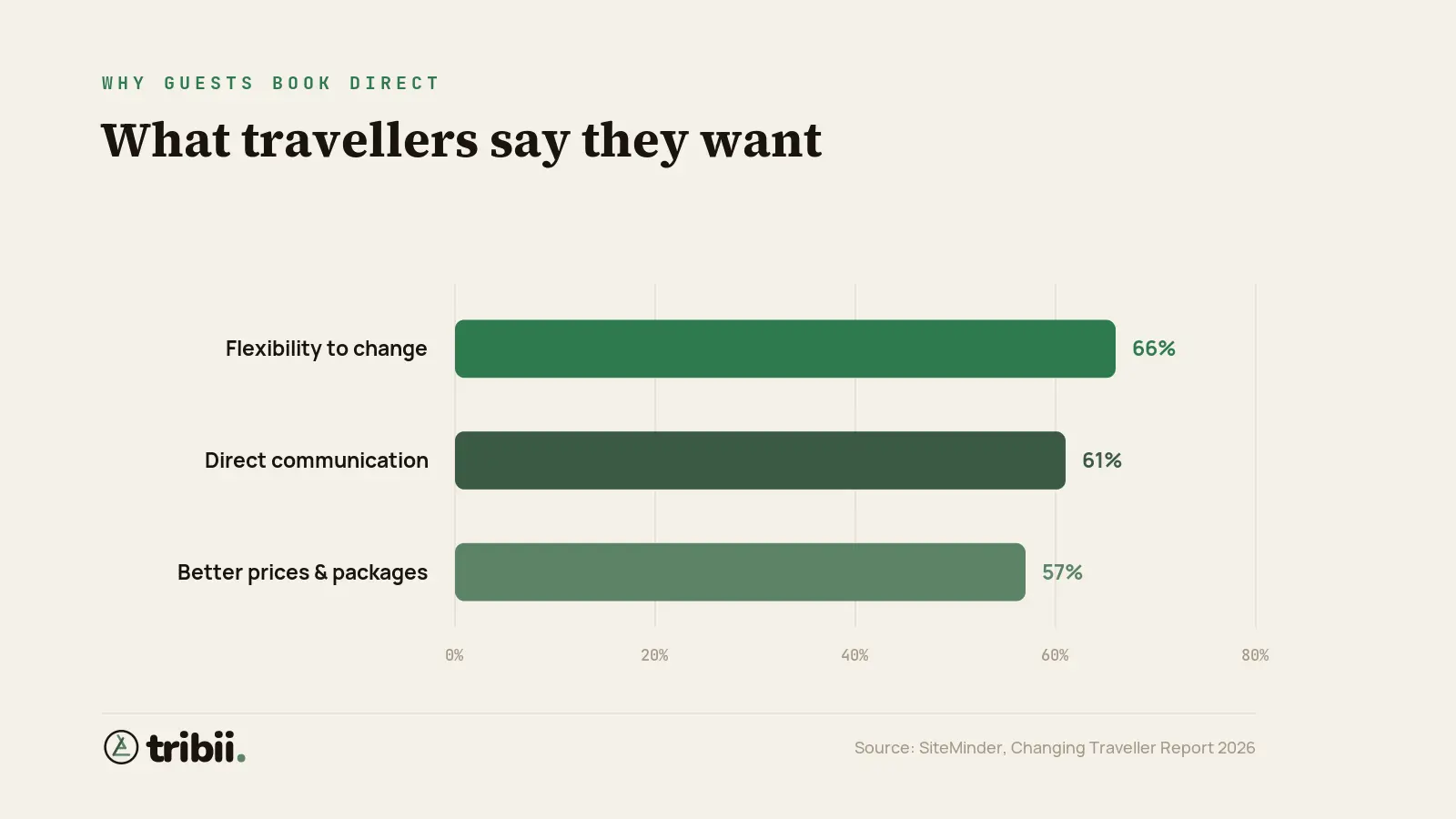
Why guests book direct: flexibility 66%, direct communication 61%, better prices 57%.
Those aren't soft preferences; they're the lived experience of anyone who has tried to move a date or fix a billing error through an OTA call centre. When something goes wrong (a room that doesn't match the listing, a charge that looks off), the guest who booked direct is talking to the person who can actually fix it. The guest who booked through a platform is triaged behind them, bounced between the hotel ("we didn't take the payment") and the OTA ("contact the property"). Direct guests get the upgrade when one's available, because you reward your own. They earn the loyalty perk; OTA bookings usually earn nothing. And they're spared the OTA checkout's quiet sins: the drip-priced "taxes and fees" that surface only at the final screen, adding 10% to 20% to a number that looked like a bargain three clicks ago.
The direct rate, post-parity, is now frequently the same or lower, often bundled with a waived fee, a late checkout, or a free breakfast that the platform's flat inventory could never match. The second tab, for the guest, is usually the better deal. They just need to be told to open it.
The uncomfortable part: most independents still aren't winning it
Here's the catch, and it's the reason this article isn't a victory lap. The legal freedom to win direct is not the same as winning. The 123compare.me pricing data for the first half of 2025 found independent hotels offering a higher direct price than at least one OTA (a "loss") 37% of the time, and ranking as the cheapest option only 54% of the time. The independents who actually convert run beat rates of 60% to 70%. The billboard effect lights up your name for free; whether the guest who clicks through to your site finds a reason to stay is entirely on you.
So treat the second tab as a discipline, not a hope:
Price with confidence. Parity is dead in the EEA. Make your direct rate at least match the OTA, and where you can, beat it, even by a token amount, even bundled as a perk rather than a raw discount. The guest is comparing two tabs; give the right one the edge.
Have a booking engine worth landing on. The billboard effect dumps a motivated guest onto your homepage. If your direct flow is slower, uglier or more confusing than Booking.com's, you've sent her back to the platform to pay your 20%. A clean, fast, mobile-first direct booking path is not a nicety; it is the entire return on the OTA's free advertising.
Capture the searcher. The person typing your name into Google is the highest-intent visitor you will ever get. Own that search (your name, your real site, first result) and meet her with the same photos, the same room, and a better offer than the one that sent her looking.
Sell the things parity used to forbid. Flexibility, direct contact, the perk, the human voice. These are exactly what guests say they want, and exactly what an OTA cannot replicate. Lead with them.
The platforms spent twenty years teaching travellers to start their search on a blue-and-white app, and they earned that habit fairly. But they also, inadvertently, built the most effective top-of-funnel an independent hotel has ever had, and the law has just removed the clause that stopped you from converting it. The guest is already opening the second tab. The only question left is whether, when she lands on your site, you've given her a reason to stay.

Daniel Vidal
Tribii Founder. Former bellboy turned hotel manager, transitioned to software developer. Now combining both worlds for a greater purpose: democratizing hotel software to help independent hoteliers compete with the big fish.
More for the kitchen table.
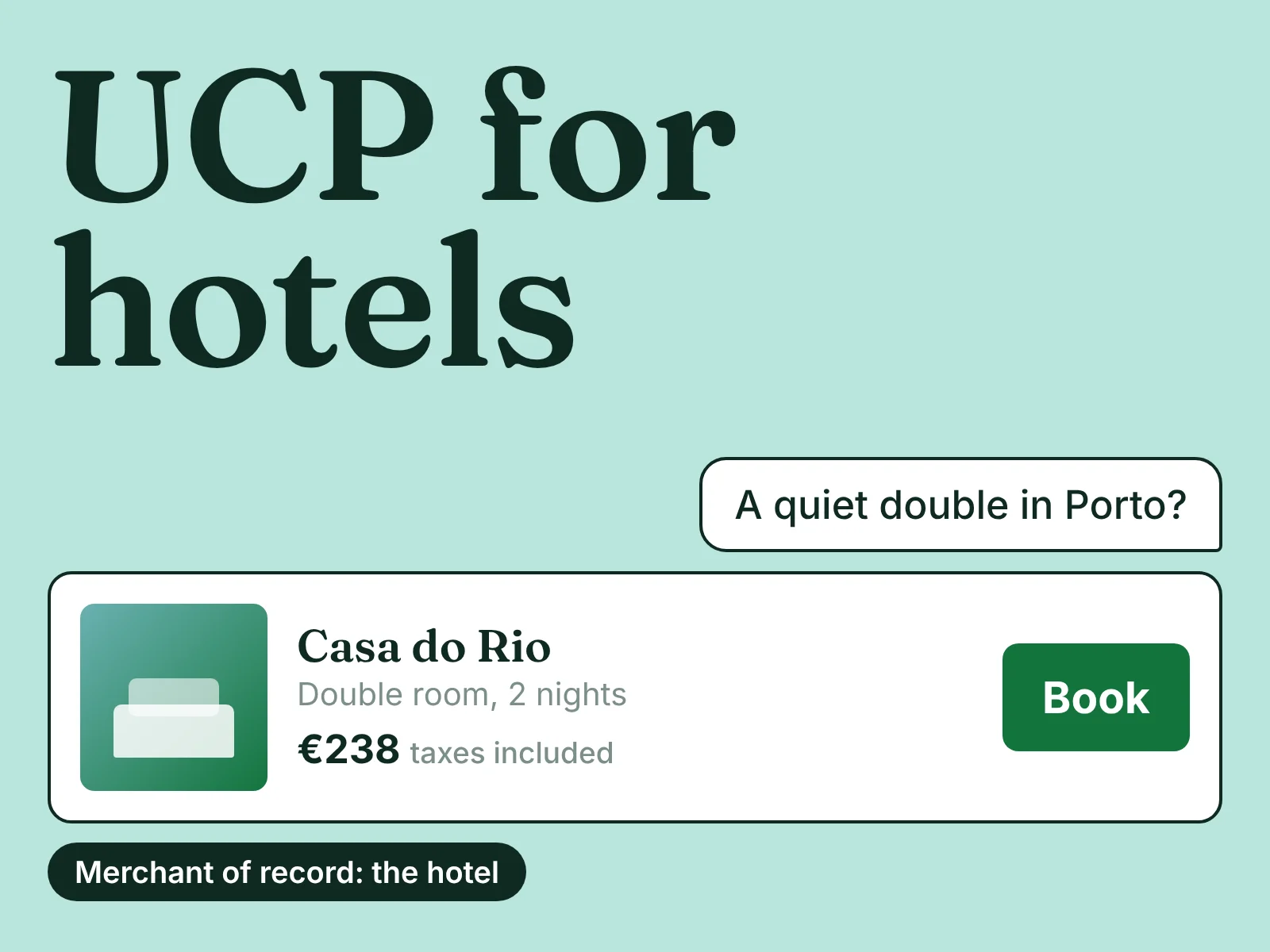
UCP for hotels: the Universal Commerce Protocol and the future of online booking
Google and the biggest names in travel have written a shared language that lets AI assistants book a hotel room inside a conversation. It is called UCP. Here is what it is, who keeps the guest, and what independent hotels should do before it reaches Europe.
 Tribii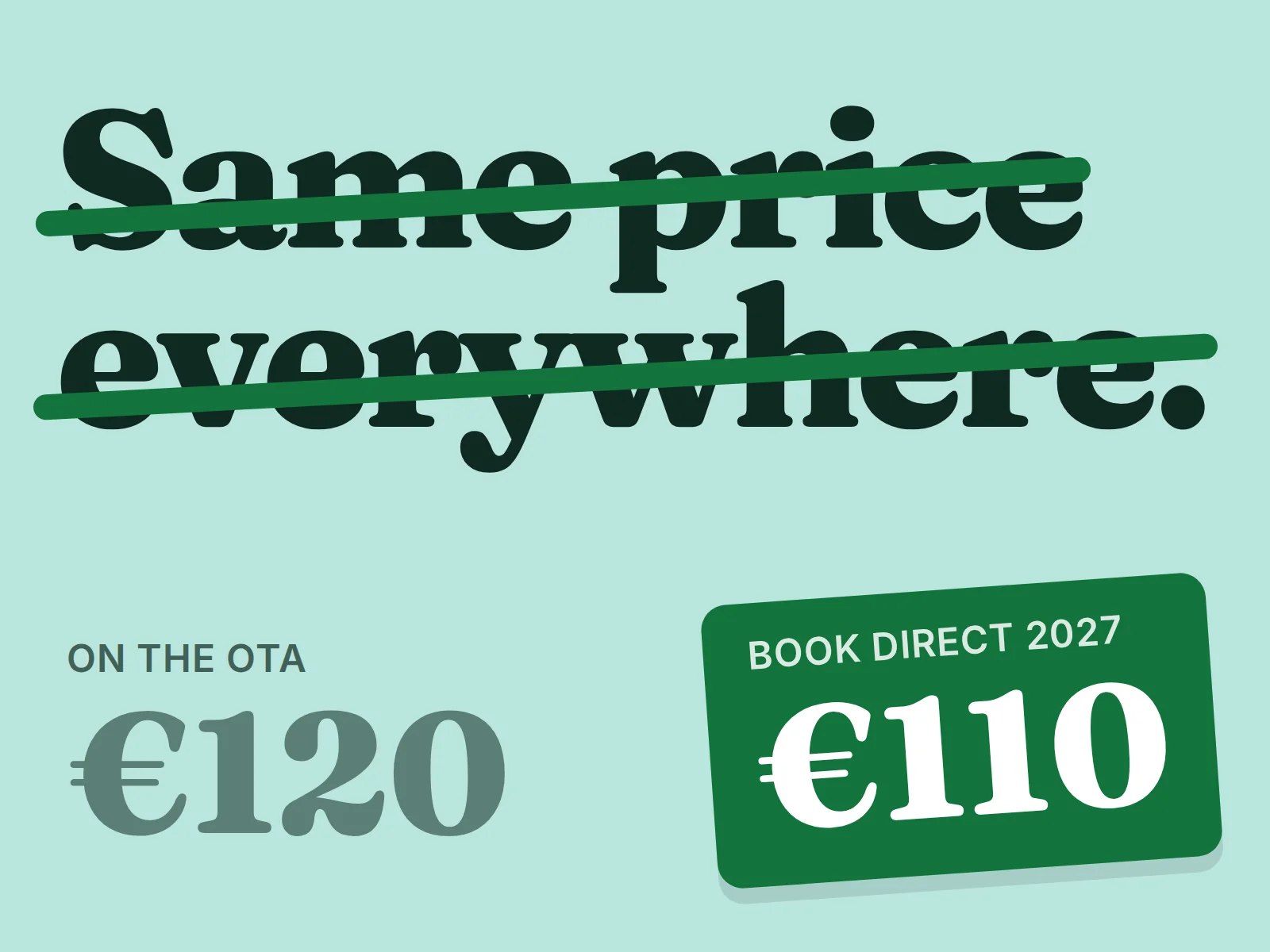
Rate parity is gone in Europe. How to price your direct rate for 2027
Booking.com can no longer make you match its price on your own website. Most small hotels still do. Here is what the law allows, what the algorithm might not, and how to set a direct rate for 2027 that pays.
Tribii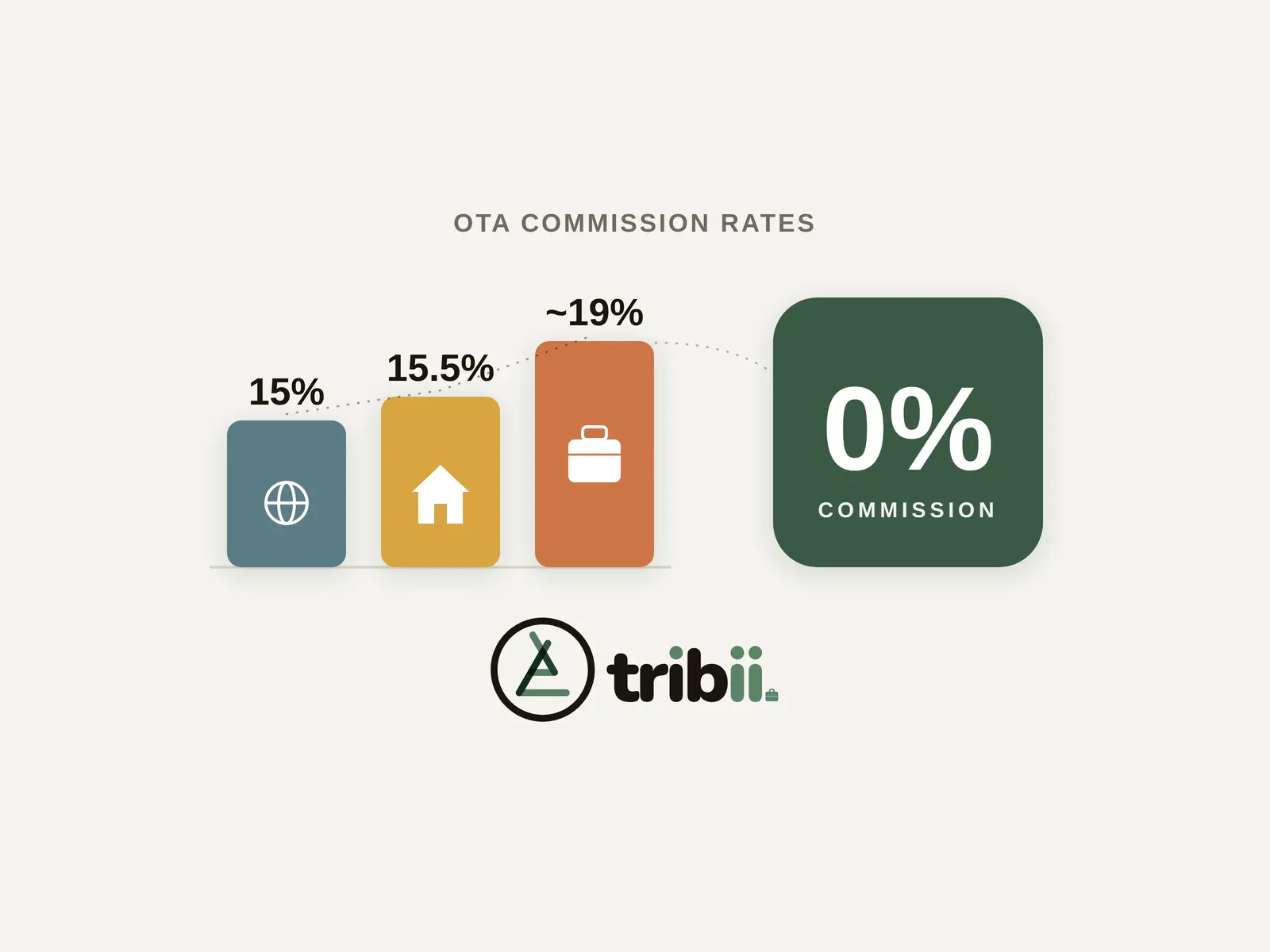
OTA Commission Rates: What Booking.com, Expedia and Airbnb Really Charge
A plain-English breakdown of what the big booking sites really take, the fees they do not advertise, and how much a year of OTA bookings actually costs you.
Tribii