The street outside is part of your hotel
How guest messaging, local experiences and a traveller board turn a stay into three connections, and why one of them lands as a real line on the folio.

A guest comes down at nine, half dressed for the day, and asks what they should do tomorrow. Somebody at the desk pulls out a paper map. The bakery on this corner, not that one. The bike place run by Marta, tell her we sent you. The bus to the cove leaves at the roundabout, but only until four.
That thirty second conversation is the most valuable thing an independent hotel gives away, and in most properties it leaves no trace at all. It is not in the PMS. It is not on the guest profile. Marta never hears where the customer came from. The hotel earns nothing from it. And when the guest gets home and tells a friend the town was wonderful, the friend books through an OTA.
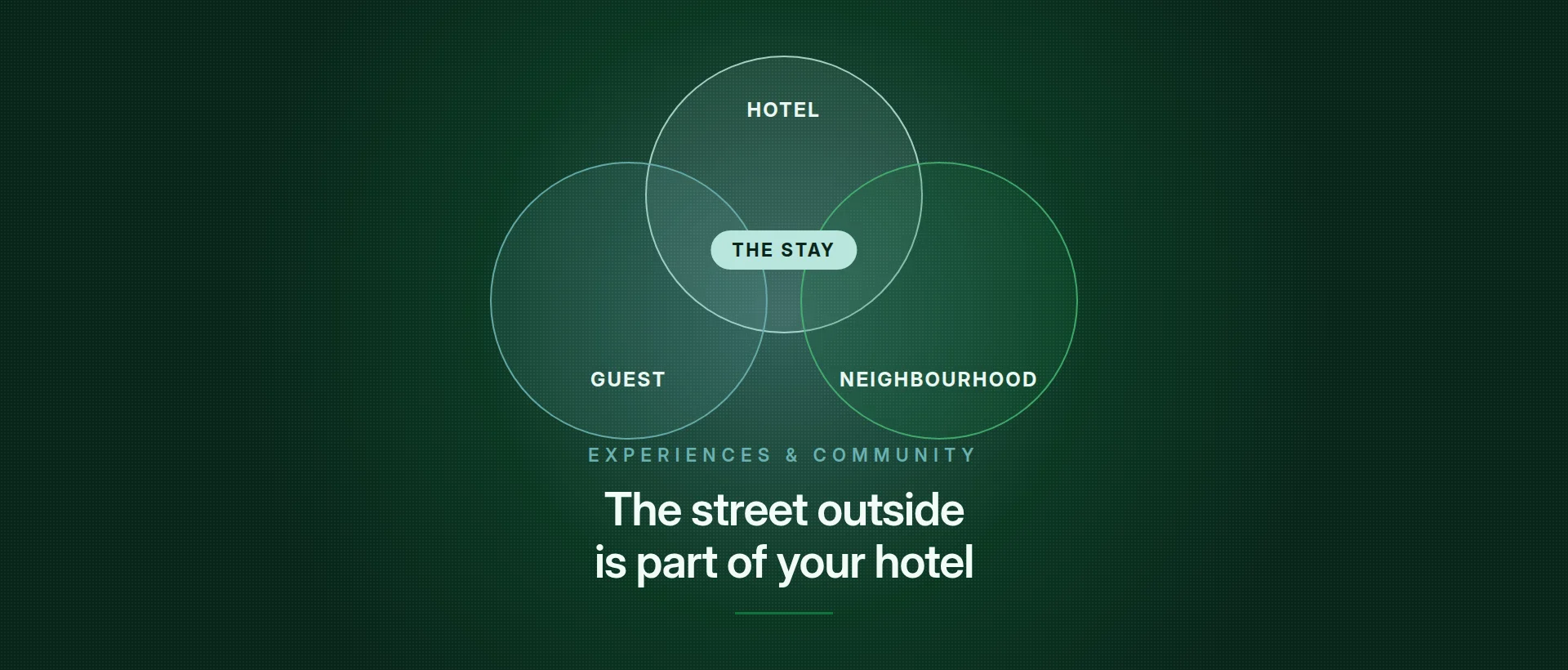
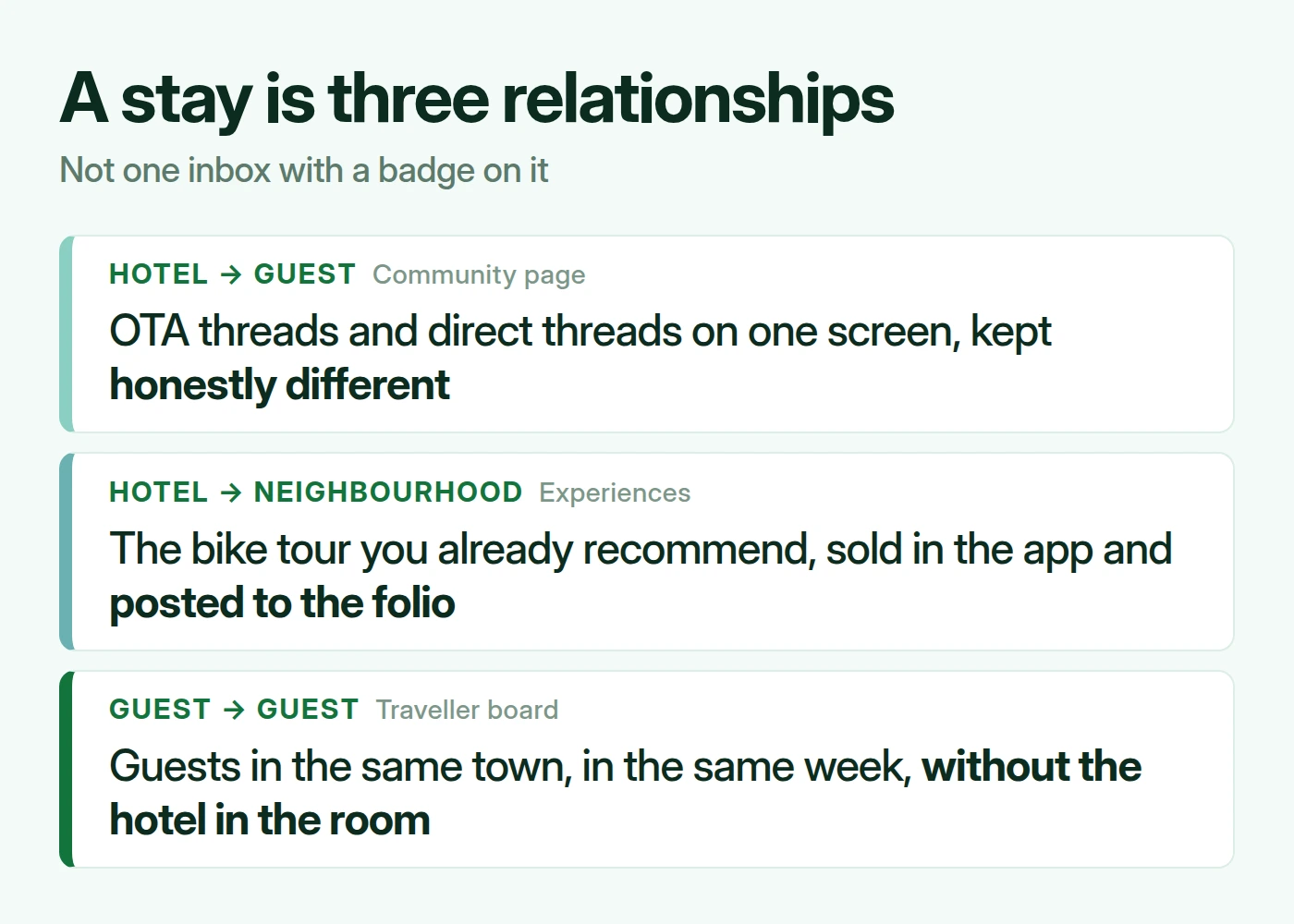
We built the community side of Tribii around a simple observation: a stay is not one relationship, it is three. The hotel and the guest. The hotel and the neighbourhood. And the guests and each other. Most hotel software only models the first one, badly, and calls it an inbox.
Circle one: you and the guest, without pretending
The Community page puts every conversation about a stay on one screen. Direct guests on one side, guests who came through Booking.com, Airbnb or Expedia on the other.
What we deliberately did not do is merge them.
The temptation in this category is to build a "unified inbox" and let the hotelier believe every thread behaves the same way. It does not. An OTA thread is not yours. You cannot open it: the guest has to write first. It carries no real email address, because the channel does not give you one. Reply to it as though it were a normal message and you will eventually try to do something the channel refuses, and the failure will land in front of a guest.
So the two live side by side and stay honestly different. The OTA threads look and behave like what they are, a window into somebody else's platform, useful for the pre arrival question and the review that follows. The direct threads are yours: a real guest, a real address, a conversation you can start, attached to a profile that stays in your CRM after checkout. Seeing them next to each other is also the clearest argument for direct booking anybody has ever made to a hotelier, because the difference is visible on one screen rather than in a slide deck.
The OTA side depends on your channel connection and is a paid add-on per property, since the channel charges us to carry those messages. Everything you can see and do on each side is on the pricing page, and the channel manager page covers the connection itself.
Circle two: you and the neighbourhood, on the folio
Experiences is where the paper map turns into something the accountant can see.
You add the things you already recommend. Marta's bike tour. The Thursday boat. The cooking class two streets over. The airport transfer your regular driver does at six in the morning without complaining. You set the price you charge, the capacity, the days it runs, a photo and a description. Guests browse them in the guest app before they arrive or from the terrace on day two, and request the ones they want.
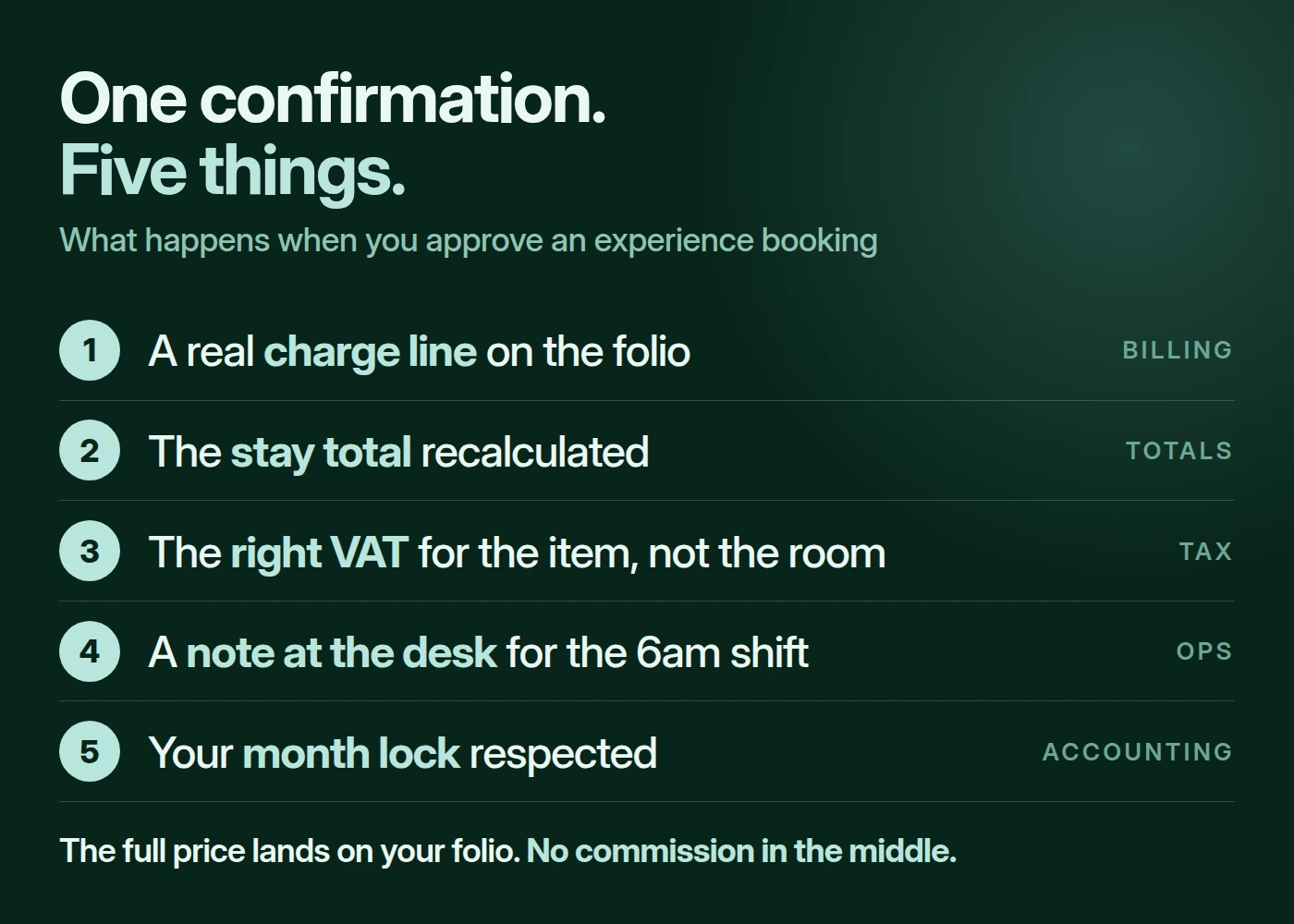
Then the part that matters. When you confirm a booking, one action does five things:
It writes the experience onto the guest's folio as a real charge line. It recalculates the stay total. It applies the correct VAT for that item, which is very often not the VAT on the room. It leaves a note for the front desk so whoever is on at six in the morning knows the transfer exists. And it respects your accounting month lock, so a confirmation cannot quietly reopen a period you have already closed.
The recommendation and the revenue stop being two separate events. They are the same click.
Be clear about the money, because a lot of the market is vague here on purpose. This is not a commission scheme and Tribii does not sit between you and the provider. The full price the guest pays lands on your folio, in your account, in your books. What you owe Marta you settle with Marta, on whatever terms the two of you already have, which in practice is usually a rate you agreed over coffee. Some properties keep a margin, some pass the whole thing through and treat it as service rather than revenue, some invoice the provider monthly. That is your business, and the software should not have an opinion about it.
The second order effect is the one hoteliers tend to notice after a month. The neighbourhood starts sending people back. A bike shop that receives eight bookings a month from you, traceable, at a fair price, becomes a bike shop that mentions you. Local supply chains are reciprocal in a way platforms are not, and the reciprocity only starts once the referral is countable.
Circle three: the guests, with you out of the room
This is the part of the product that almost never appears in hospitality software, and the part guests use most.
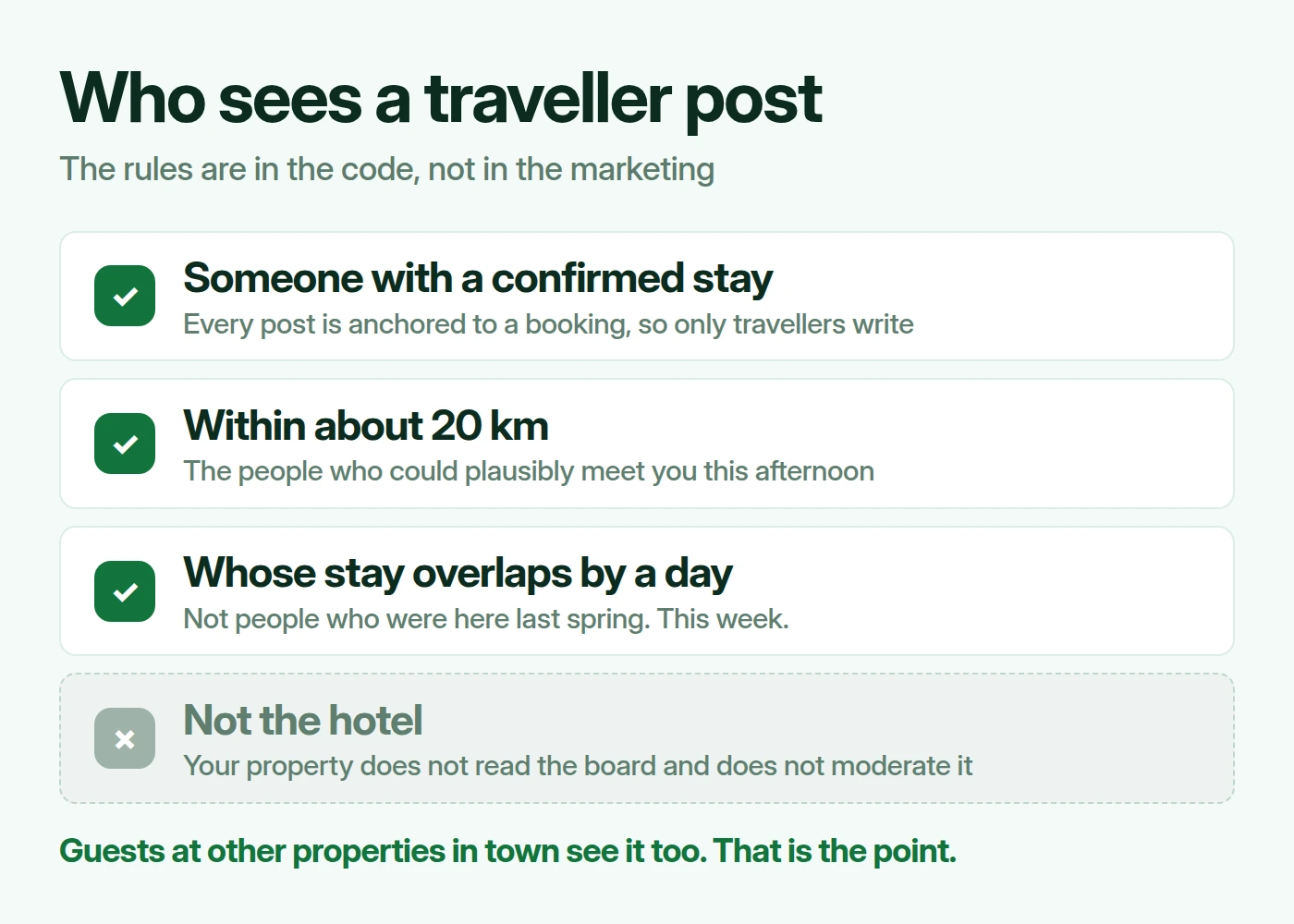
Inside the guest app there is a traveller board. A guest with a confirmed stay can post: looking for two people for the 7am hike, anybody want the third seat in the taxi to the airport, the market is closed today, do not walk down there. It is a message board for people who happen to be in the same place at the same time.
Two rules define it, and they are both in the code rather than in the marketing.
A post is anchored to a stay, so only someone actually staying somewhere can write one. And it is visible only inside roughly twenty kilometres, to guests whose stay overlaps by at least one day. Not a general travel forum. Not people who were there last spring. The people who could plausibly meet you this afternoon.
The second rule is the one we argued about the longest. The board carries no property scope. Guests staying at other hotels in the same town see the same posts. In a system where every other table is walled off by property, that absence is deliberate, and it is the whole argument: the community that matters to a traveller forms around the destination, not around the building they happen to be sleeping in. A hotel that only lets its own twelve guests talk to each other has not built a community, it has built a lobby.
Your property does not read the board and does not moderate it. That is not a gap in the roadmap. Guests behave differently when the host is in the thread, and a board the hotel curates stops being a place guests say anything useful. You get the benefit of it, which is guests who found something to do and someone to do it with, without the cost of running it.
The guest app is live in six languages, which for a house with a mixed European book is usually the difference between a board that fills and a board that does not.
What the three circles are actually worth
Take the ordinary version of the numbers. A twenty room property at seventy percent occupancy sells about four hundred and twenty room nights a month, which at three nights a stay is roughly a hundred and forty arrivals. If one stay in six adds a fifty euro experience, that is a little over a thousand euros a month passing through the folio that used to pass through a paper map. It will not save a bad year. It is also revenue with no acquisition cost attached, on inventory you never had to buy, from suppliers who now have a reason to mention your name.
The larger effect is harder to invoice and easier to feel. Guests who did something in the town remember the town. Guests who met somebody at the board remember the trip. Reviews stop being about the shower pressure. And the second visit, when it comes, comes to you directly, because the relationship was with a hotel and a place rather than with a search result.
That is the argument underneath all of this, and it is the same one we made in Rebalancing Tourism: the value an independent hotel creates is local, and the tooling should keep it local instead of routing it through a platform that takes a cut and keeps the guest.
Count what you already recommend in a week. Then ask why none of it is written down anywhere.
Try the demo, free and with no commitment, and add one experience you already send guests to. See what it looks like when the recommendation lands on the folio instead of the map.
Related reading: One system, not twenty, The second tab, What is a hotel PMS?

Daniel Vidal
Tribii Founder. Former bellboy turned hotel manager, transitioned to software developer. Now combining both worlds for a greater purpose: democratizing hotel software to help independent hoteliers compete with the big fish.
More for the kitchen table.
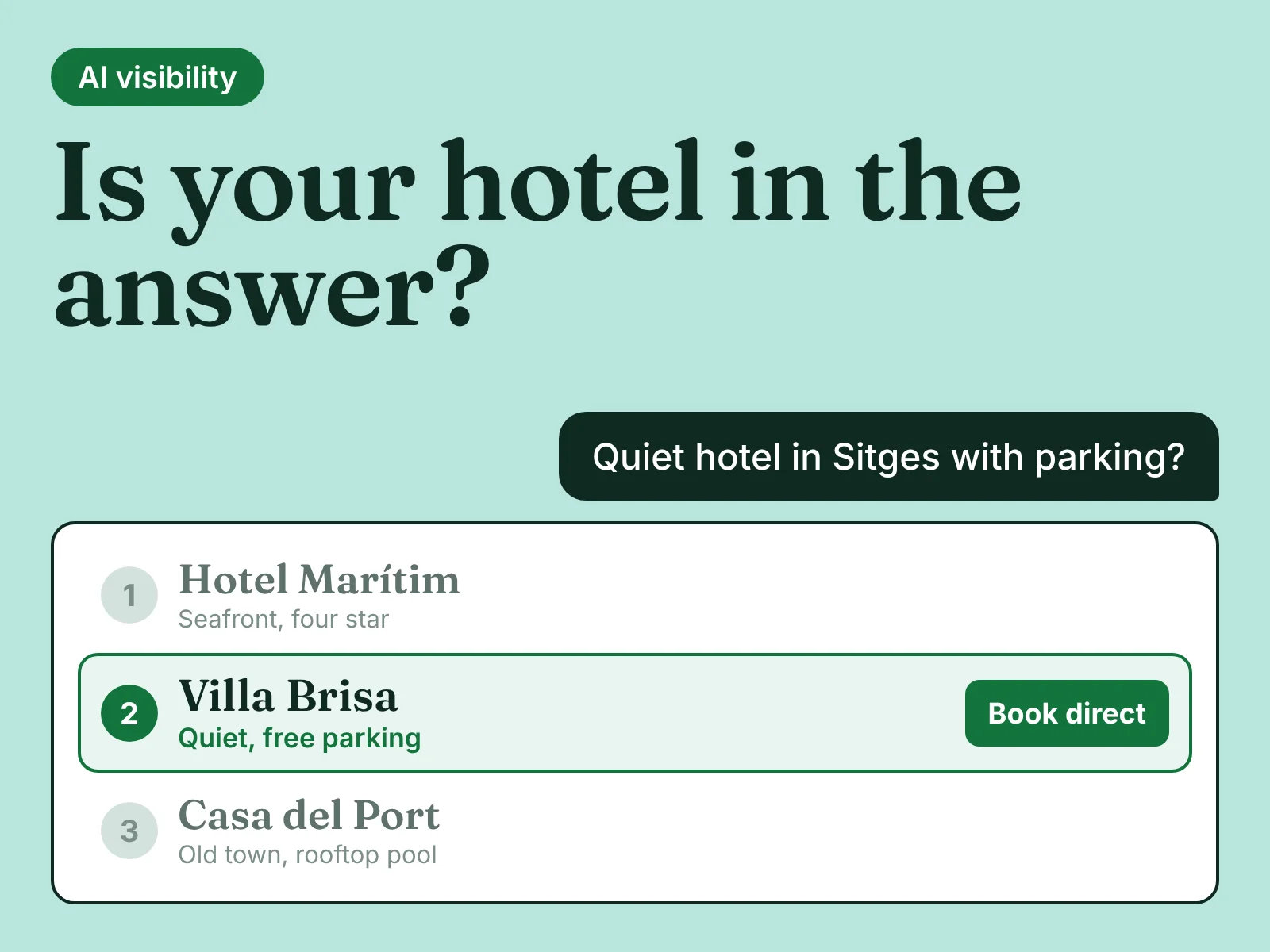
AI visibility for hotels: how to get your property recommended by ChatGPT, Gemini and Google
More guests now ask ChatGPT, Gemini or Google's AI Mode where to stay, and get a handful of names back. Most independent hotels are never one of them. Here is how AI picks hotels, and eight steps to get yours named and booked direct.
 Tribii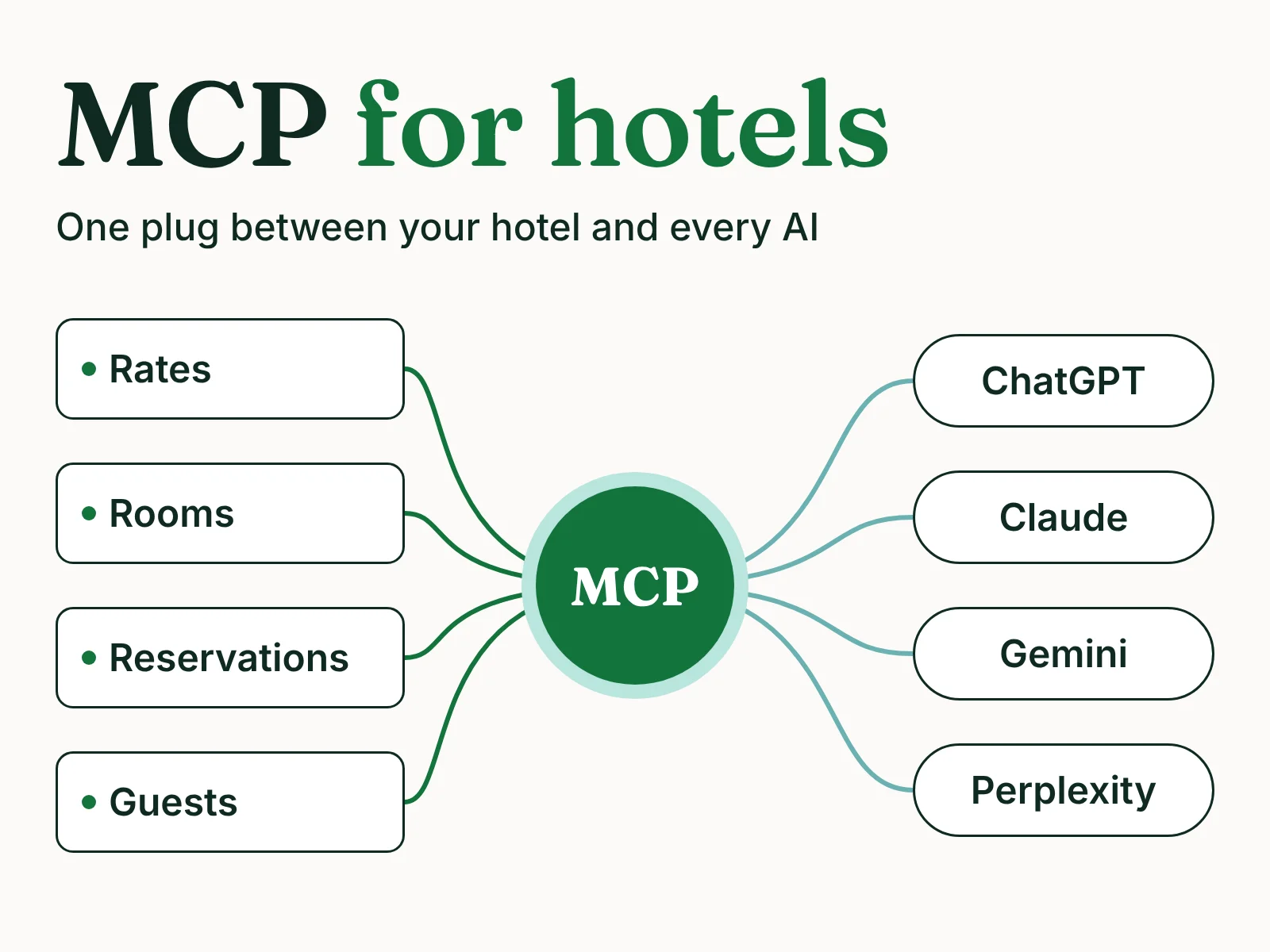
MCP for hotels: how AI assistants will find, sell and help run your property
ChatGPT, Claude and Google can now read live hotel prices, and some can take a booking. The standard behind it is called MCP. Here is what it is, what it changes for a small hotel's visibility and daily work, and what to do about it now.
Tribii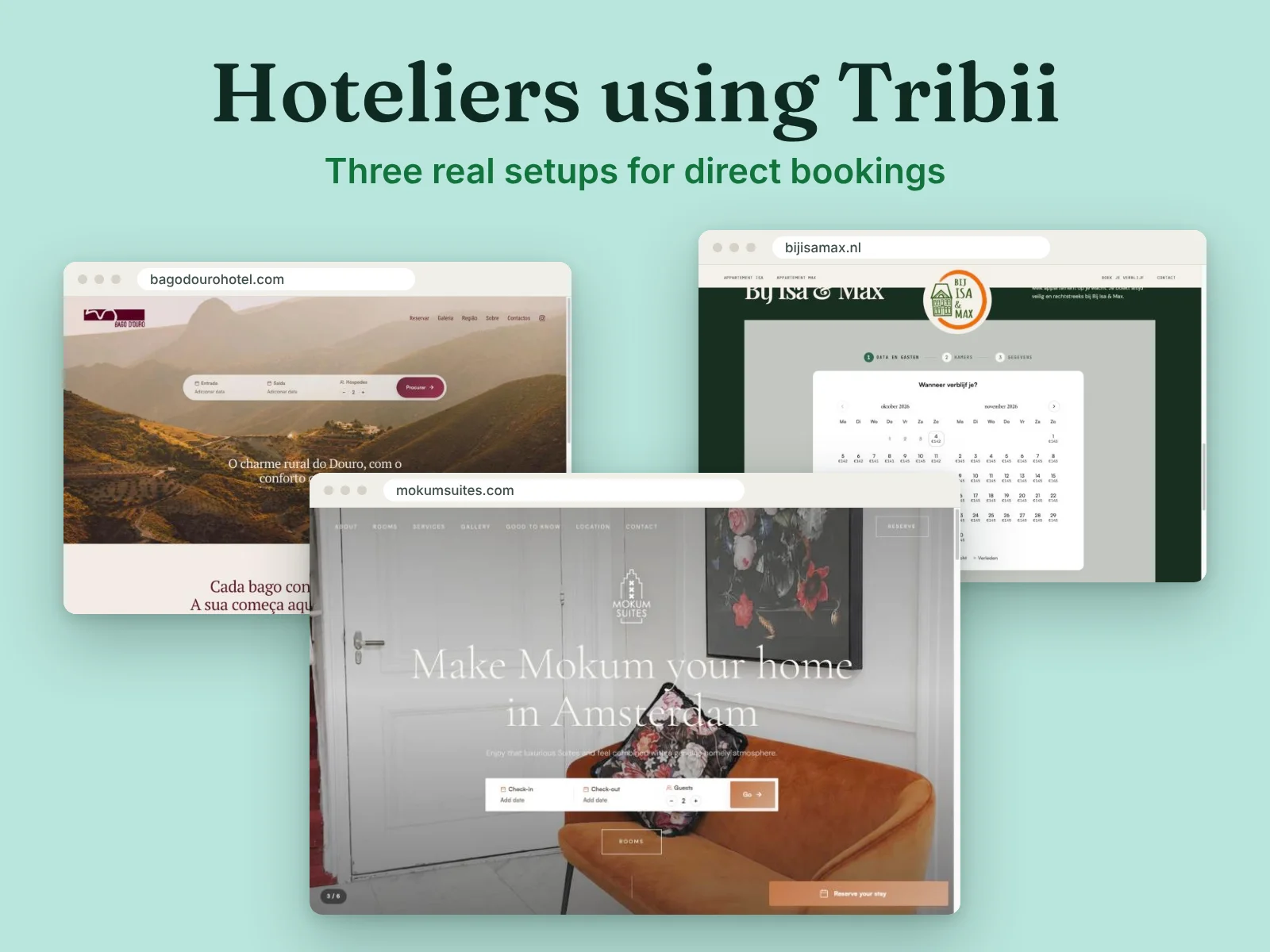
Hotels using Tribii: three real setups for direct bookings
A canal house in Amsterdam, a village guest house in the Douro and two apartments in Kampen all take commission-free bookings with Tribii. Each one set it up differently. Here is what they did, and how to choose the setup that fits your property.
Tribii