What is a hotel PMS? A plain-language guide for independent hoteliers
Not a definition from a brochure. What the software actually does between 7am and midnight at a twenty-room property, and which words mean what.
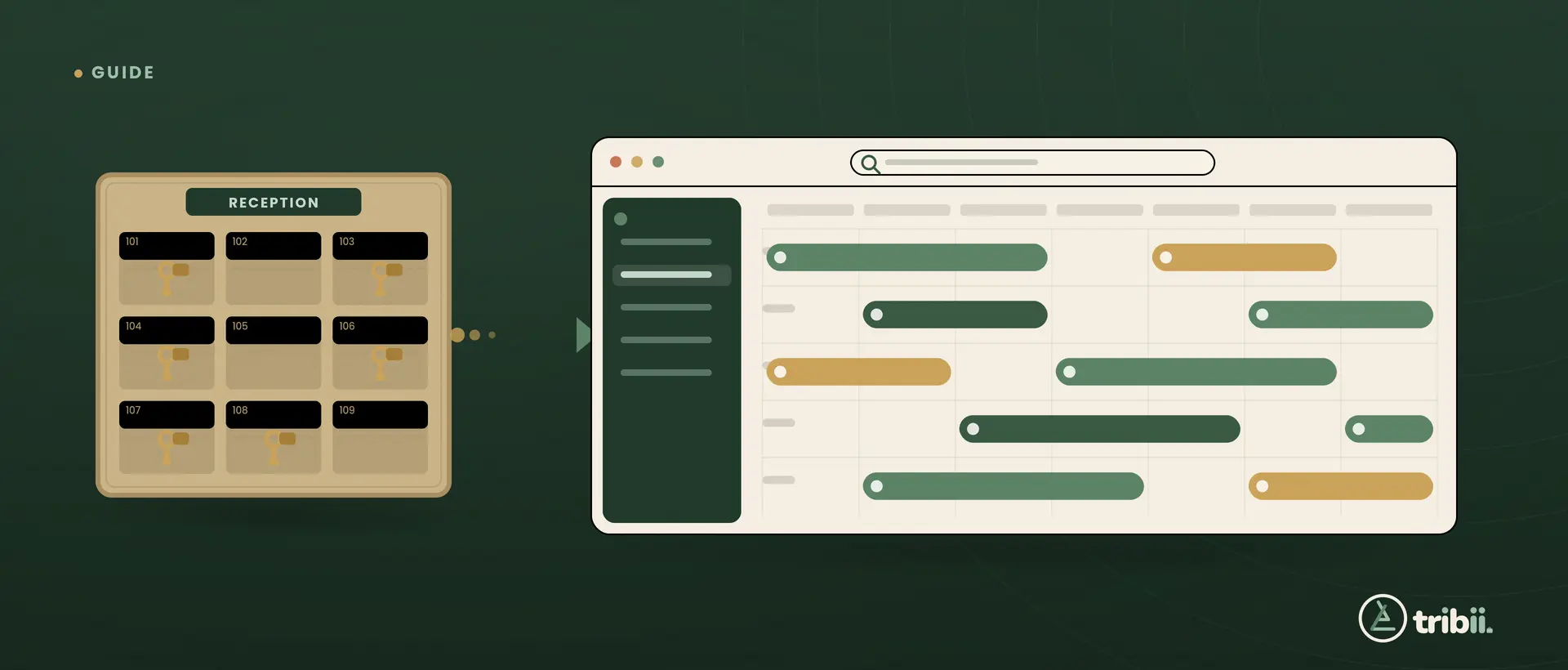
A property management system is the desk. Not the software category, the actual desk: the place where you know who is arriving, which rooms are ready, and what each guest owes.
For a hundred years that was a ledger and a board of pigeonholes with keys in them. A PMS is the same object, made queryable, so that your website can ask it questions while you sleep.
That last clause is the whole point, and every brochure buries it.
A day, hour by hour
Here is what the system is actually for, at a twenty-room property.
7am. You need today's arrivals and departures. Who is leaving, so housekeeping knows which rooms to strip. Who is coming, when, and whether anyone has requested a cot or a late check-in. In a spreadsheet this is a filter you apply by hand. In a PMS it is the screen that opens.
10am. A guest phones. They want three nights in September, with a dog. You need to know, in the ten seconds before the silence gets awkward, whether a dog-friendly room is free, what the rate is on those dates, and whether a minimum stay applies. This is the question a PMS exists to answer instantly and a spreadsheet answers by arithmetic performed under pressure.
2pm. A booking arrives from your website while you are changing a bulb. Nobody typed it in. The room is now unavailable everywhere, because availability is one number that every channel reads, rather than four numbers someone must reconcile.
5pm. Check-in. The guest's details are already there from their last stay, including the note that they liked the quiet room at the back. You add their passport for the police registration form, if your country requires one.
9pm. The guest has dinner and two drinks. Both go onto their folio, which is the running tab attached to their stay. Nobody writes it on a napkin.
Checkout. The folio becomes an invoice. The invoice is numbered, sequential, and compliant with whatever your tax authority requires. The payment is recorded against it. Month end is now a report rather than an archaeology dig.
Every one of those is a thing you already do. The PMS is the difference between doing it from memory and doing it from a system that other systems can read.
The jargon, decoded
Folio. The running bill attached to a guest's stay. Room, dinner, the minibar, the city tax. It becomes the invoice at checkout.
Room rack. A visual grid of rooms against dates. Each block is a reservation. It is the single most useful screen in hospitality and the reason people love or hate a PMS.
Night audit. The end-of-day close. Posting room charges, rolling the business date forward, reconciling the day's payments. Historically a person who worked at 3am. Now, ideally, a routine that runs itself.
Channel manager. Keeps availability in sync across OTAs, and brings their bookings back to you in one inbox, so nobody retypes them. Sells rooms on other people's websites. It is not a PMS and it does not replace one.
Booking engine. Takes reservations on your own website. Sells rooms on your website. Also not a PMS, though the good ones read from it.
OTA. Online travel agency. Booking.com, Expedia, and the rest. They bring guests and take 15 to 25% of the reservation.
Rate plan. A price with rules attached. Non-refundable, breakfast included, minimum three nights. Most pricing confusion in small hotels is really rate-plan confusion.
Restriction. A rule that stops a booking. Minimum stay, closed to arrival, closed to departure. Powerful and easy to misuse.
PMS, then, is the system holding the rooms, the rates, the reservations, the guests and the money. Everything else in the stack reads from it or writes to it.
What a small property actually needs
The category is enormous and most of it was built for hotels with departments. At under 30 rooms, the list of things you truly need every day is short:
- One calendar every member of staff can see, at once, without a file being open on someone's laptop.
- Availability that is computed, not remembered. This is what prevents double bookings.
- Rooms, rates and restrictions defined once and used everywhere.
- Guest profiles that persist, so the second stay is warmer than the first.
- Folio and invoicing attached to the reservation, with whatever your country requires for tax.
- An address your website can query, so a guest at 11pm can book without you.
That last one is the item that pays for the other five. A PMS that cannot answer your website's questions leaves you with a brochure for a website, and a brochure sends the guest back to the OTA to complete a purchase that had already been decided. If you take one idea from this article, take that one. Read more about how the free booking engine and the PMS fit together, because separating them is the mistake the market keeps selling.
Things you probably do not need on day one: housekeeping modules with role assignment, night audit automation, per-department stock and budgets, a revenue autopilot. These are real features that real properties use, and you will know when you need them, because a person will be doing the job by hand and complaining.
How to choose one, briefly
- Check the free tier's limit, and whether the booking engine is inside it. If the booking engine is above the line, the free tier is an advert.
- Ask whose payment account the guest pays into. Yours means no per-reservation fee is structurally possible. Theirs means read the processing rate.
- Try the arithmetic screen. Open the calendar and try to answer the 10am dog question. If it takes more than ten seconds, it will take more than ten seconds forever.
- Ask how you leave. Export format, before you sign up, not after.
- Match the depth to your staff count. Software built for shift handovers is a tax on a property run by two people.
Tribii's PMS is free forever up to 20 rooms and covers exactly the six-item list above: reservations and calendar, rooms and rates, guest profiles, inventory and restrictions, invoicing, and a booking engine your website can use. The front desk, housekeeping, self check-in, night audit and the channel manager are on the paid tiers, which is where they belong, because a twenty-room guesthouse does not need them and should not pay for them.
If you want to see what setting one up looks like, how it works walks through the five steps from an empty property to taking direct bookings. It fits in an afternoon.
The honest summary
A PMS is the desk, made readable by machines. It holds the rooms, the rates, the guests and the money, and it answers the question "is that room free" for everyone who asks, including your own website at midnight.
At under 30 rooms you need six things from it, and the sixth is the one that earns money. Everything past that is depth you buy when a person starts doing the job by hand.
*Tribii's PMS essentials and booking engine are free for properties up to 20 rooms, with 0% commission on direct bookings because guests pay through your own Stripe account.*

Tribii
The free booking engine for independent hoteliers. Editorial notes.
More for the kitchen table.
OTA terms explained: a plain-language glossary for independent hotels
Commissionable rate, net rate, merchant model, narrow parity. The words in your OTA contract, explained in plain language, with what each one means for your money.
 Tribii
Booking.com Genius and Preferred Partner: what they really cost a small hotel
Genius and Preferred Partner are sold as growth tools. Both are also a price. Here is what each one costs an independent hotel, how to test whether it pays, and what to decide before 2027.
Tribii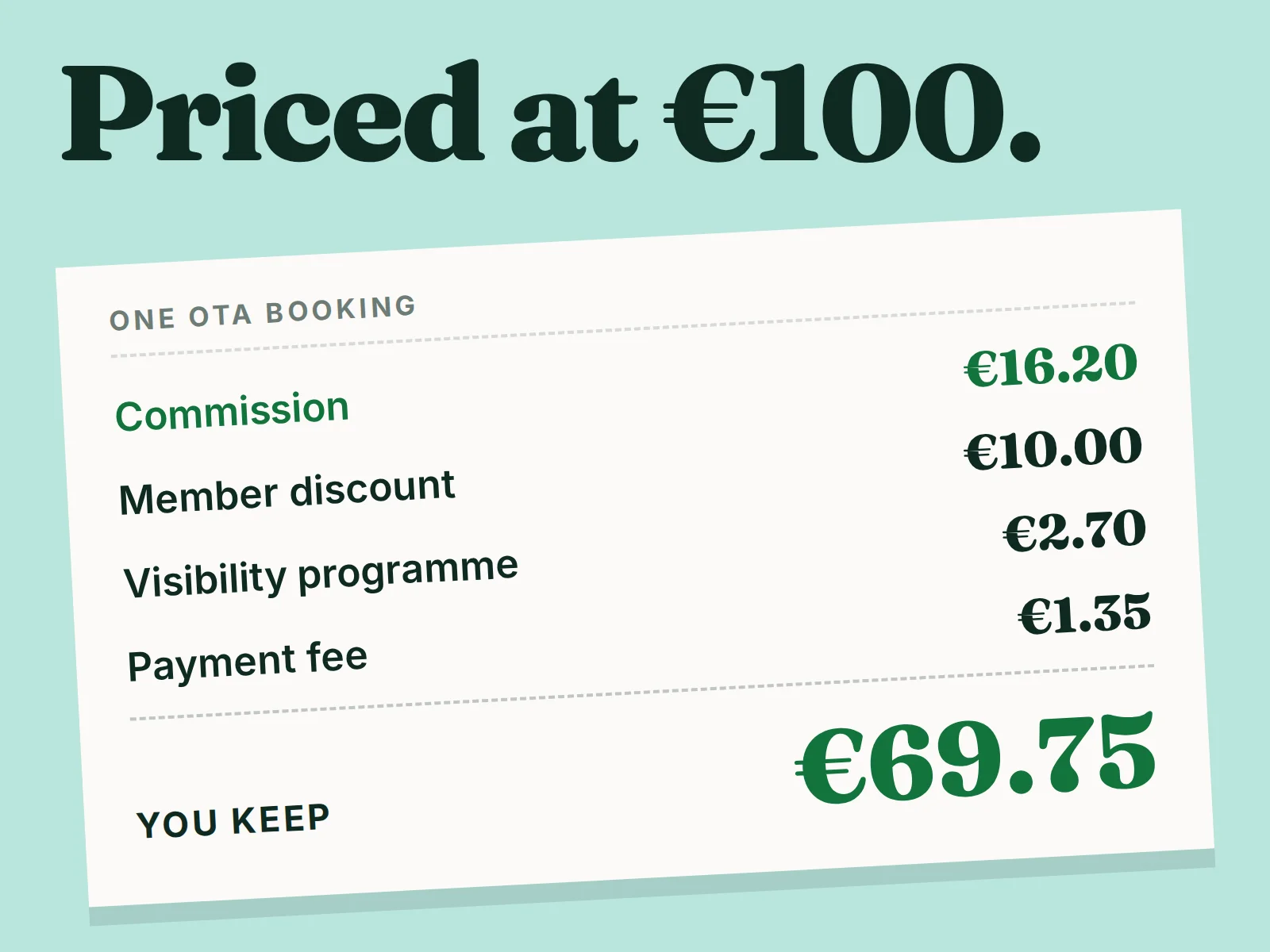
The real cost of an OTA booking: commission is only the first line
Most hoteliers know their commission rate. Few know their effective rate. Here are the other lines on every OTA booking, and how to work out what a room really costs you to sell in 2027.
Tribii