Revenue management for small hotels: what the software does, what it costs and when you need it
Revenue management means the right price for every night and channel. Here is what the software does, what it costs in 2026, and a weekly routine for small hotels that are not ready for it yet.
Ask ten small hotel owners how they set tonight's price and you will hear the same answer ten ways: last year's rate card, a look at the place down the road, and a gut feeling on Thursday afternoon. That works more often than software vendors admit.
It also leaves money on the table. Nights that sell out early were probably too cheap, and nights that never fill were often priced as if it were still summer.
Revenue management is the habit of fixing that, night by night. Hotel revenue management software promises to do it for you, but some of it suits a 20 room property and some assumes a revenue team. Here is what it means at your size, what the software costs in 2026, and a routine you can start on Monday.
The short answer
Revenue management means charging the right price for each night and each channel, based on demand, how fast dates are filling, how far ahead guests book, local events, competitors and length of stay. Revenue management software for hotels watches those signals, recommends or sets prices, and sends them to your booking engine and channel manager.
In October 2026, flat entry plans aimed at independents start at around €99 to €119 a month, tools priced per room list about US$20 per room per month before volume discounts, and enterprise systems such as IDeaS and Duetto are quote based. Under about 10 rooms, or with steady demand and one or two channels, a weekly manual routine usually does the job. Between 10 and 40 rooms, it depends on how volatile your demand is and how much time you have.
What revenue management means at 10 to 40 rooms
At a large hotel, revenue management is a department. At yours, it is decisions you already make, done more deliberately. Every term below is something you can see in your own calendar.
Occupancy. The share of your rooms sold on a night. Sell 15 of 20 rooms and occupancy is 75%.
ADR (average daily rate). Room revenue divided by rooms sold. Fifteen rooms bringing in €1,650 gives an ADR of €110.
RevPAR (revenue per available room). Room revenue divided by all your rooms, sold or not. The same night gives €1,650 divided by 20, or €82.50. It rewards price and occupancy together.
Pickup. New room nights booked for a future date since you last looked. If next Saturday had 8 rooms booked last Monday and has 12 today, pickup is 4.
Pace and lead time. Pace compares what is on the books now with the same point last year. Lead time is how far ahead guests book.
BAR (best available rate). Your standard public price for a night, the one other rates are built from. Our glossary of OTA terms covers rate plans and the rest of the extranet vocabulary.
Length of stay restrictions. Rules such as a two night minimum, or closed to arrival on a Saturday. They protect busy nights, but cost you bookings on nights that are not busy.
Comp set. The three to eight properties a guest would genuinely compare you with, not simply the nearest hotel.
Forecast. Your best estimate of where each future date will end up, from what is on the books, pace and history.
Illustrative example: 15 of 20 rooms at €110 gives €1,650 and a RevPAR of €82.50. Eighteen rooms at €95 gives €1,710 and a RevPAR of €85.50. The cheaper night earns €60 more, but means three more rooms to clean and, through an OTA, more commission. That is why the real cost of an OTA booking belongs in every pricing decision.
What the software does, and what it does not
Hotel revenue management tools go by many names: hotel rate management software, yield management software, revenue optimisation software, or simply an RMS. Under the labels, most do the same five jobs.
Rate recommendations or automatic updates. The software suggests a price for each date and room type, or sets it automatically within limits you choose.
A demand forecast. Hotel forecasting software projects occupancy and revenue for future dates from your bookings, pace and history, and updates as bookings arrive.
Market and competitor data. Most tools show what your comp set charges, plus some signal of wider local demand. This is the hardest part to copy by hand.
Alerts. A message when a date suddenly picks up, when competitors move sharply, or when a date is pacing behind last year.
Pushing rates out. The software sends prices to your PMS, channel manager or booking engine, so one change reaches your website and the OTAs. Our comparison of a channel manager and a booking engine explains which tool does which job.
Many tools now call their engine AI. What matters more is whether each recommendation is explained, whether you can set limits, and whether it connects to your systems. Our overview of AI tools for hotels covers where else AI is turning up.
What the software does not do matters as much. It does not fix a website that loses guests at the booking step, it does not know about the wedding next door unless you tell it, and it does not replace your judgement.
It also only controls your own price. In the HOTREC European Hotel Distribution Study 2026, 51% of hotels said OTAs undercut their prices frequently or occasionally, up eight percentage points since 2023. Checking what guests actually see stays part of the job, and our guide to pricing your direct rate now that parity clauses are gone in Europe covers the direct side.
A weekly routine for properties not ready for software
You can do most of what an RMS does with a spreadsheet, a calendar and an hour every Monday. The point is consistency: the same checks, every week, written down.
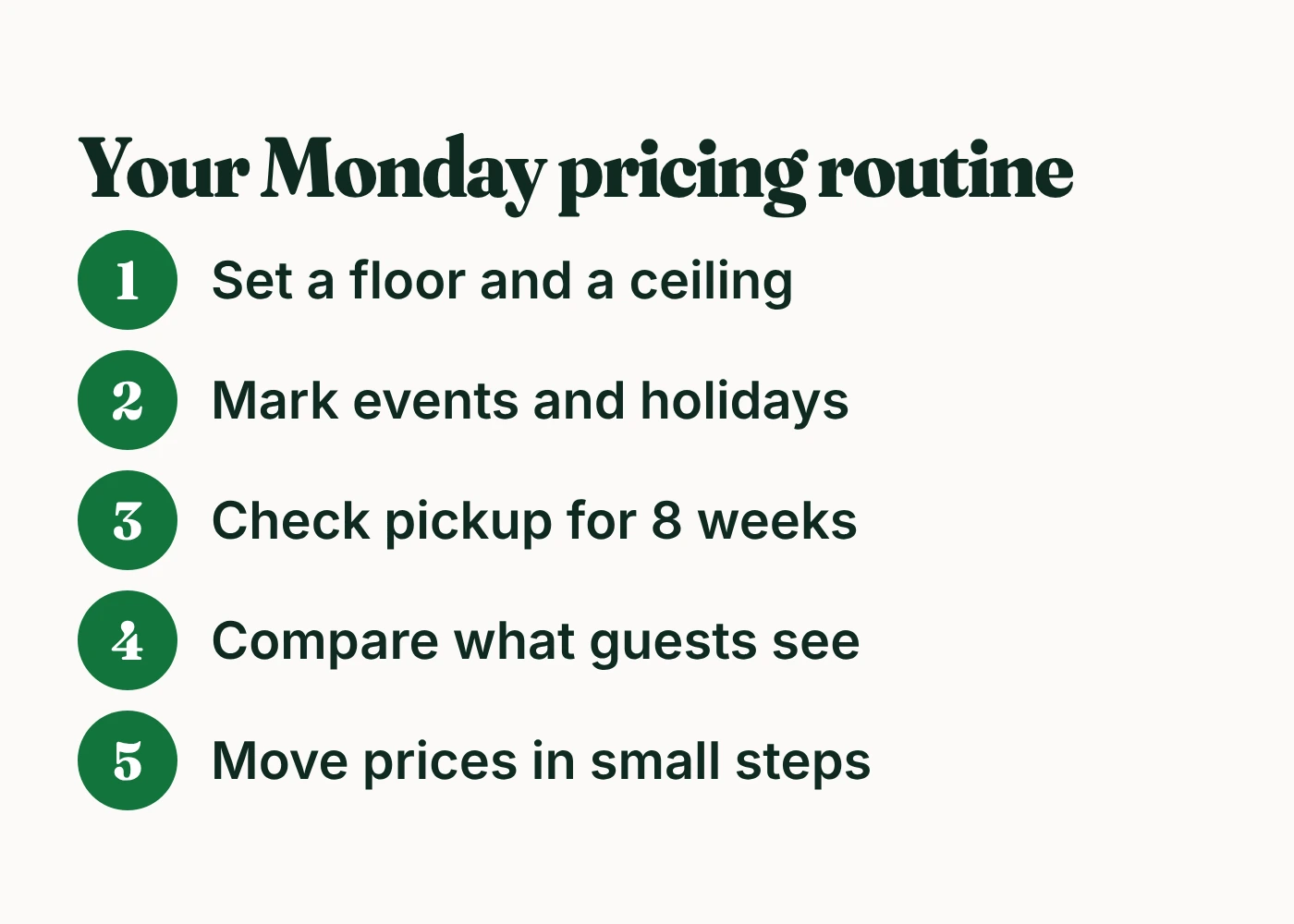
1. Set a floor and a ceiling. For each room type, write down the lowest price you will accept and the highest you will charge. The floor covers your costs and commission. The ceiling keeps you inside the range guests compare.
2. Mark the calendar. Every quarter, add events, trade fairs and school and public holidays for the next six months. Your tourist office and local venues are the best sources.
3. Check pickup every Monday. For the next eight weeks, note the rooms booked for each night and compare with last Monday and the same point last year.
4. Look at what guests see. For any unusual date, check what three to five comparable properties charge for the same stay, on their websites and on the OTAs. Check your own listing too.
5. Move prices in small steps. Raise dates that are picking up faster than usual by 5 to 10%, and hold slow dates at or above your floor. Change one thing at a time so you learn what worked.
6. Use minimum stays only where they help. Set a minimum stay on peak nights you are confident of filling, and lift it two to three weeks out if the date is not filling.
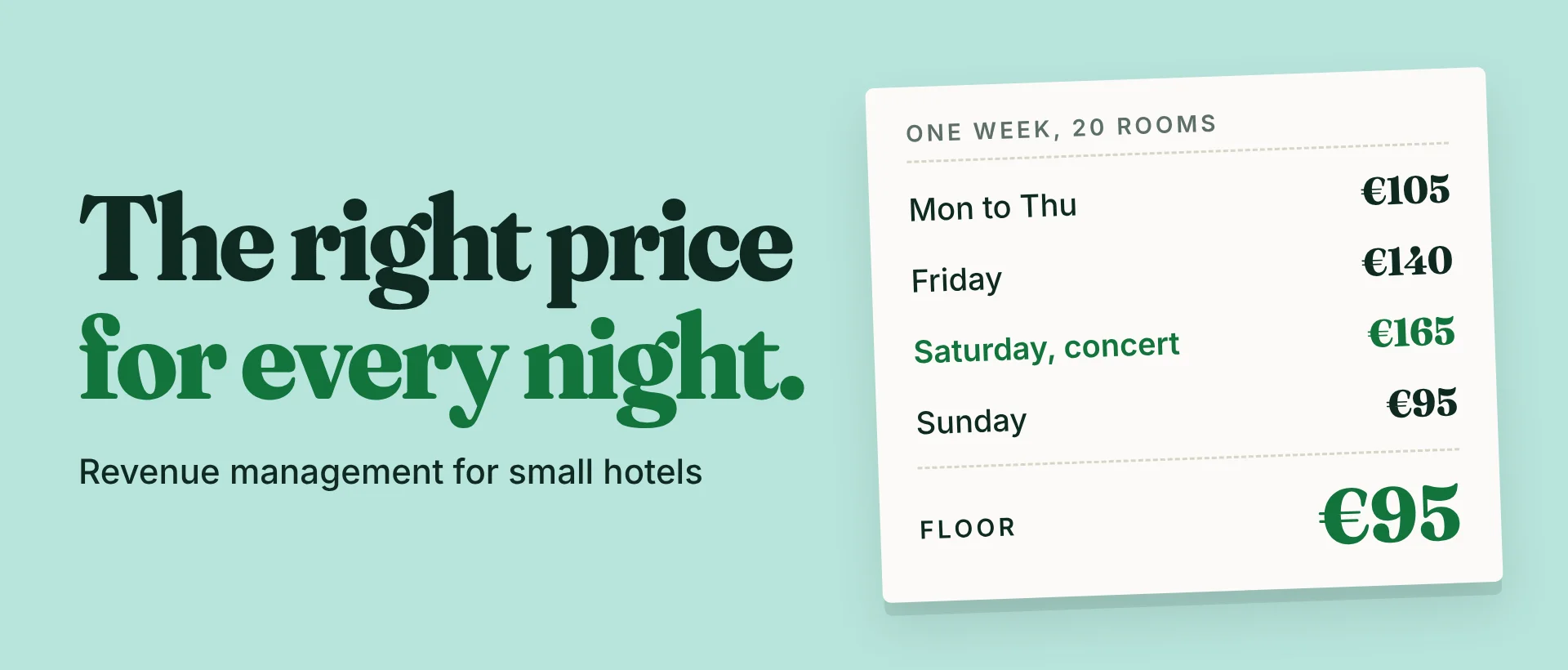
Illustrative example: a 20 room guesthouse has a midweek rate of €105, a floor of €95 and a ceiling of €180. On Monday the owner sees that a Saturday five weeks out has 12 rooms booked, against 8 a year ago, and a concert has just been announced. She raises that Friday to €140 and the Saturday to €165, adds a two night minimum on the Saturday, and drops the Sunday to €95 because the town empties after the concert.
A Tuesday three weeks out has only 4 rooms booked against 7 last year. She keeps it at €105 and adds a breakfast offer on her website instead of cutting to the floor. For quiet weeks like that, filling the low season with direct bookings usually goes further than a price cut.
What revenue management software costs in 2026
Prices change often, and more vendors now quote rather than publish. Below are the figures we could verify in October 2026, from vendor pages first and directories where vendors no longer publish.
Lighthouse. Its page for independent hotels lists a Starter plan, pricing only, from €99 a month. Plus at €129 and Complete at €189 add channel management, direct bookings and, on Complete, reservation management.
PriceLabs. Its hotel plans page lists US$19.99 per room per month in Europe, discounted from the second room onwards, or an alternative plan at 1% of booking revenue. The cost scales with your rooms.
RoomPriceGenie. Its pricing page now asks you to contact sales, with prices set by room count and features on an annual commitment. Directories still show older figures: Capterra lists pricing from US$95 a month, and G2 lists a Starter plan at €119 a month billed annually, last updated in November 2024.
Atomize. Mews acquired Atomize in November 2024, and its engine now powers Mews RMS, which has no public price. Capterra still lists Atomize from €299 a month.
IDeaS and Duetto. Both market to independent hotels as well as large groups, and neither publishes prices. Their websites lead to a demo request and a quote.
Put together, published entry prices from dedicated hotel revenue software sit between about €100 and €300 a month, or €1,200 to €3,600 a year. Per room pricing depends on your size, and higher tiers cost more. Before you sign, check whether VAT is included, which PMS or channel manager it connects to, what extras cost (PriceLabs charges US$1 per room per month for each additional daily sync), and how long the contract runs.
Illustrative example: a 20 room hotel at 65% occupancy sells about 4,745 room nights a year. A tool at €150 a month costs €1,800 a year, so it pays for itself if it adds about 38 cents to every night sold, or around 17 extra room nights at €110. The harder question is whether you would have made the same moves yourself.
When you need it, and when you do not
Five questions decide whether revenue management software for small hotels is worth it for you. The thresholds are rules of thumb.
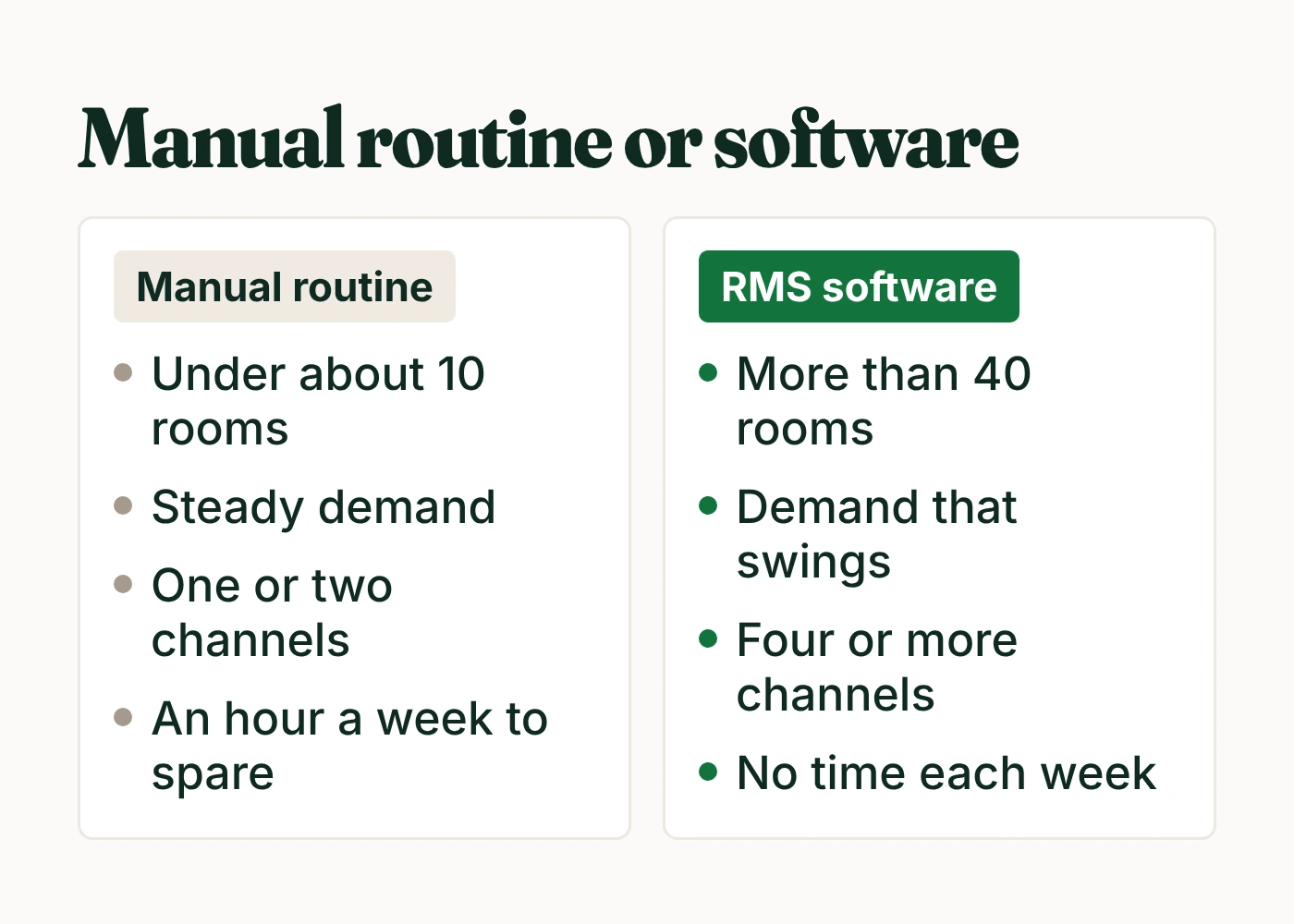
How many rooms do you have? Below about 10 rooms, a manual routine usually captures most of the value. Between 10 and 40, either approach can work. Above 40, or with two or more properties, there are too many dates and room types to watch by hand.
How often do you change rates today? If you set seasonal rates once a year and rarely touch them, start with the routine above. Software suits owners who want to adjust prices but lack the time.
How volatile is your demand? A city property with trade fairs and concerts swings far more than a countryside B&B. The more demand jumps around, the more an RMS earns its fee.
How many channels do you sell on? With your own website and one OTA, changing a price takes a minute. Across four or five channels, automatic updates through a channel manager save time and mistakes.
How much time do you have? If nobody can give pricing an hour every week, software is the more reliable choice even at 15 rooms. If you enjoy pricing and do it consistently, you may not need it for years.
If three or more answers point towards software, trial two or three tools on recommendations only for a month, and compare their calls with yours before you switch on automatic updates.
Where Tribii fits
Whatever you use, the job is the same: see what is on the books, set a price for each date, and get it everywhere you sell without retyping it. Any good PMS or RMS should help. Tribii's revenue tools are ours.
On the Free plan, with 20 rooms included, the basics are there: set rates day by day, plan pricing weeks ahead, bulk rate editing and reports. That is enough to make the price changes from the weekly routine above in one place.
Pro, at €55 a month with 40 rooms included, adds advanced revenue: forecast, alerts, market benchmark and price recommendations, with rules that watch demand and suggest changes. Max, at €95 a month with 60 rooms included, adds revenue intelligence autopilot, which applies those changes inside your floor and ceiling and pushes rates to Booking.com, Airbnb and other channels through its channel manager. On Max you can also price a channel higher than your website to cover its commission. The revenue management page shows how it works.
To be plain about the limits: Tribii's forecasting and autopilot work on your own Tribii rates. A dedicated RMS can still make sense for a larger or more complex property, a revenue manager who wants deeper market data, or a hotel that plans to keep a different PMS.
Common questions
What is hotel revenue management software?
Software that recommends or sets your room prices for each date based on demand, pickup, competitors and events, then sends them to your booking engine and channel manager. It is also called an RMS, rate management software or yield management software.
How much does revenue management software cost for a small hotel?
In October 2026, flat entry plans aimed at independents start at around €99 to €119 a month, per room tools list about US$20 per room per month before discounts, and enterprise systems are quote based.
Do I need a channel manager to use an RMS?
Not for recommendations. To update OTA prices automatically, the RMS usually sends them through a PMS or channel manager, so check its integrations before you sign.
Is dynamic pricing the same as revenue management?
Dynamic pricing is one part of it: changing prices as demand changes. Revenue management also covers stay rules, channel rates and forecasting.
Should I drop prices when a date is not filling?
Not straight away. Check pace against last year, stay at or above your floor, and try adding value before cutting. Deep late cuts can teach regular guests to wait.
The honest summary
Revenue management at a small property is a weekly habit: know your floor and ceiling, watch pickup, mark events, check what guests see, and move prices in small steps. Software does it faster and with better market data, and pays for itself easily when demand is volatile and time is short.
With under about 10 rooms, steady demand and an owner who enjoys pricing, start with the routine and revisit software when it no longer fits in an hour. If you sell on several channels in a busy market, a month of trials will tell you more than any price list.
Prices reviewed October 2026 from vendor websites (Lighthouse, PriceLabs, RoomPriceGenie, Mews) and from Capterra and G2 listings where vendors no longer publish prices; plans change often, so ask for a written quote. HOTREC figures are from the European Hotel Distribution Study 2026, published in September 2026. Vendor names are listed for information only, not as recommendations. The worked examples are illustrative. This is not financial advice.

Tribii
The free booking engine for independent hoteliers. Editorial notes.
More for the kitchen table.
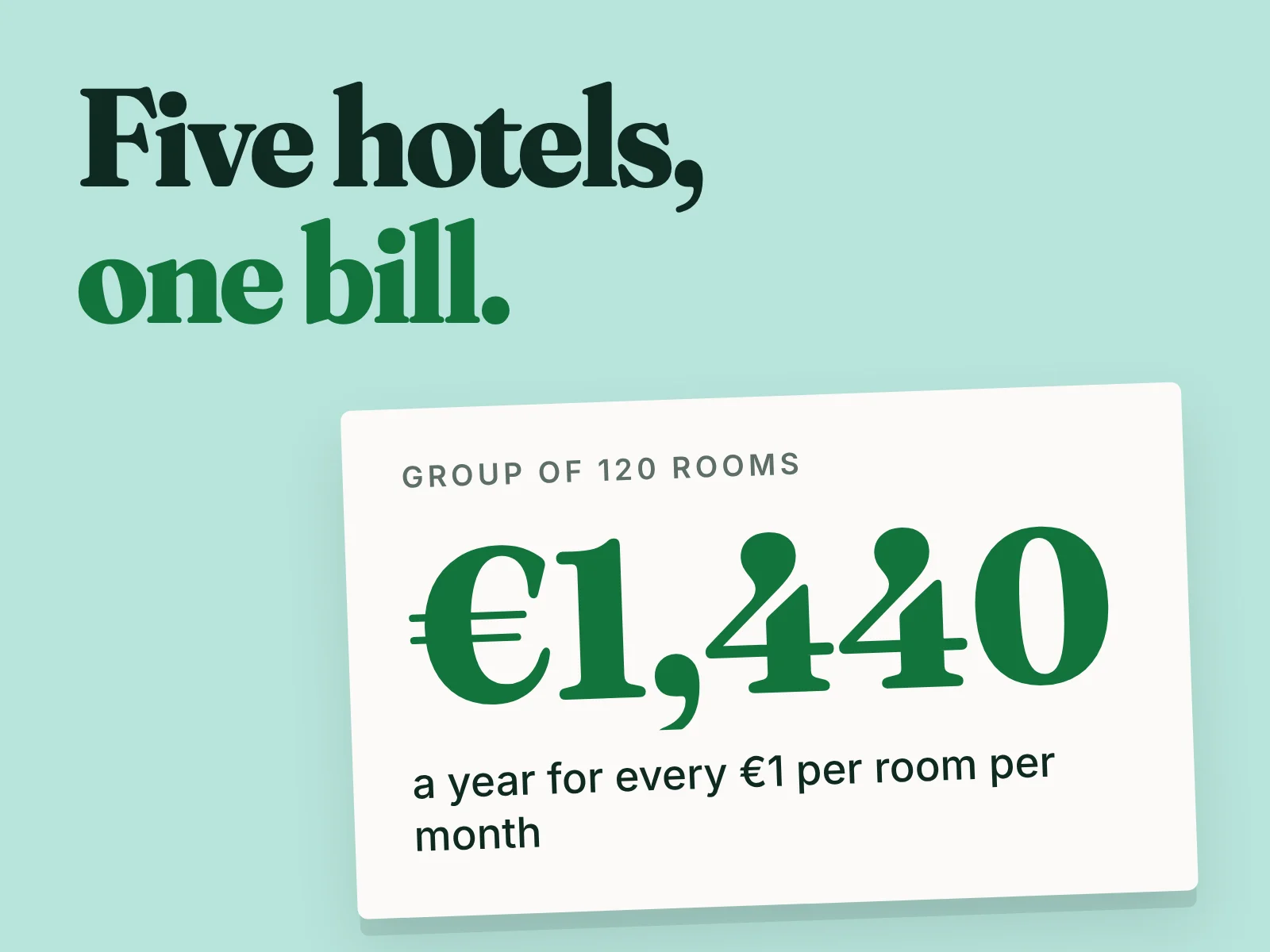
What a small hotel group really pays for its software
Group software is billed per room, per property, per module and per payment, and the subscription is often not the biggest line. What Mews, Cloudbeds, Apaleo and SiteMinder publish, a worked model and what to ask.
 Tribii
Low season without more commission: how to fill winter rooms directly
Switching on more OTA deals in winter usually means a discount and a commission on the same booking. Here is the arithmetic, and a practical playbook to fill quiet rooms directly, starting with the guests you already know.
Tribii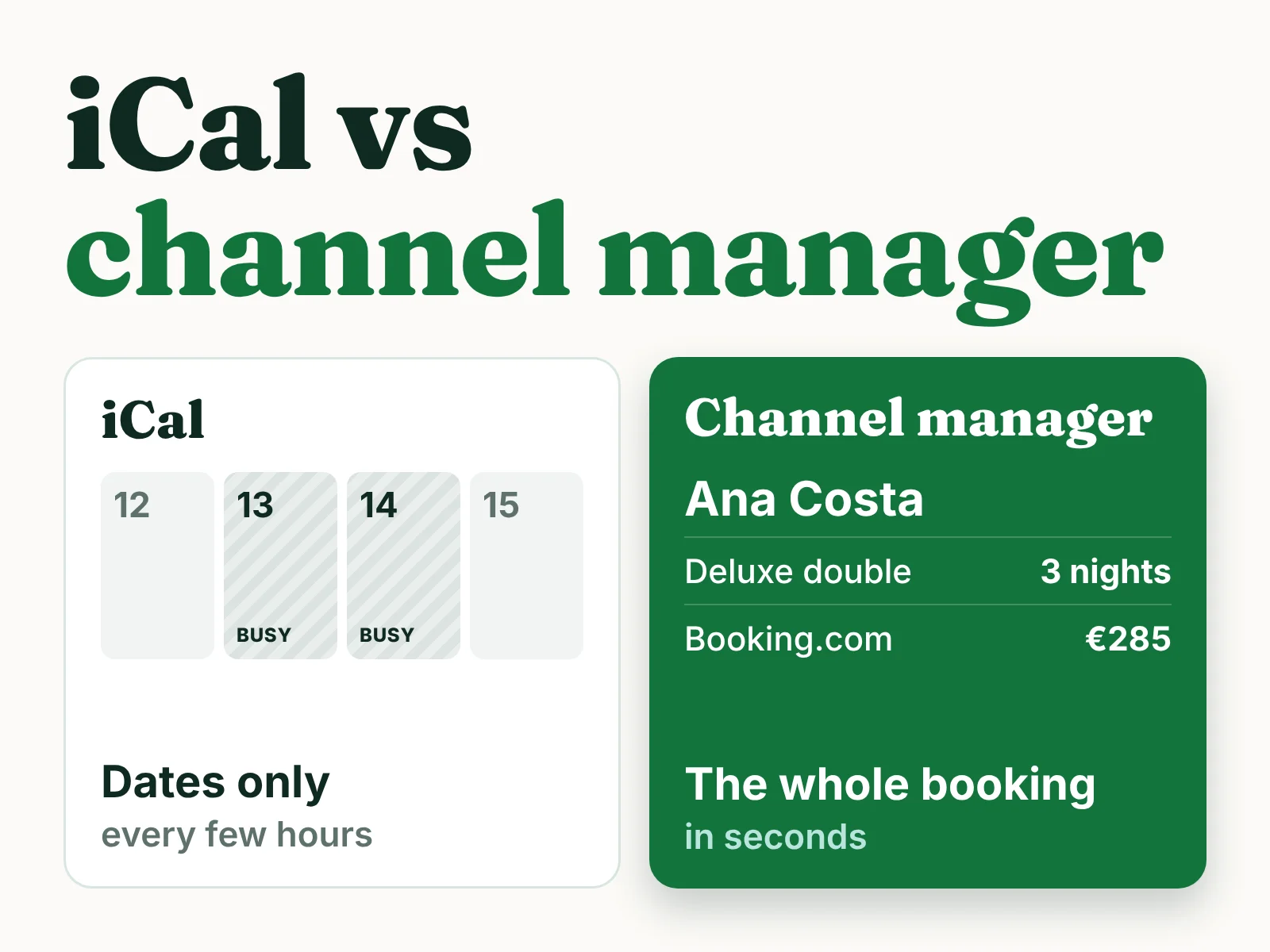
iCal vs channel manager: what really syncs, and when to switch
Both promise to keep your Airbnb, Booking.com and Vrbo calendars in step. Only one of them moves prices, rules and the booking itself. Here is what iCal really does, where it stops, and when a channel manager starts paying for itself.
Tribii