iCal vs channel manager: what really syncs, and when to switch
Both promise to keep your Airbnb, Booking.com and Vrbo calendars in step. Only one of them moves prices, rules and the booking itself. Here is what iCal really does, where it stops, and when a channel manager starts paying for itself.
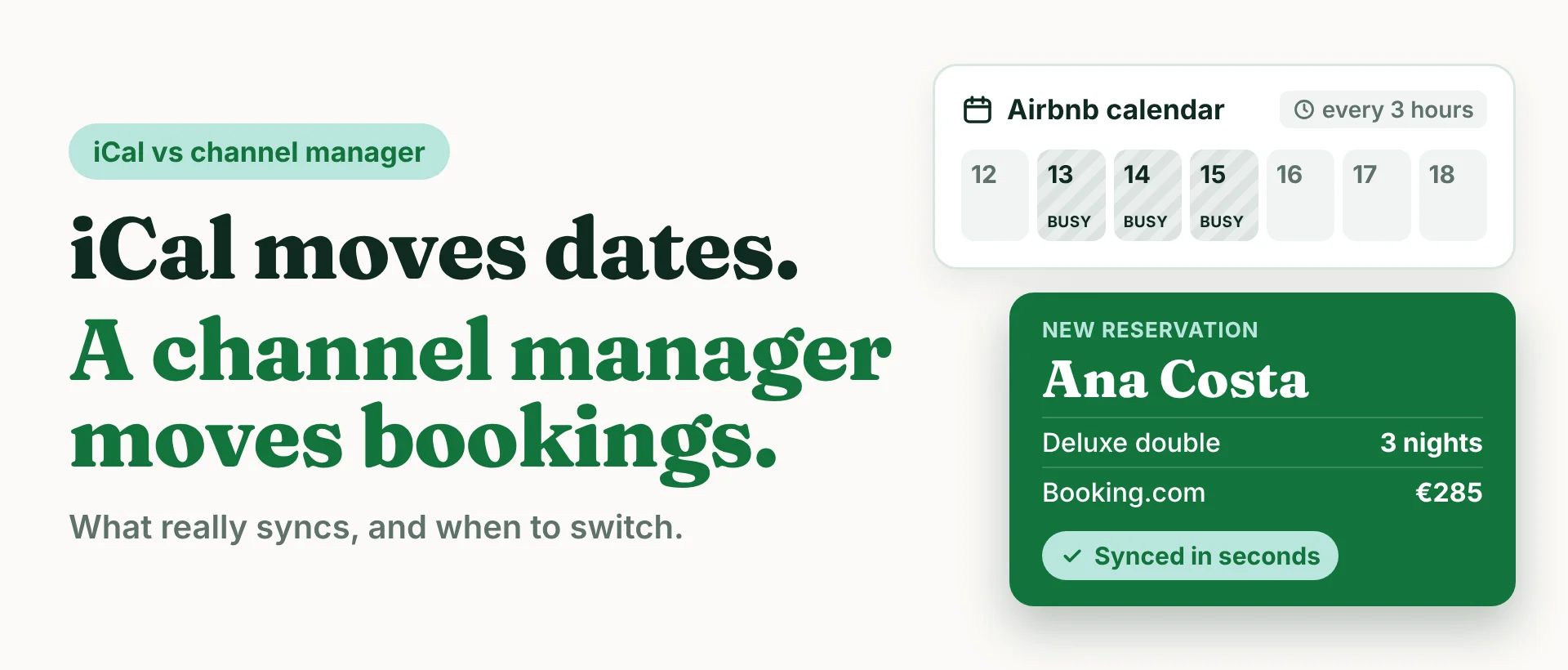
Two guests, one room, the same Saturday night. One booked on Airbnb at ten in the morning. The other booked on Booking.com at half past eleven. Both have a confirmation email, and only one of them is sleeping in your room.
If you sell on more than one site, you have probably been told to "sync your calendars". There are two very different ways to do that. iCal sync is built into Airbnb, Booking.com and Vrbo and costs nothing to set up. A channel manager is software you pay for every month. Both are sold with the same word. They do not sync the same things, and they do not do it at the same speed.
Here is what each one actually moves, where iCal stops, and how to tell which one your property needs.
The short answer
iCal sync shares one thing: which nights are taken. Each site reads your calendar link on its own timer, anywhere from every 30 minutes to every few hours, and blocks those nights.
A channel manager connects to each OTA directly. It sends your availability, rates and restrictions out, and brings complete reservations back in, usually within seconds.
iCal is a sensible start for a holiday home, or a few rooms that are each unique, sold on two or three sites. Once you sell several identical rooms, change prices often, or sell on Booking.com and Expedia together, you need a channel manager.
What iCal sync is
iCal is short for iCalendar, an open standard for sharing calendar data. It is the same format behind the .ics files that carry meeting invites, published by the Internet Engineering Task Force as RFC 5545 in 2009.
For a property, it works like this. Every listing on Airbnb, Booking.com or Vrbo gives you an export link ending in .ics. You paste that link into the calendar settings of your other sites, and paste theirs into this one. Each site then reads the links it has been given, on its own schedule, and marks the nights it finds as unavailable.
What travels is a list of dates marked busy. No guest name. No price. No number of rooms left. Just yes or no, night by night.
What a channel manager is
A channel manager is software that connects to each OTA through a direct connection the OTA provides for software partners. Instead of waiting for a site to come and read a link, it sends each change as it happens.
It also moves much more than dates. Availability, prices and restrictions such as minimum stay, closed to arrival or stop sell go out to every connected channel from one calendar. Reservations come back in complete, with the guest, the dates, the room and the price already filled in.
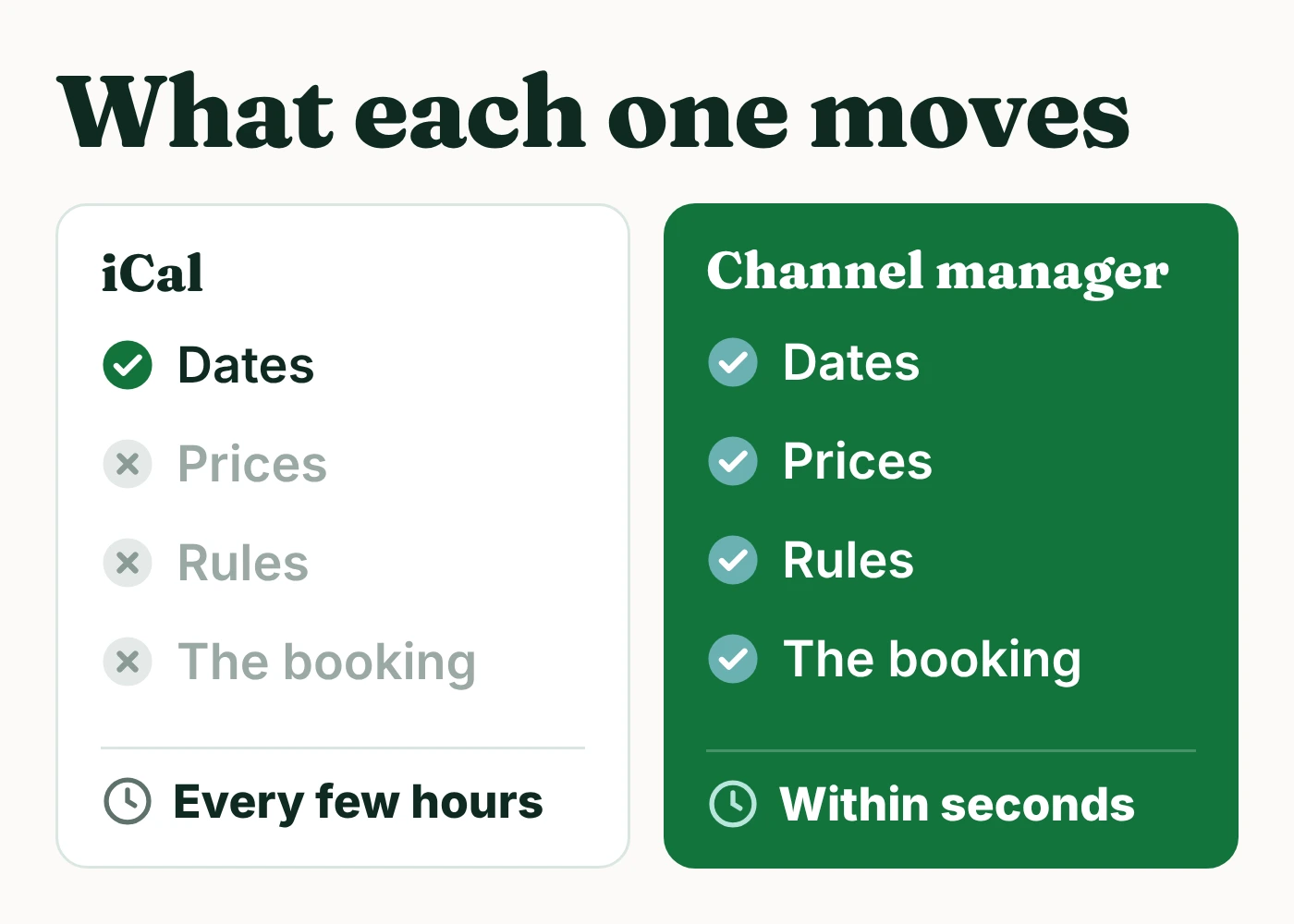
iCal moves dates. A channel manager moves the booking.
Five differences that matter
1. Speed
This is the difference that causes double bookings. Airbnb says it updates imported calendars every three hours. Vrbo says imported calendars sync every 30 minutes. Booking.com states plainly that calendars are not synced in real time.
The slowest site in the chain sets your risk. If a guest books on Booking.com at 10:00, Airbnb may not read it until 13:00. For those three hours, the same night is still for sale on Airbnb. On a quiet Tuesday in February, that rarely matters. On a festival weekend in August, it is exactly when two people book the last room.
A channel manager closes the night on the other channels within seconds of the sale.
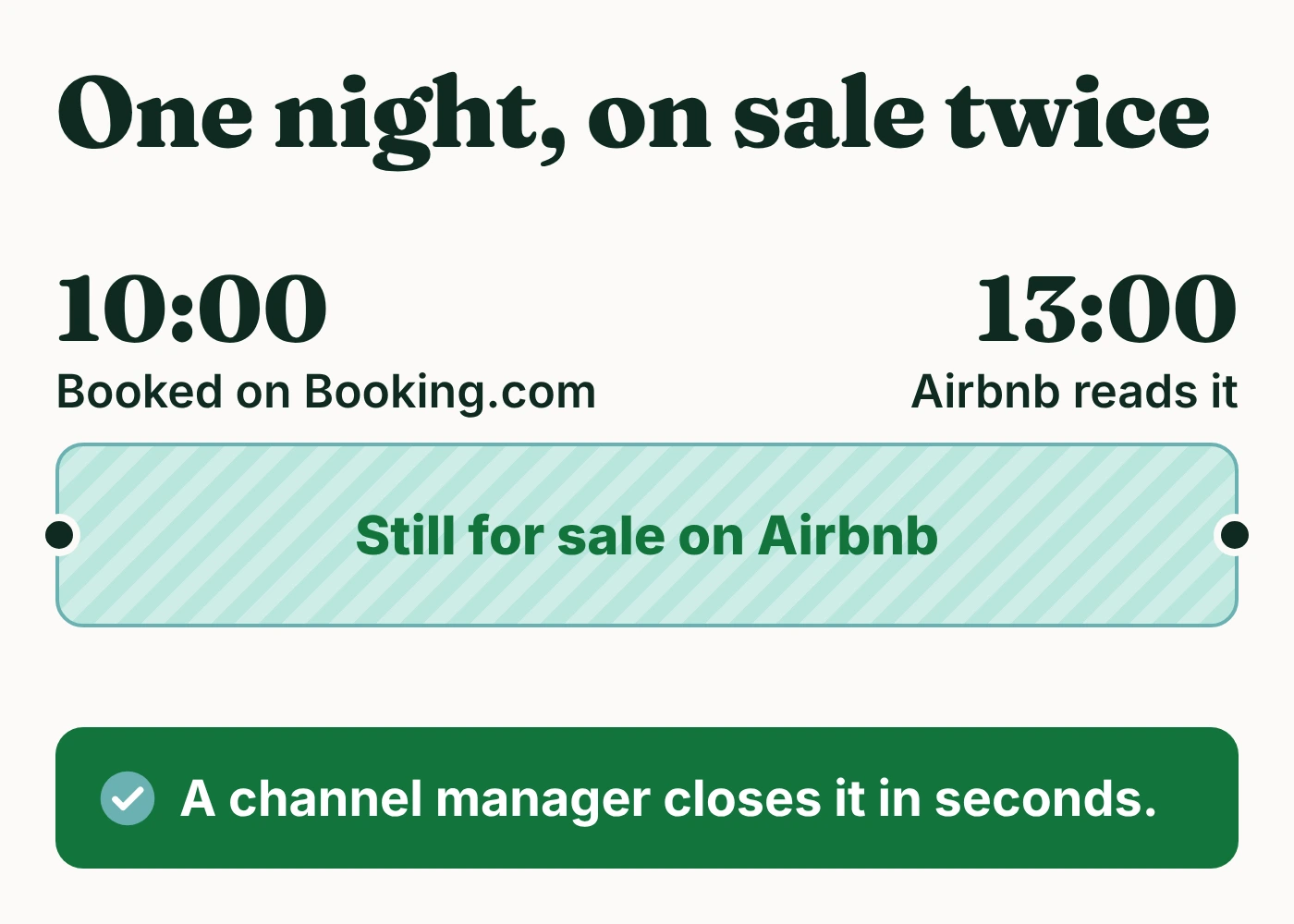
The slowest site in the chain sets your risk. Illustrative timeline.
2. Prices and rules
iCal cannot carry a price. It cannot carry a minimum stay, a closed to arrival rule or a stop sell either. Every rate change still means logging into each extranet and typing it again, and every site you forget keeps selling at last month's price.
With a channel manager you change the rate once, and every connected channel receives it.
3. The booking itself
Through iCal, an Airbnb booking reaches your system as a block of nights, not as a reservation. You still copy the guest's name, the price and who collected the payment into your own system by hand, or your reports and invoices will have a gap.
A channel manager brings the full reservation in. There is nothing to retype.
4. Rooms of the same type
This is where most hotels get caught. An iCal calendar says yes or no for each night. It cannot say "three of five doubles left".
Booking.com is explicit about it. Calendar sync is only available to properties with 20 room types or fewer and a maximum of one unit per room type, and not to properties connected through a PMS or channel manager. So a small hotel with five identical double rooms cannot use iCal with Booking.com at all. Dorm beds in a hostel run into the same wall.
A channel manager sends a number for each room type and each night, so selling six of the same room on four sites is exactly what it is built for.
5. Which channels you can reach
iCal works with Airbnb, with Vrbo, with Booking.com for properties that meet its rules, and with many smaller sites that offer an .ics link. Vrbo lets you import up to five calendars per property.
On any one channel, the two are alternatives rather than partners. Booking.com does not offer calendar sync to properties connected through a PMS or channel manager, and Vrbo's own guidance says calendar sync is for partners managing their listing in the Vrbo dashboard, not through outside software. Plan to use iCal for some sites and a channel manager for others, but never both on the same one.
What a double booking really costs
iCal is free. A double booking is not.
On Booking.com, an overbooking still carries commission, because the room was made available on the platform, and Booking.com asks you to cover the cost of relocating the guest. The only exceptions are properties live for less than 30 days, or with fewer than five overbookings in the last twelve months.
Take a room you sell at €120 on a busy weekend. The nearest comparable hotel charges €190 that night. You pay the €70 difference, perhaps a taxi, and commission on a stay you never hosted. Then there is the review, and a guest who will not book you again. One relocation in high season can cost more than several months of a channel manager. For everything else an OTA booking costs you, see the real cost of an OTA booking.
What each one costs
iCal costs nothing on the platforms themselves. It is built into Airbnb, Booking.com and Vrbo. If you want your own system in the middle as the master calendar, iCal there is usually part of a paid plan.
Channel managers charge a monthly fee, priced per property, per room, per channel or as a share of each booking. For a small independent property, published price guides put a standalone channel manager at roughly €60 to €100 a month, before the PMS and booking engine you still need. Check whether the price grows with each room, each channel or each booking before you sign.
When iCal is enough
iCal does the job if most of these describe you:
- You run a holiday home, or a few rooms that are each unique.
- You sell on two sites, perhaps three.
- You set prices once a season and rarely touch them.
- Your occupancy leaves gaps, so two bookings landing on the same night is unlikely.
- Someone looks at every calendar each day.
When you need a channel manager
Switch as soon as one of these is true:
- You sell several rooms of the same type.
- You sell on Booking.com and Expedia, or on three or more OTAs.
- You change prices often, or use minimum stays and closed to arrival rules.
- Your busy dates sell out fast.
- You have had a double booking in the last year, or you hold rooms back because you do not trust the sync.
- You are tired of retyping every OTA reservation into your own system.
For the wider question of whether a small property needs one at all, see Do small hotels need a channel manager? And if you are still choosing your first piece of software, our guide to channel manager vs booking engine explains which comes first.
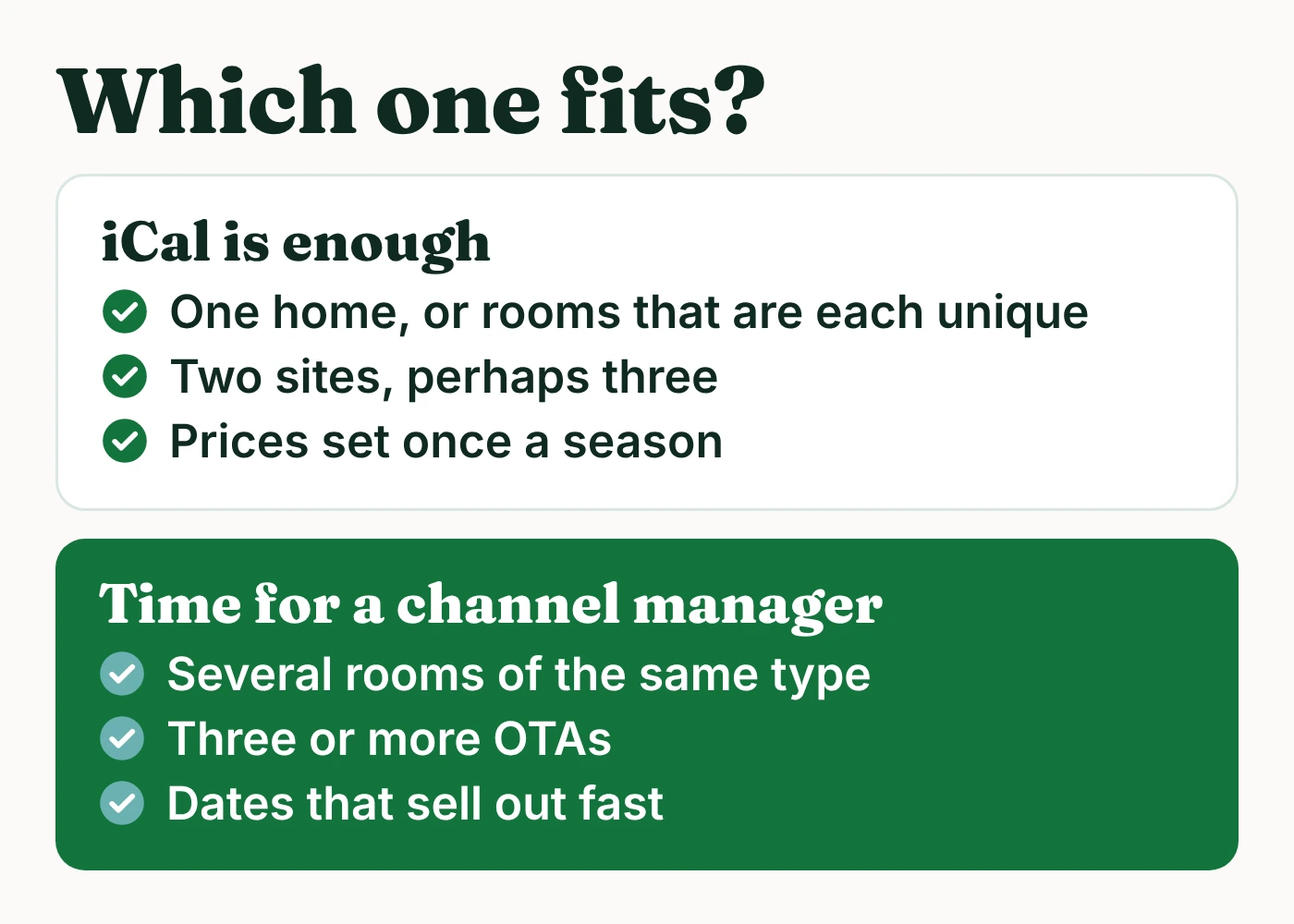
Most properties outgrow iCal the day they add identical rooms or a third OTA.
How to make iCal safer while you use it
If iCal is the right fit for now, a few habits close most of the gap.
Sync in both directions. Every site must import every other site's calendar. A link in one direction only protects you half the time.
Use one hub. Let your own system hold the master calendar and link each site to it. Direct bookings and the dates you close yourself then reach every site too.
Refresh before busy dates. Airbnb lets you refresh an imported calendar, and Booking.com has an Import now button. Use them before a holiday weekend rather than waiting for the timer.
Leave a little room. In peak weeks, a minimum stay or closing arrivals on the day itself lowers the chance that two late bookings collide.
Check your links. A link can stop working quietly after a listing change. Look at each site's sync status once a month.
Where Tribii fits
Tribii offers both, and says plainly which is which.
iCal calendar sync is included with Pro, from €55 a month. Link each Airbnb, Booking.com or Vrbo listing, or any site with an .ics link, to a room type. Tribii reads your linked calendars every five minutes and holds those dates on your rack, labelled Held by iCal, until you turn each one into a full reservation in a couple of clicks. If two sites sell a night you have no room for, Tribii flags the overlap instead of hiding it. Your taken dates go back out too, though each site still reads them on its own schedule, Airbnb about every three hours.
The channel manager is included with Max, from €95 a month, with no fee per booking and no commission. It connects Booking.com, Airbnb, Expedia and Vrbo among others. Availability, rates and restrictions go out from one calendar, and reservations come back in complete, usually within seconds. You can hold the last room back for direct guests, and every night Tribii checks what the channels are holding against your own calendar.
Both run on the same calendar as Tribii's free booking engine, so a booking on your own website reaches every linked site too. Moving from Pro to Max keeps your rooms and reservations exactly where they are, and Max still includes iCal for any small site the channel manager does not reach. Every plan is on the pricing page.
Common questions
What is the difference between iCal and a channel manager?
iCal shares which nights are taken, through a calendar link each site reads on its own schedule. A channel manager connects to each OTA directly and moves availability, rates, restrictions and complete reservations, usually within seconds.
Is iCal sync real time?
No. Airbnb updates imported calendars every three hours, Vrbo every 30 minutes, and Booking.com says its calendars are not synced in real time. A night can stay open on one site for hours after it sells on another.
Can iCal sync prices or minimum stays?
No. iCal only carries dates. Prices, minimum stays and other rules must be changed on each site by hand.
Can a hotel use iCal with Booking.com?
Only with 20 room types or fewer, one unit per room type, and no PMS or channel manager connected to Booking.com. A hotel with several identical rooms does not qualify.
Can I use iCal and a channel manager at the same time?
Yes, for different sites. Use the channel manager for the OTAs it connects, and iCal for smaller sites it does not reach. Never connect the same site through both, or its bookings arrive twice.
Does iCal prevent double bookings?
It reduces them, but it cannot rule them out. Two bookings for the same night made inside the delay between sites will both go through.
The honest summary
iCal shares dates. A channel manager shares the business: availability, prices, rules and the booking itself, in seconds rather than hours.
Start with iCal if you have a holiday home or a handful of unique rooms on two sites. Move to a channel manager when you sell identical rooms, add Booking.com and Expedia, or the first double booking arrives. Whichever you use, make sure your own website can take the booking too, because that is the one channel with no commission and no delay.
Platform details reviewed October 2026 from the Airbnb, Booking.com and Vrbo help centres. Sync intervals and eligibility rules can change, so check each platform before you rely on them. The relocation example is illustrative and channel manager price ranges are indicative.

Tribii
The free booking engine for independent hoteliers. Editorial notes.
More for the kitchen table.
AI tools for hotels: a practical guide to less admin and more bookings
Almost every hotel now uses AI somewhere, and more and more guests ask an assistant where to stay. Here is where AI really saves time at an independent property, where it brings in bookings, and where a person should stay in charge.
 Tribii
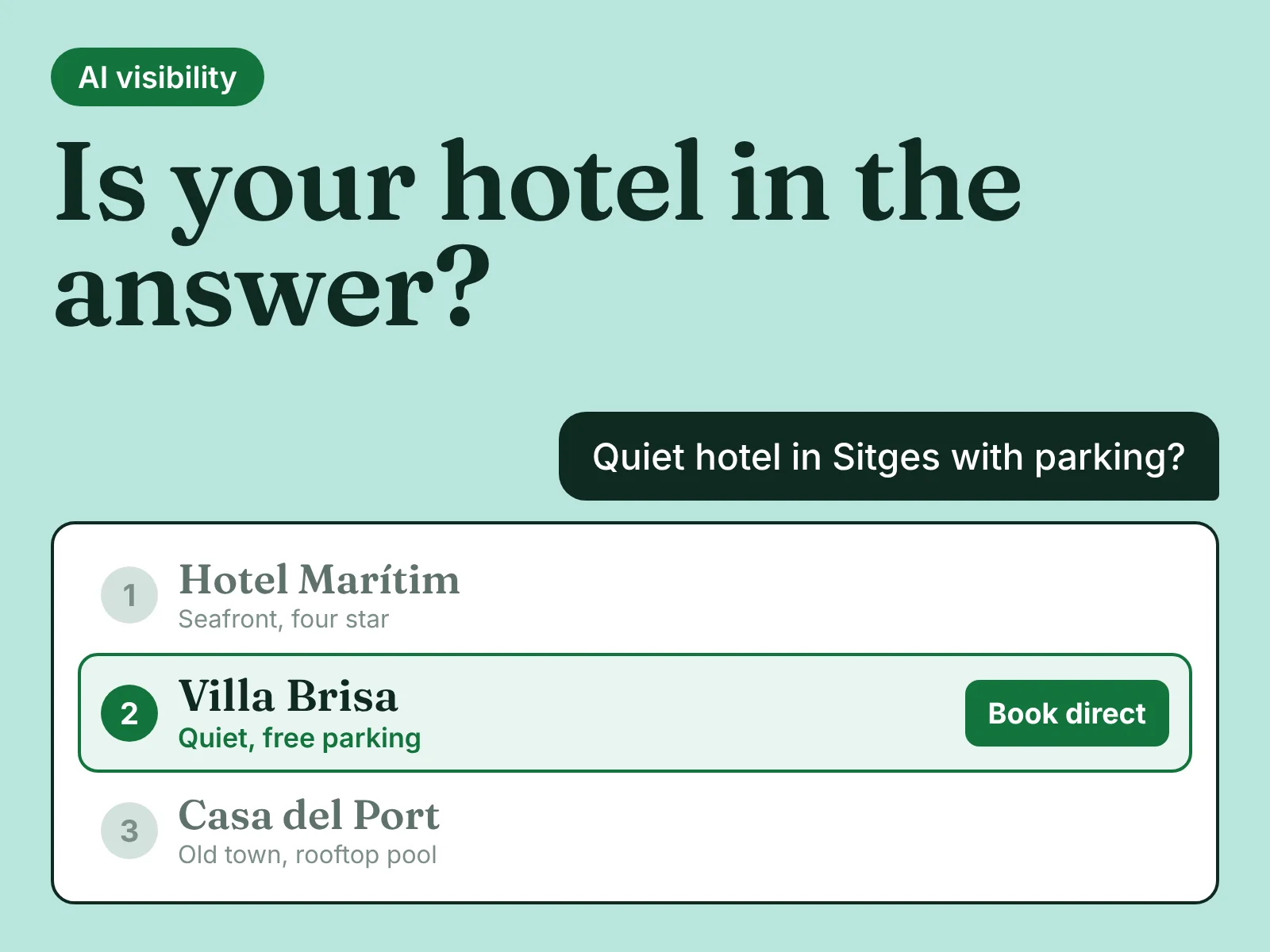
AI visibility for hotels: how to get your property recommended by ChatGPT, Gemini and Google
More guests now ask ChatGPT, Gemini or Google's AI Mode where to stay, and get a handful of names back. Most independent hotels are never one of them. Here is how AI picks hotels, and eight steps to get yours named and booked direct.
Tribii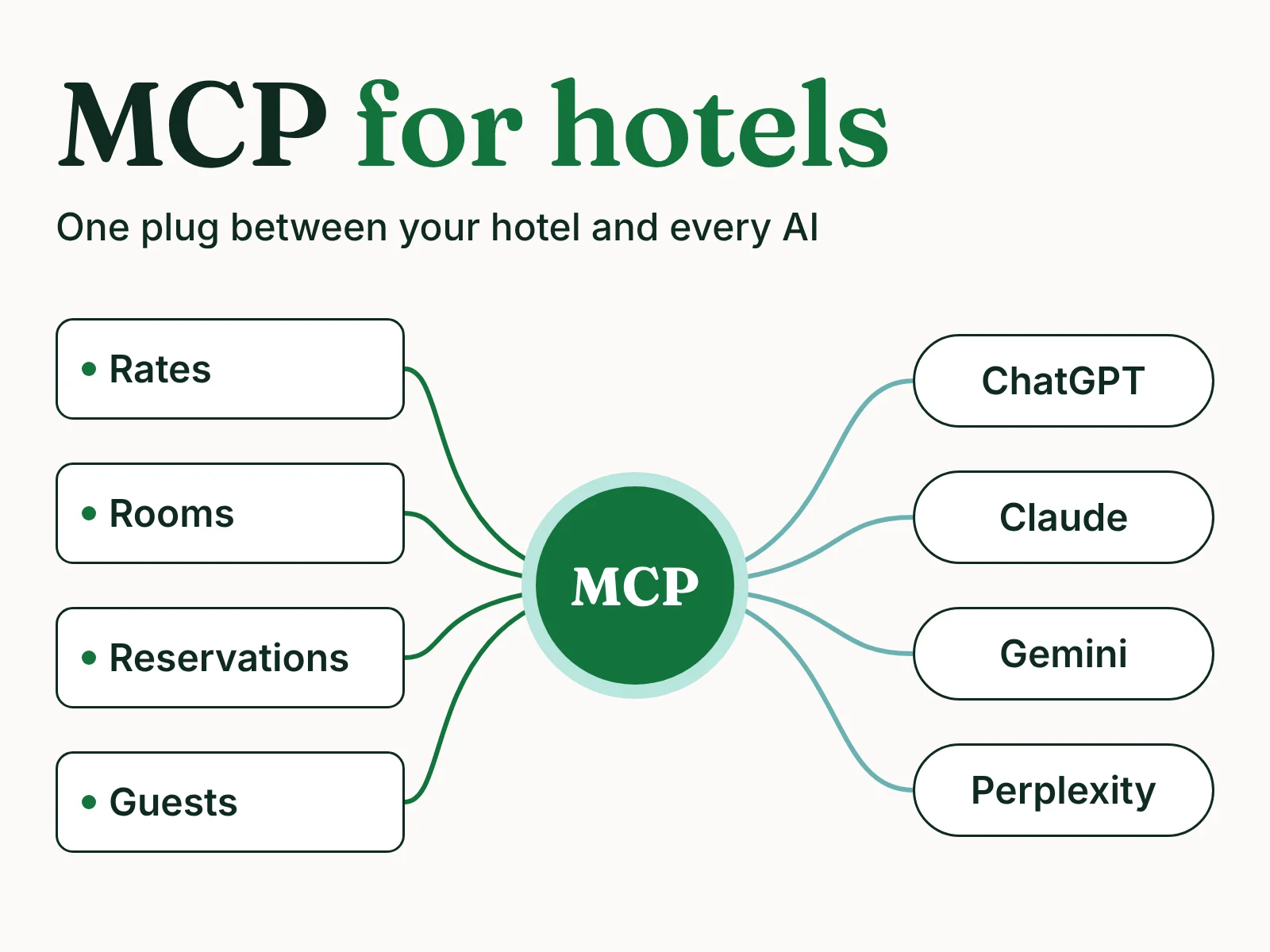
MCP for hotels: how AI assistants will find, sell and help run your property
ChatGPT, Claude and Google can now read live hotel prices, and some can take a booking. The standard behind it is called MCP. Here is what it is, what it changes for a small hotel's visibility and daily work, and what to do about it now.
Tribii