What a small hotel group really pays for its software
Group software is billed per room, per property, per module and per payment, and the subscription is often not the biggest line. What Mews, Cloudbeds, Apaleo and SiteMinder publish, a worked model and what to ask.
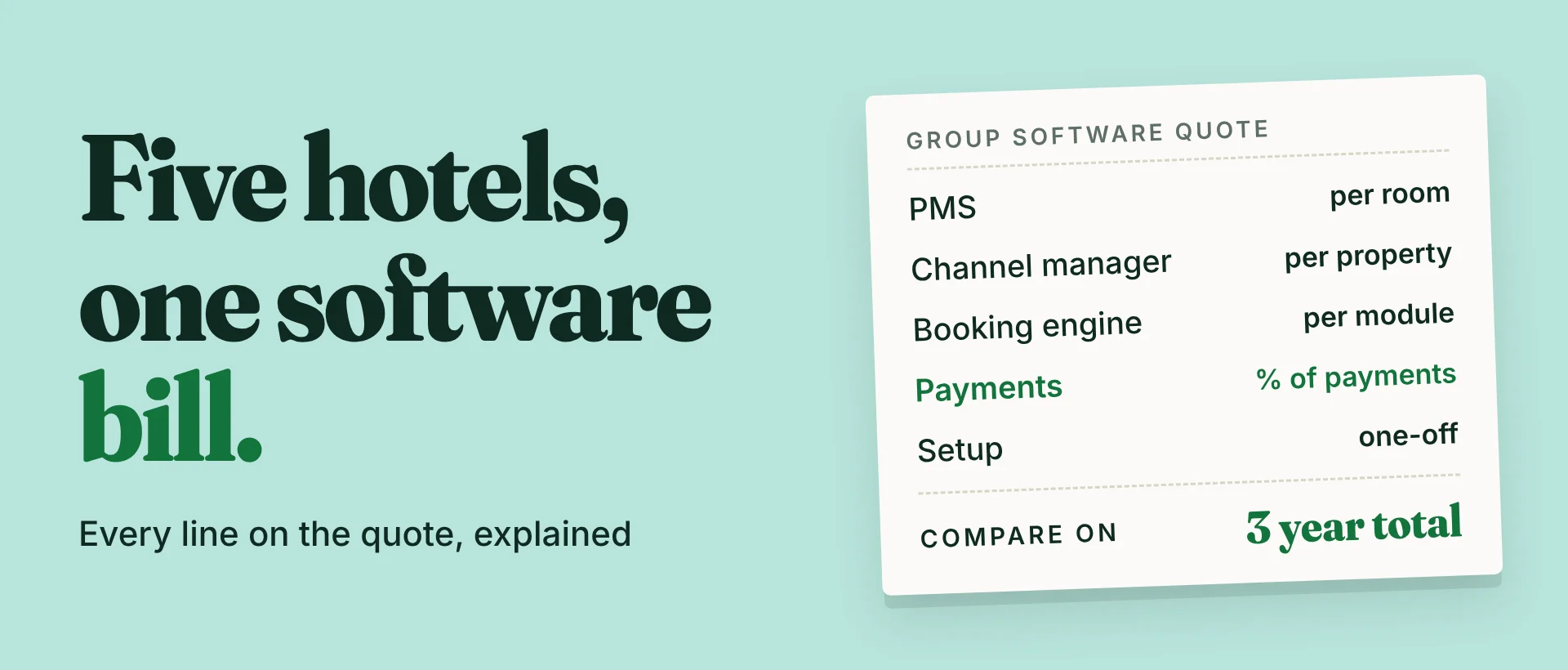
The first quote usually looks reasonable. A monthly figure for the PMS, a line for the channel manager, perhaps a setup fee. Then the second property goes in, the payment terms arrive, and the contract mentions a renewal date three years away.
Small groups sit in an awkward place: too big for plans built around one guest house, too small for a procurement team that reads every clause. And most vendors who sell to groups publish no group prices at all.
This guide is for owners and operators of 3 to 30 properties. It covers how group software is priced, what the main vendors actually publish, and a simple model for comparing quotes line by line.
The short answer
A small hotel group pays for its software in five ways at once: a subscription priced per room or per property, extra modules, a share of every card payment, booking or marketplace commissions, and upfront costs for each property. The subscription is the line vendors lead with, but it is often not the biggest. Card processing and any percentage fees often are.
Few vendors publish prices. Apaleo lists €8 per room per month, starting at €400 a month. Mews, Cloudbeds, Oracle OPERA Cloud and SiteMinder's group plan are quoted. So the number that matters is not the headline price but the total over the contract, built from every line, and you only get it by asking every vendor the same questions.
How group software is priced
Almost every quote is built from the same blocks. Once you know them, a quote becomes much easier to read.
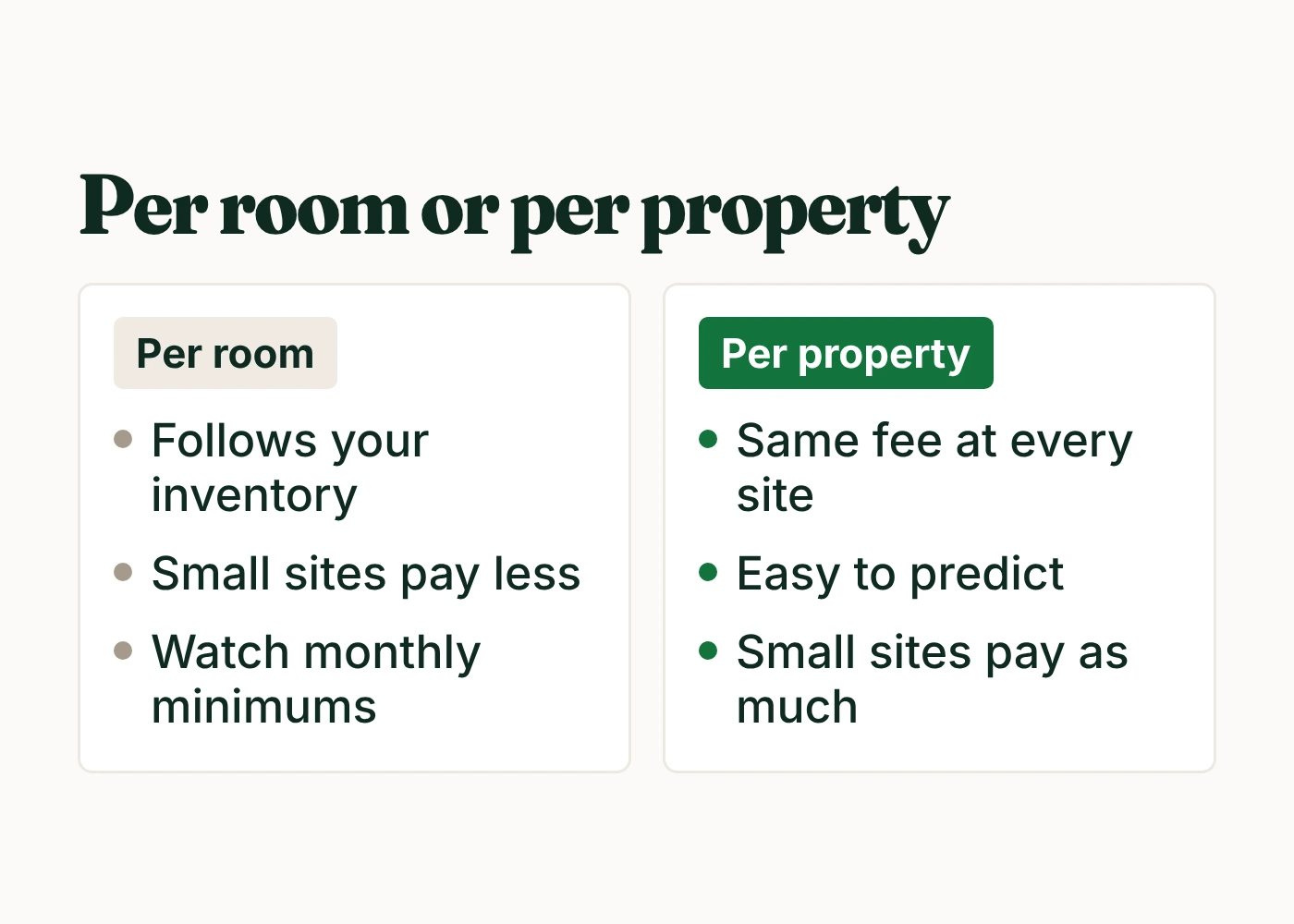
Per room per month. The most common model for a PMS. The fee follows your inventory, so a guest house with 12 rooms pays less than a hotel with 40. Watch for monthly minimums.
Per property tiers. A flat fee for each property, often banded by room count. Predictable, but your smallest guest house pays the same as your flagship.
Modules. PMS, channel manager, booking engine, revenue management (RMS), payments, POS, CRM, housekeeping. Some vendors bundle these into tiers, others sell each one separately. If you are adding an RMS, our guide to revenue management for small hotels explains what it should do for you.
Group features. Central reporting, shared guest profiles, group rate management and central reservations may be included, sold as an add-on or kept for an enterprise tier.
Payment processing. A percentage of each card payment, often with a fixed fee on top. This line grows with your revenue, not your room count.
Commissions and booking fees. Some plans take a percentage of booking value. Others charge commission on metasearch or marketplace bookings, usually after the stay.
Upfront fees. Implementation, training, data migration and integration connection fees, often charged per property.
Contract terms. Length, renewal notice and how far prices can rise. These decide what a good first year price is really worth.
What the vendors publish
We reviewed every page below on 15 October 2026. Prices and plans change, so check the live page before you sign.
Mews. No published prices: each plan leads to a sales form. Mews states that it prices per room and sells two plans plus enterprise setups for multi-brand groups. Core suits less complex properties, while Pro includes PMS, revenue management, channel manager, booking engine, payments, guest technology, business intelligence and housekeeping. POS and bookable spaces such as parking are add-ons.
Payment processing is billed separately, with fees that depend on card type, currency and payment method. Mews' fees page also lists a fee for each card stored and each terminal payment request. So a Mews quote is your rooms times a per room rate for your plan, plus add-ons, payment fees and any one-off fees in the order form.
Cloudbeds. No public prices; every plan asks you to request a quote. Flex covers PMS, payments and the marketplace, with your own channel manager. One adds Cloudbeds' channel manager and booking engine, Experience adds guest experience and reputation tools, and Enterprise offers custom packages for groups.
Cloudbeds says multi-property management is in every plan and its booking engine adds no commission, while metasearch commission is charged after the stay. Our Cloudbeds pricing explainer goes into the tiers.
Apaleo. The clearest public price we found: €8 per room per month, starting at €400 a month, with no setup, licence, maintenance or integration fees and no long-term contract. Apaleo Pay starts at 0.6%. Its store lists more than 200 apps, including booking engines and revenue management tools, but the pricing page gives no prices for them.
SiteMinder. Distribution, booking engine and website tools that connect to your PMS. Independent plans are priced per property by room count. Groups and Chains is quoted on property count, room count, products and term length, with an initial term of 1, 2 or 3 years. On top come transaction fees on payments, commission on metasearch and marketplace bookings, and a connection fee for some premium integrations, including Oracle OPERA interfaces.
Little Hotelier. Built for properties with 1 to 30 rooms and priced mostly by room count; several properties means talking to sales. Basics adds a 1% fee on booking value, and payments carry transaction fees. You can pay monthly with no contract.
Oracle OPERA Cloud. No public price. Oracle sells it through demos and says you pay only for the functionality you need: a modular quote.
The cost lines groups miss
Minimums per property. A fair price per room can still be expensive if a minimum applies to every property. Five small properties can trigger five minimums.
Central reporting. Consolidated reports and a shared guest database are what make a group a group. Mews markets a Multi-Property layer and SiteMinder's group plan includes portfolio insights, but neither page says how that is priced. Ask.
User seats. Staff turn over and move between properties. If users are priced or capped, the bill grows with your headcount, not your rooms.
Payment fees. At Stripe's standard Netherlands pricing, a standard EEA consumer card costs 1.5% plus €0.25, a premium EEA card 2.8% plus €0.25 and a card from outside the EEA and UK 3.15% plus €0.25, with 2% more for currency conversion. The more premium and foreign cards your guests use, the higher your real rate, so ask for a blended rate on your own card mix.
Implementation and migration. Setup, onsite training and moving future reservations, guests and open folios are often charged per property. Mews' master terms (version 5.0, effective 26 February 2025) charge 60% of the training and installation fee if you cancel confirmed onsite dates within four weeks. Apaleo states no setup fees.
Contracts tied to payments. When your PMS vendor is also your payment processor, the contracts travel together. Under Mews' terms, its fees are taken from your sub-merchant account, and the merchant agreement forms part of the same contract. Leaving the software can mean changing processor too.
Add-ons. Marketplace apps and premium connections can each carry a fee. Mews add-ons bought through its marketplace run for the full subscription term and cannot be cancelled within it.
Renewals and increases. Mews may change fees on 30 days' notice (you can terminate if the change is material), and subscriptions renew for 12 months unless you give notice at least 30 days before the end date. Ask every vendor for a written cap on increases.
Self-hosting. Open-source software avoids licences, but the cost moves to hosting, updates and security, as we set out in the real cost of self-hosting.
A worked model: five properties, 120 rooms
This example is illustrative. Take five properties with 40, 30, 20, 18 and 12 rooms: 120 rooms in total. Assume 70% occupancy at a €100 average rate, which gives €3,066,000 of room revenue a year, with €2,000,000 of it paid by card through your system in payments averaging €300.
Rather than invent quotes, here are the multipliers. Put each vendor's own figures into them.
1. Every €1 per room per month costs €1,440 a year. That is 120 rooms times 12 months. At Apaleo's published €8, the core PMS comes to €11,520 a year.
2. Every €100 per property per month costs €6,000 a year. This is where minimums bite. If a €400 monthly floor applied to each property, the group would pay €2,000 a month instead of €960, more than double for the same rooms. Apaleo's page does not say which way its minimum works, so ask.
3. Every 1% of booking value costs €30,660 a year. On this group's revenue, a 1% booking fee costs more than twice the €11,520 subscription in line 1.
4. Every 0.1 percentage point on card payments costs €2,000 a year. At Stripe's standard EEA card rate of 1.5% plus €0.25, those payments cost about €31,700. Premium and foreign cards push that higher.
5. Every €1,000 of setup per property costs €5,000. Spread over a three year contract, that is €1,667 a year.
6. A 5% yearly increase on a €20,000 bill adds €3,050 over three years. You pay €20,000, then €21,000, then €22,050: €63,050 instead of €60,000.
Fill in lines 1 to 5 for each vendor, apply line 6 from year two, and compare totals over the full contract, not monthly headlines. The booking engine deserves its own scrutiny, as we explain in what a hotel booking engine really costs.
What to ask every vendor
Send every vendor the same questions and ask for the answers in writing. Quotes are only comparable when they answer the same questions.
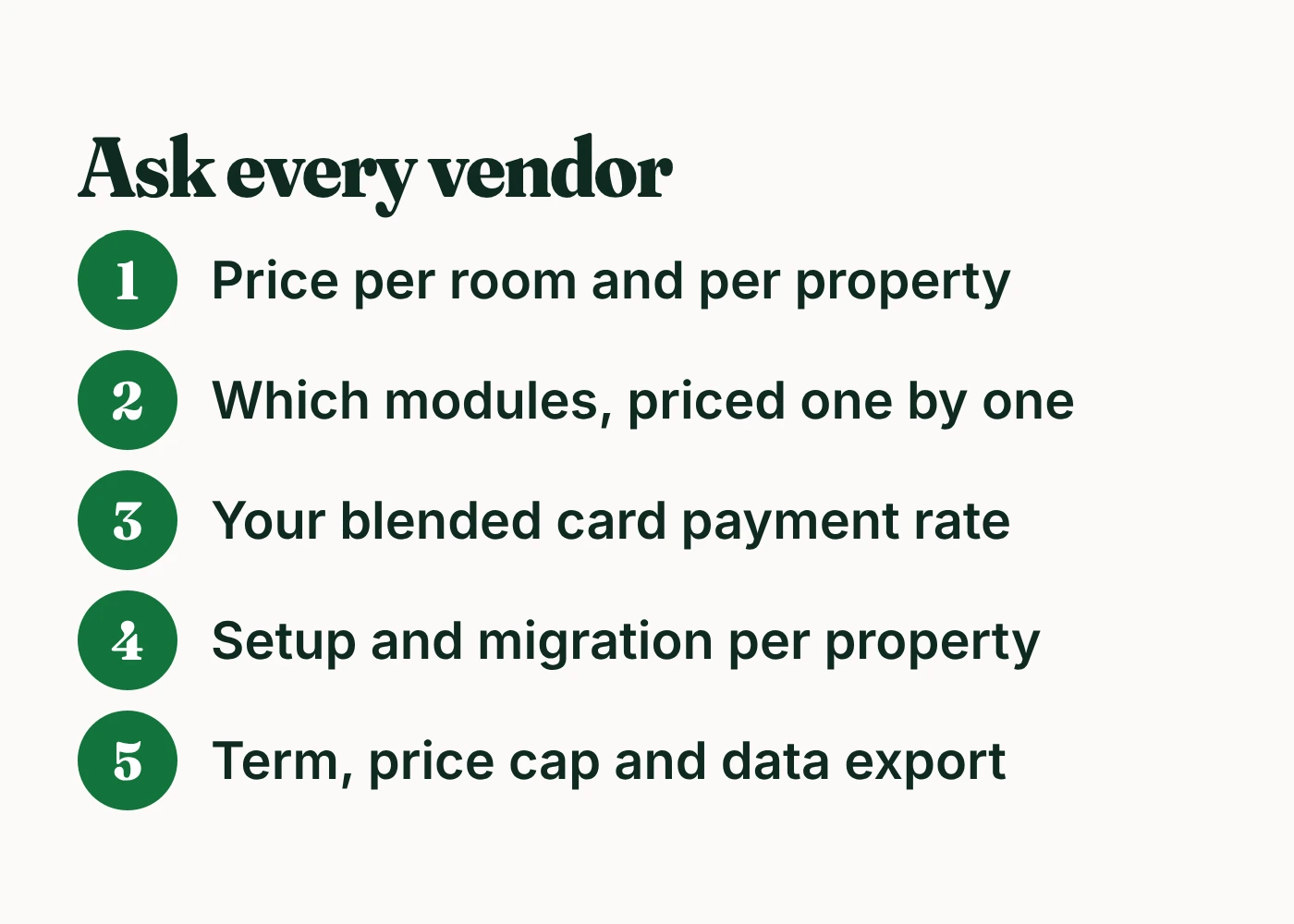
1. Price basis. What is the price per room and per property, and does any minimum apply per property or per account?
2. Modules. Which modules are in the quote, and what does each one cost on its own?
3. Group features. Are central reporting, shared guest profiles and group rate management included?
4. Users. Are team members priced or capped?
5. Payments. Must I use your processor? What is my blended rate on my card mix? Who holds the money, and when is it paid out?
6. Commissions. Is there any percentage on bookings, metasearch or marketplace channels?
7. Upfront costs. What do setup, migration and training cost per property, and is training remote or onsite?
8. Contract. How long is the term, how much notice ends it, and how far can the price rise at renewal?
9. Exit. How do I export reservations, guests and financial data if we leave, and does it cost anything?
What to standardise across properties
Group software pays off when your properties look alike inside it. Agree these points before migration, not after.
Room types and rate plans. The same names, the same structure and, where the market allows, the same cancellation policies. Group reports are only as clean as the codes underneath.
One payment setup. One processor and a clear payout account for each legal entity, so reconciliation works the same way everywhere.
User roles. Define front desk, housekeeping and manager roles once, then apply them to every property.
Report definitions. Agree what occupancy, ADR and RevPAR mean, including whether revenue is counted with or without VAT, so the numbers compare.
Contract dates. Line up every property's renewal on the same date, so you can renegotiate or leave as one group.
Keep local what is local: VAT, city tax, guest registration and tourism statistics differ by country. The wider case for running all of this in fewer tools is in One system, not twenty.
Where Tribii fits
Any good group system should give you one place to run every property, a price you can predict and data you can take with you. Tribii's Enterprise plan is ours.
Enterprise includes everything in Max, with unlimited rooms, beds and properties, unlimited team members and unlimited AI and marketing emails. The Tribii team sets up properties of any type (hotels, hostels, guest houses, rentals and campsites) side by side in one account, and migrates your bookings, guests and payments for you. The Max tools come with it, including the two-way channel manager, front desk, housekeeping and online self check-in.
Enterprise is quoted, like Mews and the group plans of Cloudbeds and SiteMinder, so we will not claim a percentage saving. For reference, our published plans include Max at €95 a month with 60 rooms included and €5 for each extra room.
Tribii charges 0% commission on direct bookings, and guest payments go into the property's own Stripe account, so Tribii never holds the money. Stripe's processing fees still apply. Put us through the same checklist as everyone else.
Common questions
How much does hotel software cost for a small group?
Most group plans have no list price. Build the total from subscription, modules, payment fees, commissions and upfront costs. With 120 rooms, every €1 per room per month adds €1,440 a year.
What is a typical PMS cost per room?
Few vendors publish one. Apaleo lists €8 per room per month, starting at €400 a month. Mews prices per room but quotes every property.
How is Mews priced?
Mews publishes no prices. It prices per room, sells Core, Pro and enterprise setups, treats POS and bookable spaces as add-ons and bills payment processing separately. Its standard terms renew for 12 months at a time.
Is there a cheaper Mews alternative for a small group?
Possibly, but compare like with like. Run every candidate, Mews included, through the same checklist and compare totals over the contract. A lower subscription can be undone by a higher card rate or a longer term.
Should every property use the same system?
Usually yes for the PMS, payments and reporting, so your data compares and staff can move between properties. Tax and guest registration rules differ by country, so check each market is supported.
Do payment fees really matter that much?
Yes. In our illustrative model, card processing at Stripe's standard EEA rate costs about €31,700 a year, more than twice a subscription at €8 per room. A small difference in your processing rate moves the total more than most software discounts.
The honest summary
The subscription is the line vendors lead with, and for a small group it is often one of the smaller ones. Payment fees, percentages, minimums per property and contract terms decide what you really pay.
Ask every vendor the same questions in writing, put the answers into the same model and compare totals over the full contract. Then standardise your properties, so that whichever system you choose, the group runs as one.
Vendor pricing pages and terms reviewed 15 October 2026 from Mews, Cloudbeds, Apaleo, SiteMinder, Little Hotelier, Oracle and Stripe. Prices, plans and terms change and vary by country and contract: check the live pages and your own quotes before you sign. The worked model is illustrative and is not a quote from any vendor. This is not financial or legal advice.

Tribii
The free booking engine for independent hoteliers. Editorial notes.
More for the kitchen table.
Revenue management for small hotels: what the software does, what it costs and when you need it
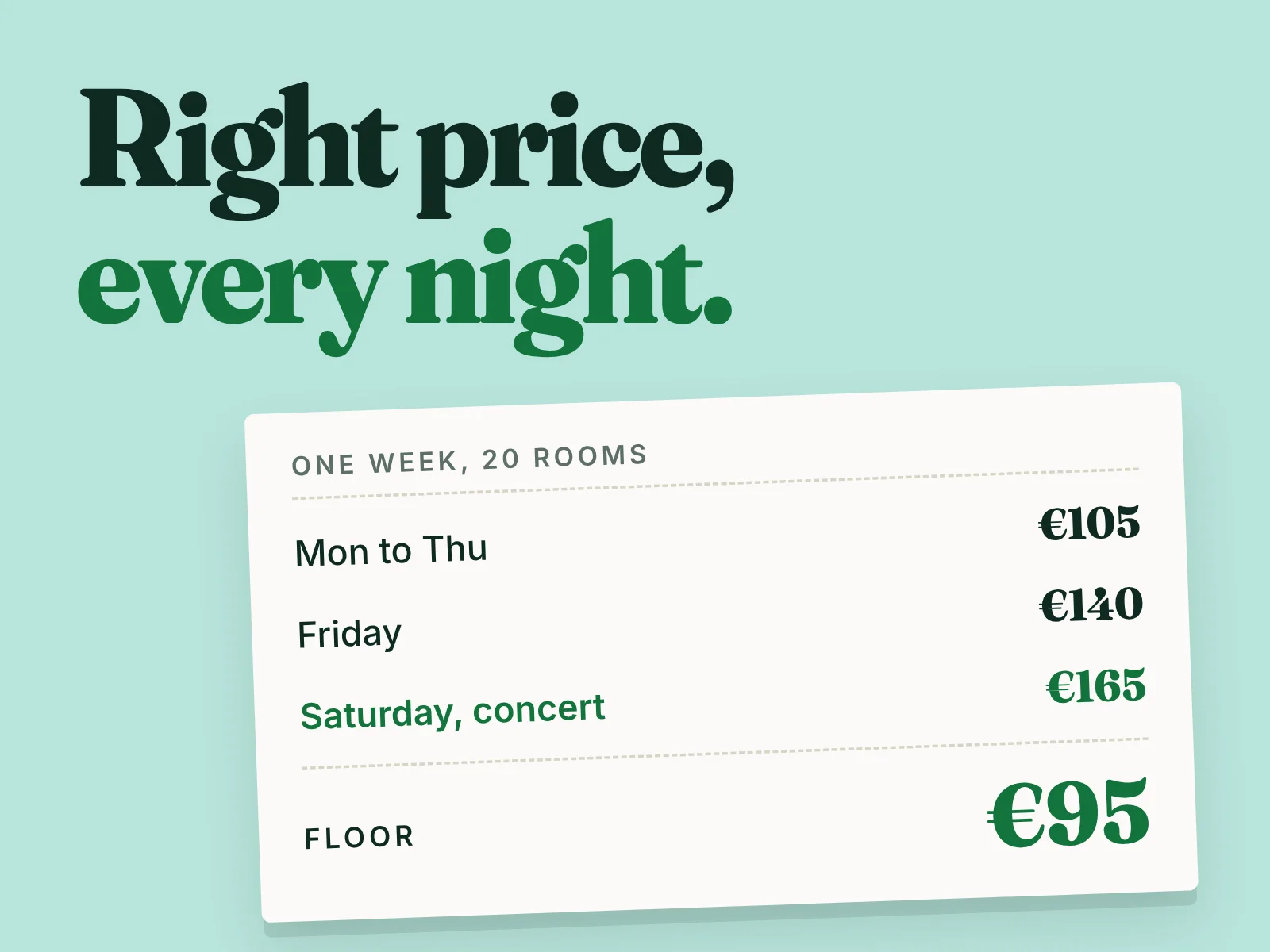
Revenue management means the right price for every night and channel. Here is what the software does, what it costs in 2026, and a weekly routine for small hotels that are not ready for it yet.
 Tribii
Low season without more commission: how to fill winter rooms directly
Switching on more OTA deals in winter usually means a discount and a commission on the same booking. Here is the arithmetic, and a practical playbook to fill quiet rooms directly, starting with the guests you already know.
Tribii
iCal vs channel manager: what really syncs, and when to switch
Both promise to keep your Airbnb, Booking.com and Vrbo calendars in step. Only one of them moves prices, rules and the booking itself. Here is what iCal really does, where it stops, and when a channel manager starts paying for itself.
Tribii