How much does a hotel booking engine cost in 2026?
Published prices, hidden tiers, and per-booking fees. What the market actually charges a small property, with every figure sourced and dated.
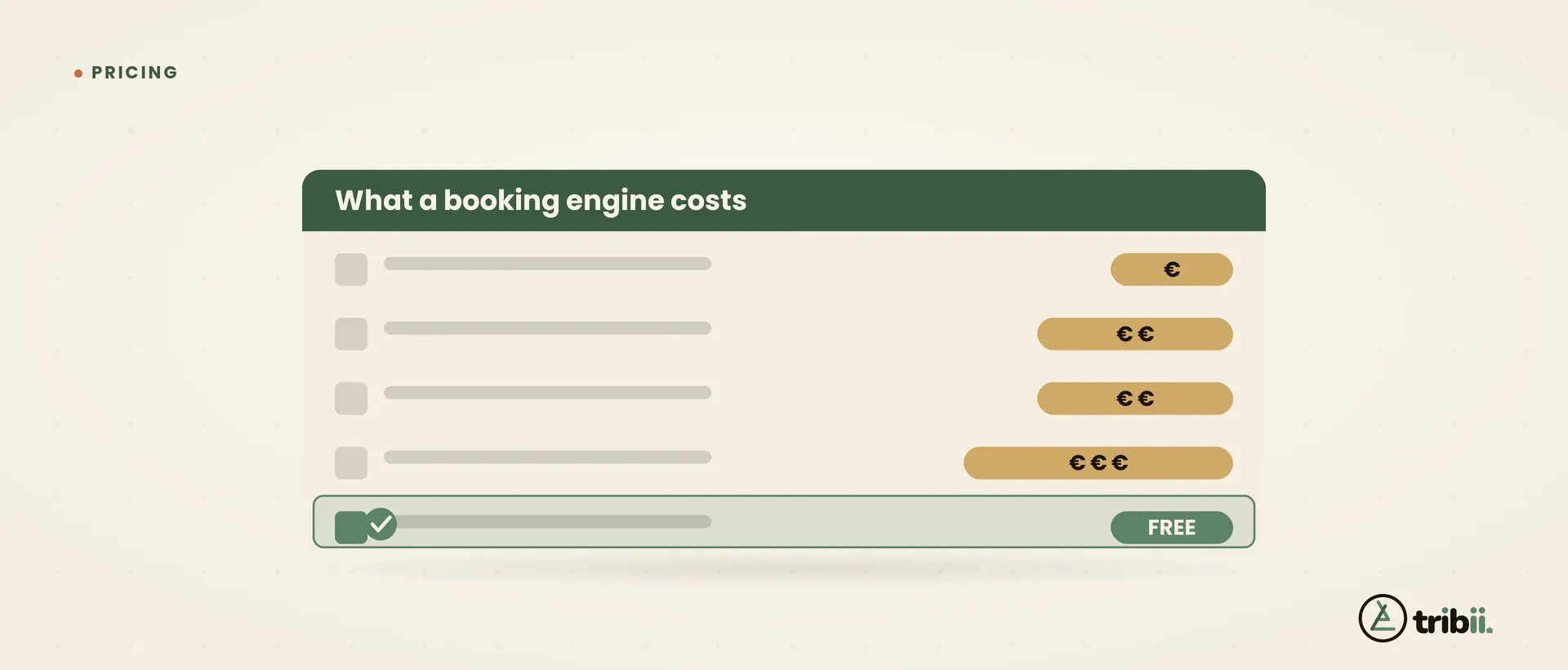
Booking engine pricing is deliberately hard to compare. Some vendors publish a number. Some publish a number that does not include the booking engine. Some will not publish anything until you sit through a demo. And a few charge a percentage of every reservation while calling themselves commission-free.
This is what the market looked like when we reviewed it in July 2026. Every figure below comes from the vendor's own pricing page, linked at the end. Quote-only vendors are labelled as estimates, because that is all anyone outside the company honestly has.
The four pricing models
Before the numbers, understand what you are being quoted.
Flat monthly fee. You pay a fixed amount, usually scaled by room count. Predictable, and the model most vendors use.
Per-booking percentage. The vendor takes a cut of each reservation, often 1% to 3%. Sold as "you only pay when you earn", which sounds fair until you notice it is a commission by another name, charged on the bookings you fought hardest to win.
Freemium. A genuinely free tier with a defined limit, and paid tiers above it. The question is always where the limit sits and what falls outside it.
Quote only. No public price. You get a number after a sales call, and that number depends on your room count, your market, and how well you negotiate.
Watch for a fifth thing that is not a pricing model but behaves like one: payment-processing markup. If a vendor requires you to use their payment product and charges above the going card-processing rate, the difference is a fee on every booking, whatever the price page says.
What vendors charged in July 2026
| Vendor | Published price | Booking engine included? |
- | Sirvoy | Free for a single room, then paid. About €150/mo for 25 rooms billed monthly | Yes, on all plans |
- | Little Hotelier | From about €29/mo (Basics) up to about €119/mo (Pro) | Yes, but Basics adds 1% of every booking's value |
- | SiteMinder | 14-day trial, then from about €95/mo by room count | No. The booking engine needs the Plus tier, about €119/mo |
- | Cloudbeds | Quote only, no public price. Third-party estimates put small properties around €100 to €600/mo | Not in the entry plan |
- | Mews | Quote only. Independent estimates put a small hotel at roughly €300+/mo | Yes |
- | Tribii | Free forever up to 20 rooms | Yes |
Two patterns jump out.
First, the advertised entry price is often not the price of a booking engine. SiteMinder's headline figure is a channel manager plan; the direct booking engine sits a tier higher. Cloudbeds excludes it from the entry plan entirely. If you compare headline numbers you are comparing different products.
Second, the cheapest published number carries a percentage. Little Hotelier's Basics tier is the lowest advertised price in the table, and it charges 1% of the value of every booking, direct and OTA alike, on top of the monthly fee. On a property turning over €200,000 a year, that 1% is €2,000, which reframes a €29 monthly plan considerably. Commission-free only holds on their Pro tier.
Doing the arithmetic properly
Compare total annual cost, not monthly headline, and include the percentage.
Take a 20-room property with €250,000 of annual room revenue, of which €80,000 comes through the direct channel.
- A flat €119/mo plan costs €1,428 a year. Done.
- A €29/mo plan with 1% of all bookings costs €348 plus €2,500, so €2,848 a year. It is twice the price of the plan that looked four times more expensive.
- A quote-only vendor at an estimated €300/mo costs €3,600 a year before any add-on.
- A free plan costs nothing, and the question becomes what it does not include.
The percentage always wins the argument at volume, and it wins it against you. A fixed fee gets cheaper per booking as you grow. A per-booking fee never does. That is the entire reason OTAs use one and good software vendors use the other.
Where free actually fits
There is a reasonable suspicion of free software, and it is usually right. Free tiers are typically a trial with the clock hidden, or a lead magnet with a room limit set just below where any real property operates.
The questions worth asking before you trust one:
- Where is the limit, and is it honest? A limit of 20 rooms covers most independent properties. A limit of one room covers nobody.
- Is the booking engine in the free tier, or the bait for the paid one?
- Who touches the money? If guests pay through your own payment gateway, the vendor cannot take a cut of a reservation even if they wanted to. If payments flow through the vendor, read the processing rate.
- What happens when you outgrow it? A free plan that becomes a hostage situation at room 26 is not free, it is deferred.
- Can you leave? Ask how you export your reservations and guest data, before you need to.
We built Tribii's free booking engine on the first answer to each of those: free forever up to 20 rooms, the booking engine and website builder included rather than upsold, guests paying directly into your own Stripe account, and paid tiers that add operational depth rather than unlocking the front door. Our pricing page states the paid tiers plainly, because a free plan that hides its business model is not honest.
What to ask on a sales call
If you are getting a quote rather than a price, arrive with these questions written down.
- Is the direct booking engine included in the tier you just quoted, or a tier above it?
- Is there any per-booking fee, on direct bookings or OTA bookings, at any tier?
- Am I required to use your payment product, and what is the processing rate?
- What is the contract length, and what does the price do at renewal?
- What is the setup or onboarding fee?
- Is the website builder included, or an add-on?
Get the answers in writing. A vendor who will not put the per-booking fee in an email is telling you something.
The honest summary
For a small independent property in 2026, a booking engine costs anywhere from nothing to roughly €300 a month, and the spread has very little to do with quality. It has to do with which tier the feature sits in, whether a percentage rides along, and whether the vendor sells to 20-room guesthouses or to hotel groups and is simply willing to take your money too.
Compare annual totals. Read the tier the feature actually lives in. Refuse the percentage.
*Prices reviewed July 2026 from each vendor's public pricing page. Quote-only figures are third-party estimates, clearly labelled as such, and we do not present them as vendor statements. See our comparison pages for the detailed, dated breakdowns.*

Tribii
The free booking engine for independent hoteliers. Editorial notes.
More for the kitchen table.
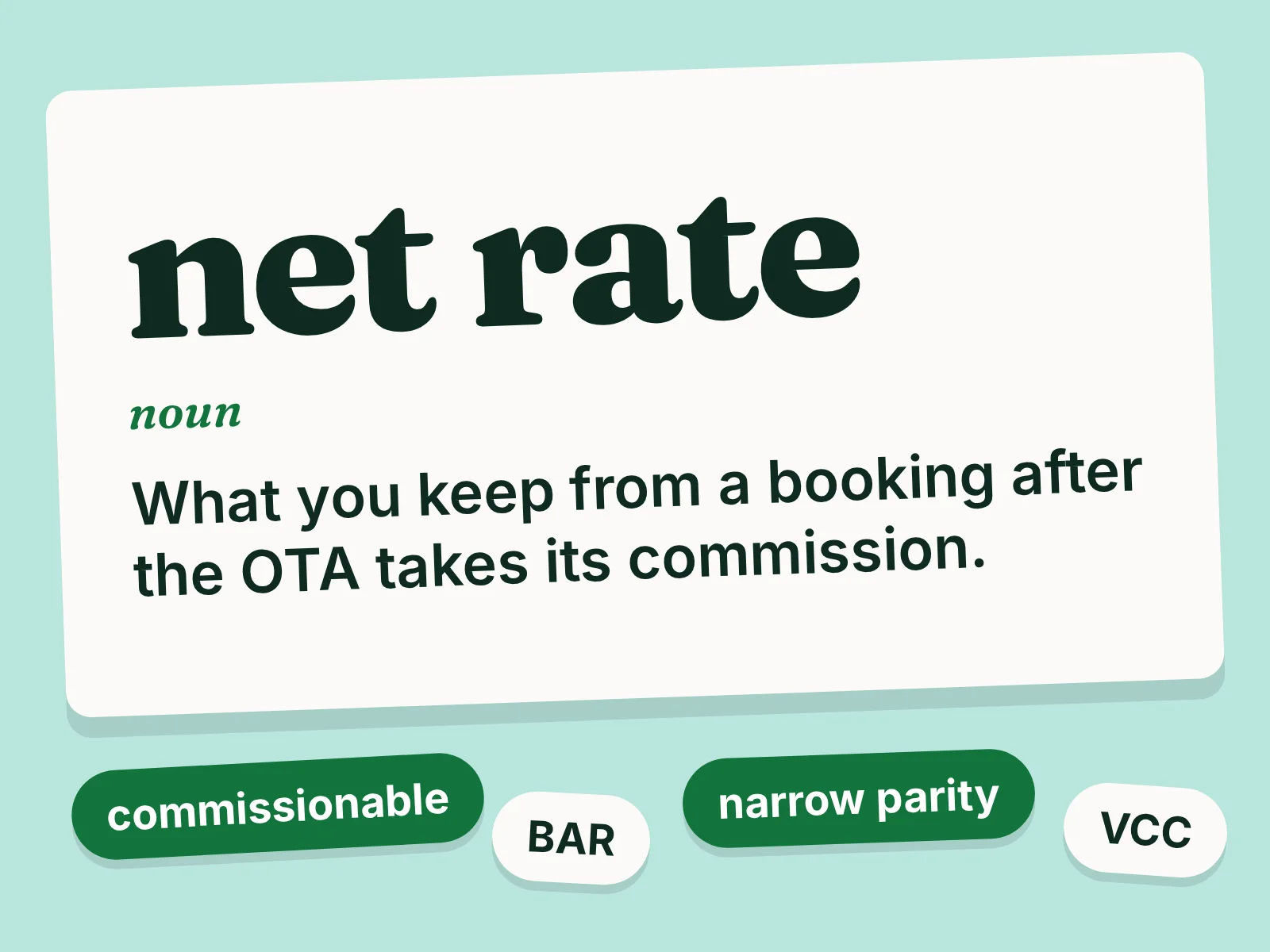
OTA terms explained: a plain-language glossary for independent hotels
Commissionable rate, net rate, merchant model, narrow parity. The words in your OTA contract, explained in plain language, with what each one means for your money.
 Tribii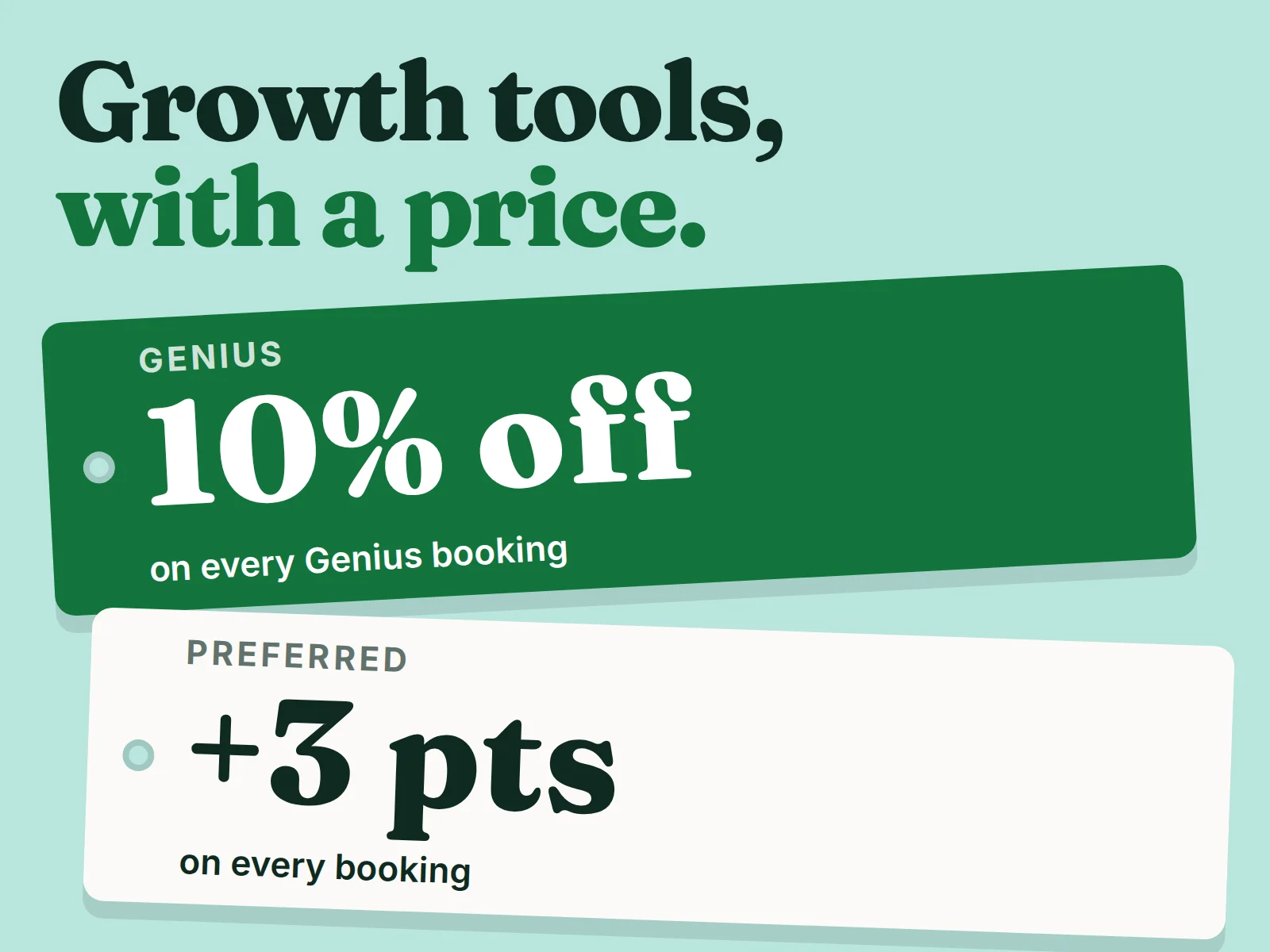
Booking.com Genius and Preferred Partner: what they really cost a small hotel
Genius and Preferred Partner are sold as growth tools. Both are also a price. Here is what each one costs an independent hotel, how to test whether it pays, and what to decide before 2027.
Tribii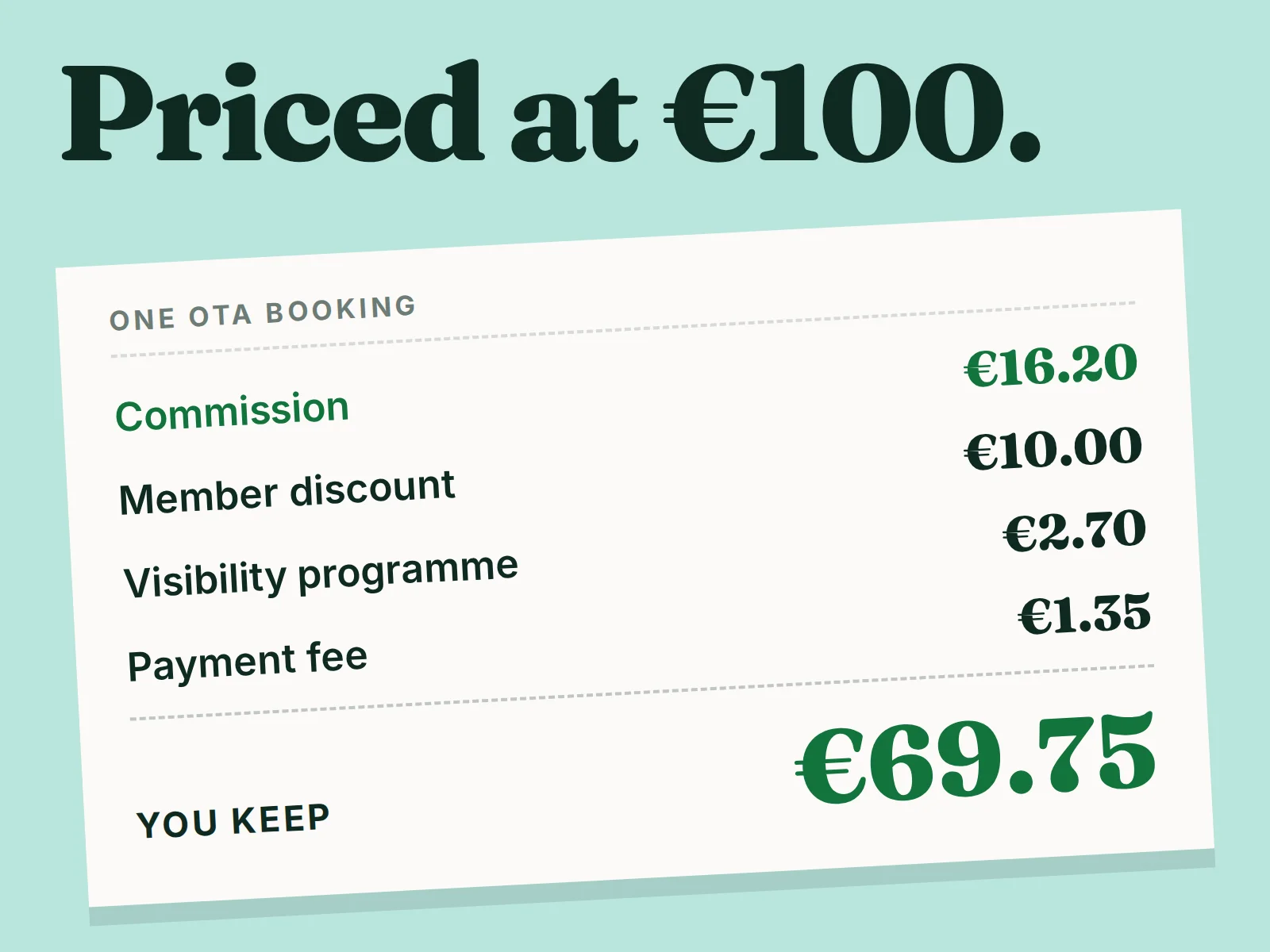
The real cost of an OTA booking: commission is only the first line
Most hoteliers know their commission rate. Few know their effective rate. Here are the other lines on every OTA booking, and how to work out what a room really costs you to sell in 2027.
Tribii