Hotel invoicing for small properties: corporate guests, city tax and a clean month end
What a hotel invoice must show in the EU, how VAT and city tax land on one stay, how to bill companies and agencies, and a month-end routine that takes an hour instead of a weekend.
A guest checks out and asks for a receipt. A consultant wants the invoice in her employer's name, with its VAT number. A travel agency wants one document for twelve rooms. None of that is hard on the day.
It gets hard at the end of the month, when the payments in your bank do not match the bills in your system, a corrected invoice exists in two versions, and your accountant asks why city tax went into room revenue.
This playbook covers the documents you issue, what an EU invoice must show, how VAT and city tax land on one stay, how to bill companies and agencies, and a month-end routine that fits in an hour.
The short answer
Good hotel invoicing software builds the invoice from the guest folio, puts the right VAT rate on each line, keeps city tax on its own line, records every payment against the stay and numbers invoices in one unbroken sequence. For corporate guests it stores the company's name, address and VAT number, and splits the bill so the company pays for the room and the guest pays for the extras.
You do not need expensive software for this. You need one system where charges, invoices and payments live together, a rule that issued invoices are corrected with a credit note and never edited, and a monthly close: match payments, chase open balances, lock the month, send one export to your accountant.
Five documents and when to use each
Most confusion at the front desk comes from using one document to do another's job.
Folio. The running bill for a stay: room nights, breakfast, the bar, city tax. It is a working document and can change until checkout. Our plain-language guide to a hotel PMS explains how the folio sits at the centre of your system.
Proforma. A preview of an invoice, sent before the stay so a company can approve the amount or pay in advance. It is not the tax document. Mark it clearly as a proforma and keep it out of your invoice numbering.
Invoice. The tax document, with a unique sequential number, your VAT number, the VAT per rate and, for business customers, their details. Once issued, it is fixed.
Receipt. Proof that money was received: amount, date and payment method. A holidaymaker usually wants a receipt, a business traveller an invoice.
Credit note. The way to correct or cancel an issued invoice. It refers to the original by number and reverses all or part of it.
What an EU invoice must show
Article 226 of the EU VAT Directive lists what a full invoice must carry. In plain words:
Who and when. The date of issue. A sequential number that identifies the invoice uniquely (you may run more than one series, such as one per property). Your name, address and VAT number. The customer's name and address.
What and how much. What you supplied and how much, such as two nights and four breakfasts. The date of the stay if it differs from the invoice date. The amount excluding VAT per rate, the unit price and any discounts. The VAT rate and VAT amount. A reference to the exemption on any exempt line.
The customer's VAT number. The directive requires it mainly when the customer accounts for the VAT. A hotel stay is taxed where the property is (article 47), so you charge your own VAT even to a foreign company. Companies still want their VAT number on the invoice, so store it.
Simplified invoices. For amounts of €100 or less, every member state must allow a simplified invoice (article 220a) showing the date, who you are, what you supplied and the VAT (article 226b). Countries may raise that limit to €400.
National rules on top. The directive is a floor. Countries add deadlines, language rules, storage periods and sometimes certified software. The Netherlands, for example, asks you to keep basic records for seven years.
Corrections and numbering. Never edit or delete an issued invoice. If something was wrong, issue a credit note that refers to the original by number, then a new invoice. The directive treats such an amending document as an invoice in its own right (article 219). Let your system assign the numbers, because gaps and duplicates are hard to explain later.
VAT and city tax on one stay
VAT on accommodation varies by country, and within one stay it often varies by line.
The Netherlands. VAT on accommodation rose from 9% to 21% on 1 January 2026, while breakfast offered separately stays at 9%. Packages must be split by the market value of each part, and KHN, the Dutch hospitality association, advises against shifting value from room to breakfast. KHN also reported that Booking.com agreed to keep calculating commission at the old 9% rate for 18 months, a reminder that OTA commission is usually charged on a price including VAT, as we explain in the real cost of an OTA booking.
Germany. Hotel rooms for short stays are taxed at 7%. Since 1 January 2026, restaurant and catering food is permanently at 7% too, while drinks stay at 19%, so a breakfast line now carries two rates.
Ireland. Hotel accommodation stays at 13.5%. Since 1 July 2026, restaurant and catering food is at 9%, while alcohol and soft drinks remain at 23%.
City or tourist tax is something else. It is not VAT and not your revenue. You collect it for the municipality, usually per person per night or as a percentage of the room price, and pay it over. Keep it on its own line and out of your room revenue.
Amsterdam charges 12.5% of the overnight price excluding VAT, and breakfast is outside that base. The city's coalition agreement plans 16% for 2027, rising in steps to 20%, so check what the council adopts.
Edinburgh charges a visitor levy of 5% of the accommodation cost before VAT, for stays from 24 July 2026, capped at five consecutive nights. Unlike the Paris tax below, it is subject to VAT when you pass it on.
Paris indexed its top rates on 1 January 2026. With the regional and departmental additions, a 5-star hotel collects €11.70 per adult per night and a 3-star hotel €5.53. In France, tax collected per guest must appear separately on the invoice and is not subject to VAT.
Rules change yearly and differ by municipality, so check yours with the town hall before January.
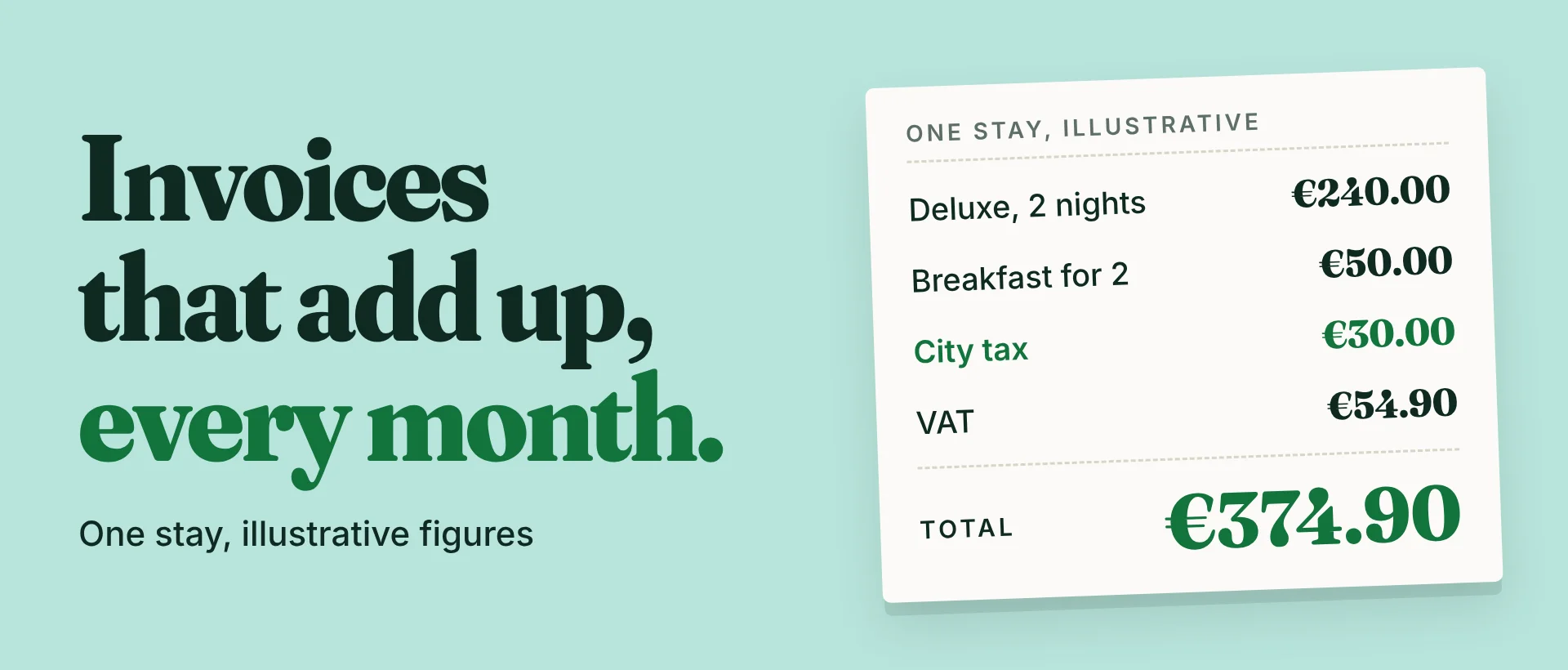
One stay, line by line (illustrative). Two guests, two nights in a Deluxe room in Amsterdam at €120 a night excluding VAT, breakfast at €12.50 per person. The room is €240.00 plus €50.40 VAT at 21%. Four breakfasts are €50.00 plus €4.50 VAT at 9%. City tax is €30.00 on its own line, with no VAT. Total VAT is €54.90 and the guest pays €374.90.
Corporate guests, groups and agencies
Business guests are reliable revenue, and the most likely to send an invoice back.
Store the company, not just the guest. A business invoice goes to the company's legal name, address and VAT number. Keep companies as their own records, so repeat bookings pick up the right details.
Ask for the reference. Many companies will not pay without a purchase order number or cost centre. Ask at booking and print it on the invoice.
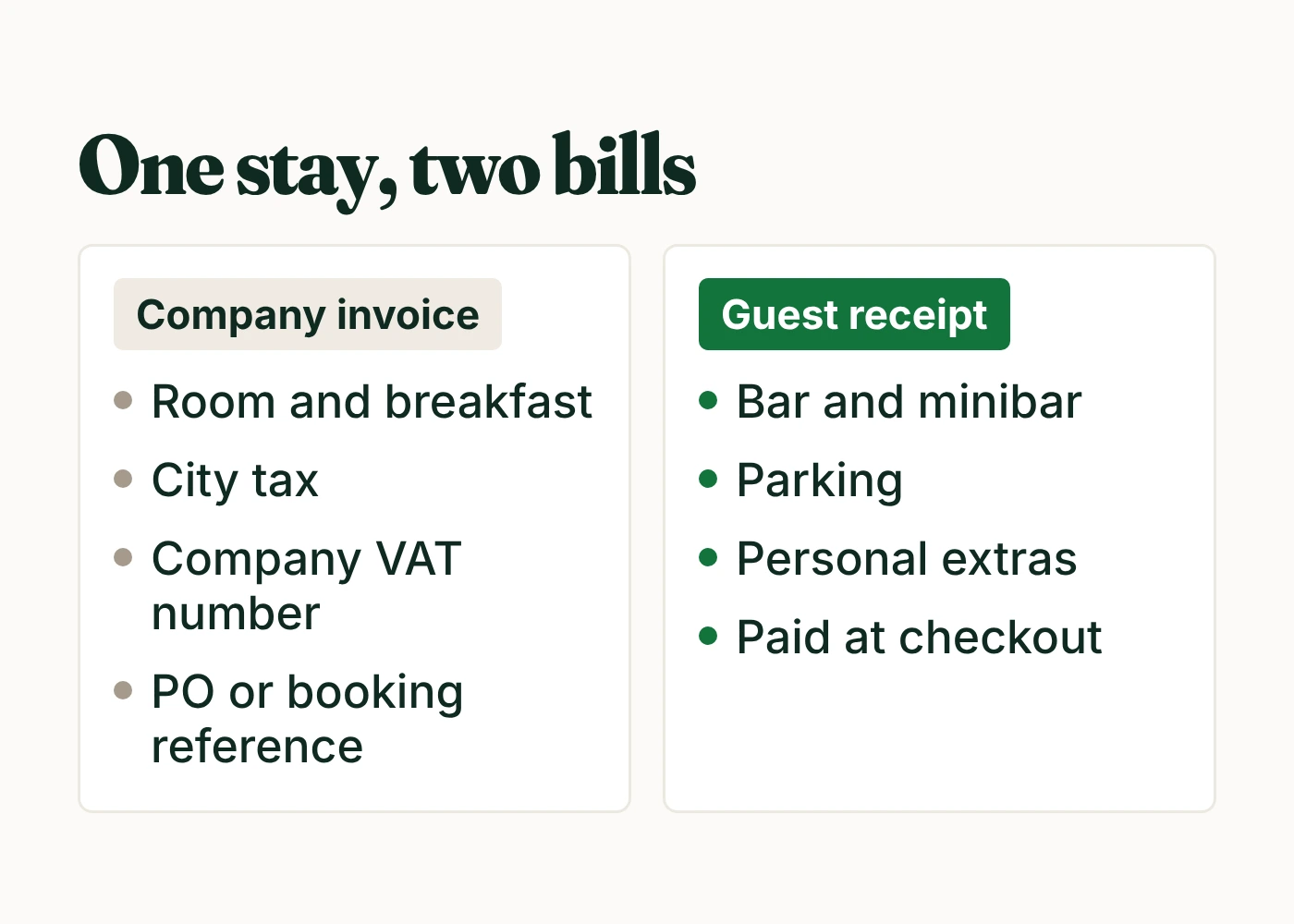
Split the folio. Usually the company pays for the room, breakfast and city tax, and the guest pays for the bar, parking and anything personal. Agree the split in writing at booking, then issue the company invoice and give the guest a receipt for their part.
Deposits and advance invoices. For groups and events, take a deposit. Send a proforma if the company needs to approve the amount, then issue an invoice when the money arrives, since EU rules expect an invoice for a payment on account from a business. The final invoice deducts what was already invoiced.
Travel agencies and tour operators. When an agency books for its clients, the agency is your customer. Invoice it at the agreed rate under its own details, quote its reference, and make sure the guest is not charged again at checkout for what the agency prepaid.
Payment terms. Put a due date on every business invoice, such as 14 or 30 days, and send it to the accounts payable email, not the traveller. Under EU late payment rules, if no term is agreed, interest starts automatically 30 days after the customer receives the invoice, and you can claim a flat €40 for each invoice paid late.
Month end in one hour
When charges, invoices and payments live in one system, the close is a checklist, not a project.
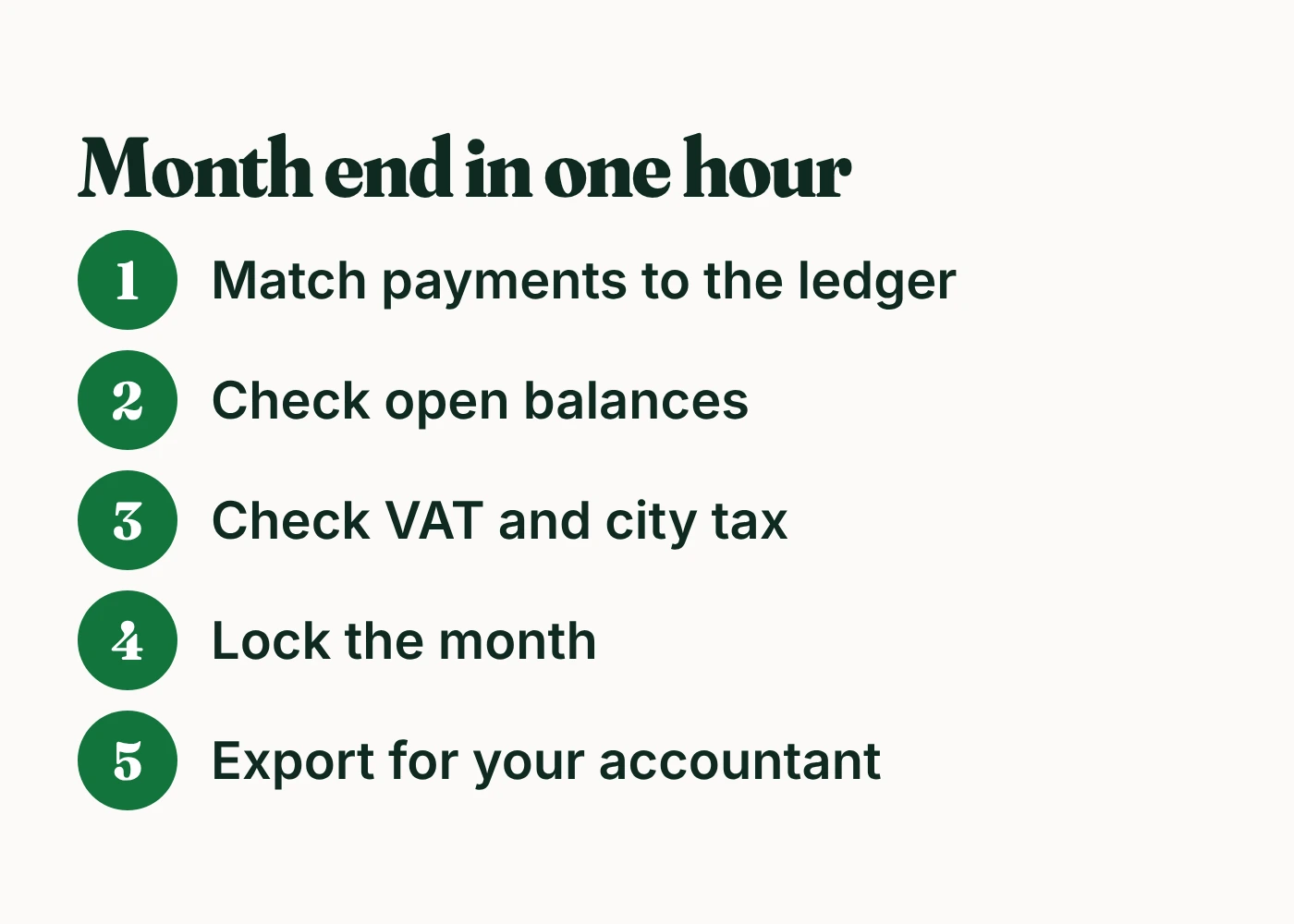
1. Match payments to the ledger. Compare card and Stripe payouts, bank transfers and cash with the payments in your system. Every euro in the bank should point to a booking. Payouts often arrive net of fees, so record the fee rather than changing the payment.
2. Check open balances. List departed guests who still owe money and companies with overdue invoices. Send reminders the same day.
3. Check the tax lines. Compare city tax collected with the nights and guests you hosted, and check VAT per rate against what you sold.
4. Lock the month. Freeze the month so nobody can change a charge or payment inside it. Anything found later is corrected in the current month with a credit note.
5. Export for your accountant. Send one export with invoices, credit notes, payments by method, VAT per rate and city tax, in the same format every month.
If it takes longer, the cause is usually upstream: payments taken outside the system, or a spreadsheet next to the PMS. Our guide to moving your small hotel off spreadsheets covers the switch, and what to look for in a booking engine with a payment gateway explains how online payments should reach your bank.
E-invoicing: what is coming
Across Europe, invoices between businesses are moving from PDF to structured electronic formats. For a small hotel this mainly affects company and agency invoices. The dates we could confirm:
Belgium. Domestic B2B e-invoicing through the Peppol network since 1 January 2026.
Poland. The KSeF system since 1 February 2026 for the largest businesses and since 1 April 2026 for most others. The smallest follow on 1 January 2027.
Greece. Larger businesses since 2 March 2026. Everyone else from 2 November 2026, postponed from 1 October.
France. All businesses must be able to receive e-invoices from 1 September 2026. Large and medium businesses issue them from then, small and micro businesses from 1 September 2027.
Germany. Issuing becomes mandatory on 1 January 2027 for businesses with over €800,000 turnover in the previous year, and on 1 January 2028 for the rest.
Spain. Verifactu sets rules for the invoicing software itself, from 1 January 2027 for companies paying corporate tax and 1 July 2027 for others. In October 2026 the government announced a plan to move it to October 2028, so check whether that has been adopted.
Ask your software provider what it supports in your country, and your accountant which rules apply to you.
Where Tribii fits
Everything in this playbook works in any system that keeps charges, invoices and payments together, puts VAT on each line and lets you lock a month. A spreadsheet next to a card terminal does not.
Tribii's hotel invoicing software is ours, and it is part of the free plan for up to 20 rooms. It covers invoices with VAT per line and VAT-exempt flags as PDF, a monthly ledger and charges book, the guest folio, and payments by cash, card, transfer and Stripe. Receipts, refunds and proformas are included, as are city tax kept apart from room revenue and VAT, corporate billing with each company's own details, invoice customisation, a month lock with period close, and searchable records you can export in a batch for your accountant. Above 20 rooms it is €5 a month per room. Custom invoice items come with Pro, at €55 a month.
Legal e-invoicing and fiscalisation are listed as coming soon, certified country by country. Until they are available in your country, Tribii gives you a receipt, a full statement and a CSV export that your own fiscal software can turn into an invoice.
Running several properties? Our guide to software costs for small hotel groups looks at the wider picture.
Common questions
Which hotel platforms make it easy to send invoices to corporate clients?
Look for a PMS that stores companies with their legal name, address and VAT number, splits a folio between company and guest, prints a purchase order reference and emails the invoice as PDF. Tribii includes corporate billing in its free plan. With any provider, ask to see a split folio in a demo.
Is there free hotel invoicing software?
Yes. Tribii includes invoicing, the ledger, the folio, payments, city tax and corporate billing free for up to 20 rooms. Whatever you choose, check that free covers exports and a month lock, not only a PDF.
Is city tax subject to VAT?
It depends on the country. In France, tourist tax collected per guest is outside VAT. A Dutch court has ruled that it stays outside VAT when based on actual stays and listed separately on the bill. In Edinburgh, VAT applies to the levy.
Can I change an invoice after I have sent it?
No. Issue a credit note that refers to the original invoice number, then a new invoice if needed.
Do I need e-invoicing for my hotel guests?
Most mandates cover invoices between businesses, so watch your company and agency invoices first. Some countries also set rules for the software you invoice with, as Spain does with Verifactu, so ask your accountant.
Is a PMS with invoicing the same as accounting software?
Not quite. A PMS with a ledger covers charges, invoices and payments. Your accountant still keeps the books and files the VAT return from the export you send.
The honest summary
Hotel invoicing comes down to a few habits: the right document for the job, the right VAT on each line, city tax on its own line, companies stored with their own details, and corrections by credit note.
It also needs one place where charges, invoices and payments meet, and a month that closes and stays closed. Get that right and month end takes an hour. E-invoicing will change the format of your business invoices, not those habits.
Figures reviewed October 2026 from the EU VAT Directive, the Belastingdienst, KHN, DEHOGA, Ibec, the City of Edinburgh Council, the City of Paris and national tax administrations. VAT rates, city taxes and e-invoicing dates change often and differ by country and municipality: check with your tax office, municipality and accountant. The worked example is illustrative. This is not tax or legal advice.

Tribii
The free booking engine for independent hoteliers. Editorial notes.
More for the kitchen table.
What a small hotel group really pays for its software
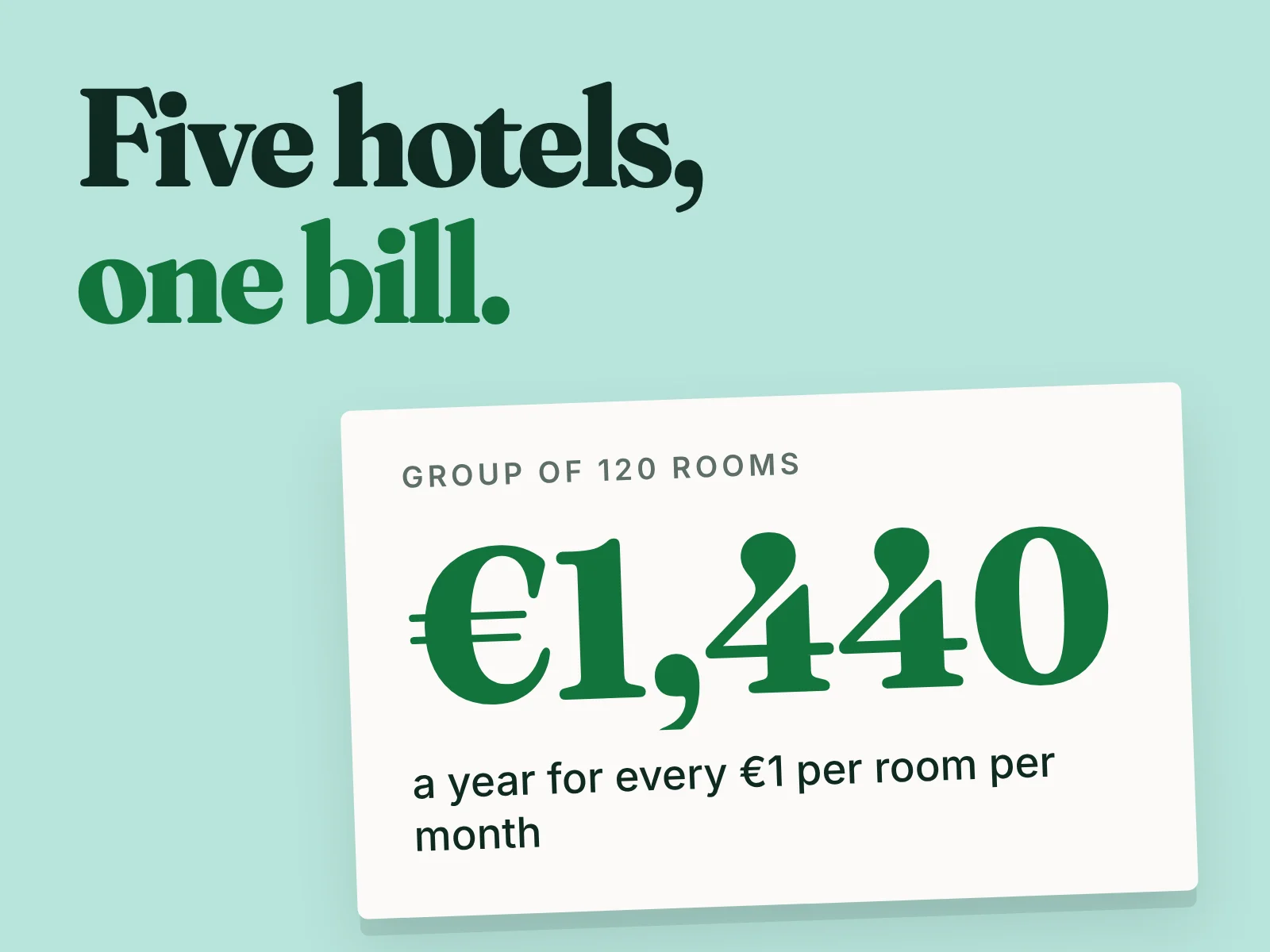
Group software is billed per room, per property, per module and per payment, and the subscription is often not the biggest line. What Mews, Cloudbeds, Apaleo and SiteMinder publish, a worked model and what to ask.
 Tribii
Revenue management for small hotels: what the software does, what it costs and when you need it
Revenue management means the right price for every night and channel. Here is what the software does, what it costs in 2026, and a weekly routine for small hotels that are not ready for it yet.
Tribii
Low season without more commission: how to fill winter rooms directly
Switching on more OTA deals in winter usually means a discount and a commission on the same booking. Here is the arithmetic, and a practical playbook to fill quiet rooms directly, starting with the guests you already know.
Tribii