Commission-free booking engine: what it really means
Every booking engine calls itself commission-free. The phrase is doing different work in each case, and only one version means what you think.
"Commission-free" is the most reliable phrase in hotel software marketing, in the sense that everyone uses it and it reliably means nothing on its own.
It is not usually a lie. It is a claim about one line of a pricing model, made without reference to the other lines. Learning to read the whole model takes about five minutes and saves a percentage of your revenue for as long as you run the property.
What a commission is, structurally
A commission is a fee proportional to the value of a reservation, taken by an intermediary. The OTA takes 15 to 25% because it found the guest.
The reason software vendors avoid the word is that they did not find the guest. The guest was already on your website. Charging a percentage of a booking you generated yourself is difficult to justify, so the fee gets a different name: a booking fee, a transaction fee, a success fee, a processing rate.
The name is not the thing. If the amount you pay rises when the reservation value rises, and the vendor did nothing extra to earn the difference, it is a commission.
That gives you the test. Does what I pay scale with what my guest paid?
The four models, and where the fee hides
Flat monthly fee. You pay a fixed sum, scaled by rooms. Nothing scales with reservation value. This is genuinely commission-free. Your cost per booking falls as you sell more, which is the alignment you want.
Per-booking percentage. The vendor takes 1% to 3% of each reservation. Sometimes only on direct bookings, sometimes on every booking in the system, including the OTA ones you already paid commission on. Little Hotelier's entry Basics tier, for instance, charges 1% of the value of every booking, direct and OTA alike, on top of its monthly fee; the 0% claim holds on their higher Pro tier. That is not hidden, it is on their pricing page, but it is easy to skim past when you are comparing headline monthly numbers.
Freemium. Free up to a limit, paid above it. Commission-free if the free tier really is free and no percentage lurks underneath. The thing to check is what the limit is, and whether the booking engine is inside the free tier or is the reason the free tier exists.
Quote only. No public price, therefore no public model. You find out what you are paying after a demo, and you should ask explicitly, in writing, whether any per-booking fee exists at any tier.
Then the model that is not a pricing model:
Payment-processing markup. The vendor requires their payment product and charges above the going card rate. Standard European card processing sits around 1.4% to 1.5% plus a small fixed fee. Amenitiz, to take a vendor that publishes theirs, states AmenitizPay at about 1.5% plus €0.25, with EU cards from 1.4%, which is a normal market rate rather than a markup. A vendor charging 2.9% while advertising 0% commission has simply moved the commission into the payment rail, where nobody thinks to look.
The single question that settles it
Whose payment account does the guest pay into?
If the money lands in your own gateway account, your own Stripe, your own merchant account, then the software vendor never holds a euro of it. They are structurally incapable of taking a cut of a reservation, whatever their contract says. The only way they can charge you is a fee you can see: a subscription.
If the money lands in the vendor's account and is remitted to you later, they hold your revenue and they set the terms of its release. Now the processing rate matters, the payout schedule matters, the chargeback policy matters, and "commission-free" is a claim about one clause in a document that governs your cash flow.
This is why we built Tribii's booking engine so guests pay directly through your own Stripe account. It is not generosity. It is the only architecture in which "0% commission, always" is a property of the system rather than a promise in the marketing copy.
The fine-print checklist
Before you sign anything, get written answers to these.
- Is there a per-booking fee at any tier? Not "on your plan". At any tier, on any booking type.
- Does that fee apply to OTA bookings too? Some do. You would be paying twice on the same reservation.
- Whose payment account receives the guest's money?
- If it is yours: which gateways are supported, and do I hold the contract with them?
- If it is theirs: what is the processing rate, what is the payout delay, and who eats a chargeback?
- Is the booking engine included in the tier you quoted, or one above it? Several vendors put it a tier up. SiteMinder's booking engine, for example, sits above their entry plan.
- What is the setup fee?
- Is there a minimum contract term, and what happens to the price at renewal?
- Is there a cap or throttle? A "free" plan with a monthly reservation limit is a per-booking fee with extra steps.
- How do I export my reservations and guest data if I leave?
A vendor who answers all ten in an email is a vendor worth talking to. One who answers nine and gets vague about the fifth has told you which clause pays for their office.
Why the distinction is worth the effort
Consider a property with €250,000 of annual room revenue, of which €90,000 comes direct.
A 2% per-booking fee on the direct channel is €1,800 a year. A 1% fee on all bookings is €2,500. A flat plan at €119 a month is €1,428, fixed, whatever the year does.
Now grow the property by 30%. The flat plan still costs €1,428. The percentages grow by 30% with you, forever, in exchange for nothing additional.
That is the whole argument. A percentage is a tax on your success, and unlike the OTA's, it buys you no guests.
The honest summary
"Commission-free" is a claim about the subscription line. Read the payment line, the tier line, and the per-booking line before you believe it.
Ask where the guest's money lands. Ask whether any fee scales with reservation value. Get both answers in writing.
Then compare annual totals rather than monthly headlines, and pick the vendor whose bill does not grow when your business does.
*Vendor pricing models reviewed July 2026 from each company's public pricing page. Our comparison pages set out the dated detail per vendor, and our own pricing states plainly what is free and what is not.*

Tribii
The free booking engine for independent hoteliers. Editorial notes.
More for the kitchen table.
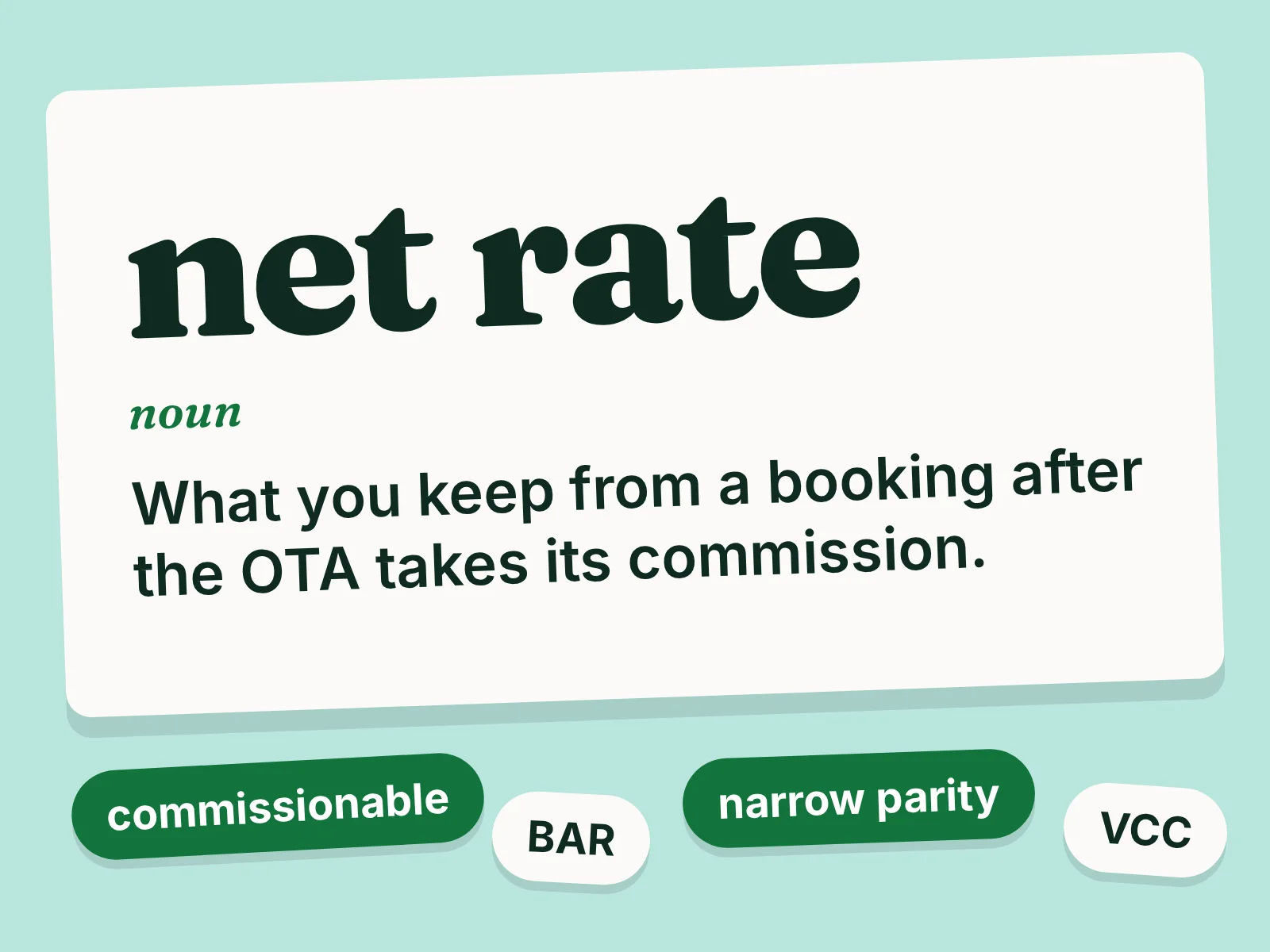
OTA terms explained: a plain-language glossary for independent hotels
Commissionable rate, net rate, merchant model, narrow parity. The words in your OTA contract, explained in plain language, with what each one means for your money.
 Tribii
Booking.com Genius and Preferred Partner: what they really cost a small hotel
Genius and Preferred Partner are sold as growth tools. Both are also a price. Here is what each one costs an independent hotel, how to test whether it pays, and what to decide before 2027.
Tribii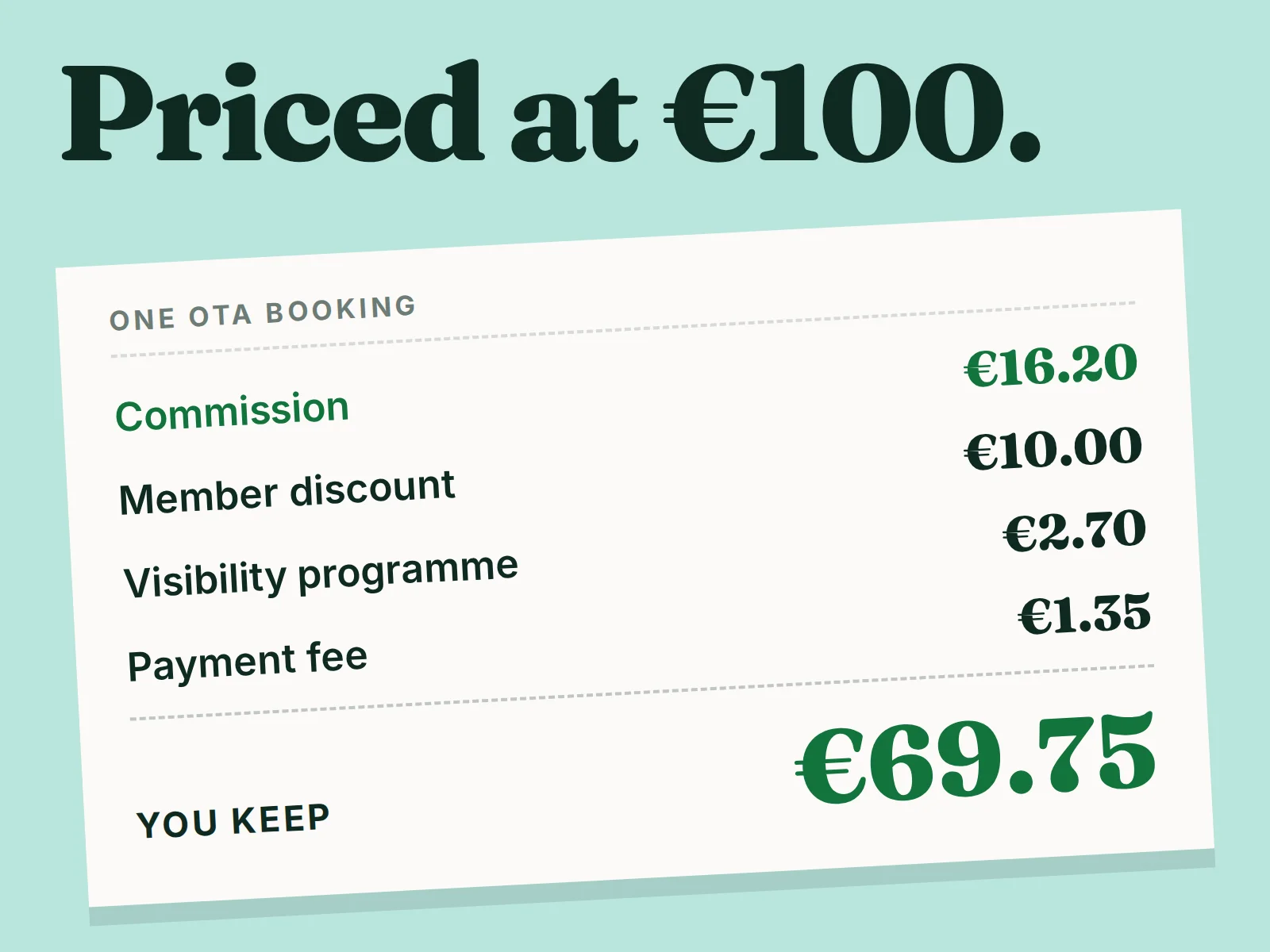
The real cost of an OTA booking: commission is only the first line
Most hoteliers know their commission rate. Few know their effective rate. Here are the other lines on every OTA booking, and how to work out what a room really costs you to sell in 2027.
Tribii