AI agents have started booking hotels. Who keeps the commission?
In the US, a guest can now ask an AI agent in WhatsApp to find and book a hotel, and investors wiped billions off the big OTAs in two weeks. For now those agents mostly book through Booking.com and Expedia. Here is how that could change, what it means for your commission, and what to get ready on your own website.
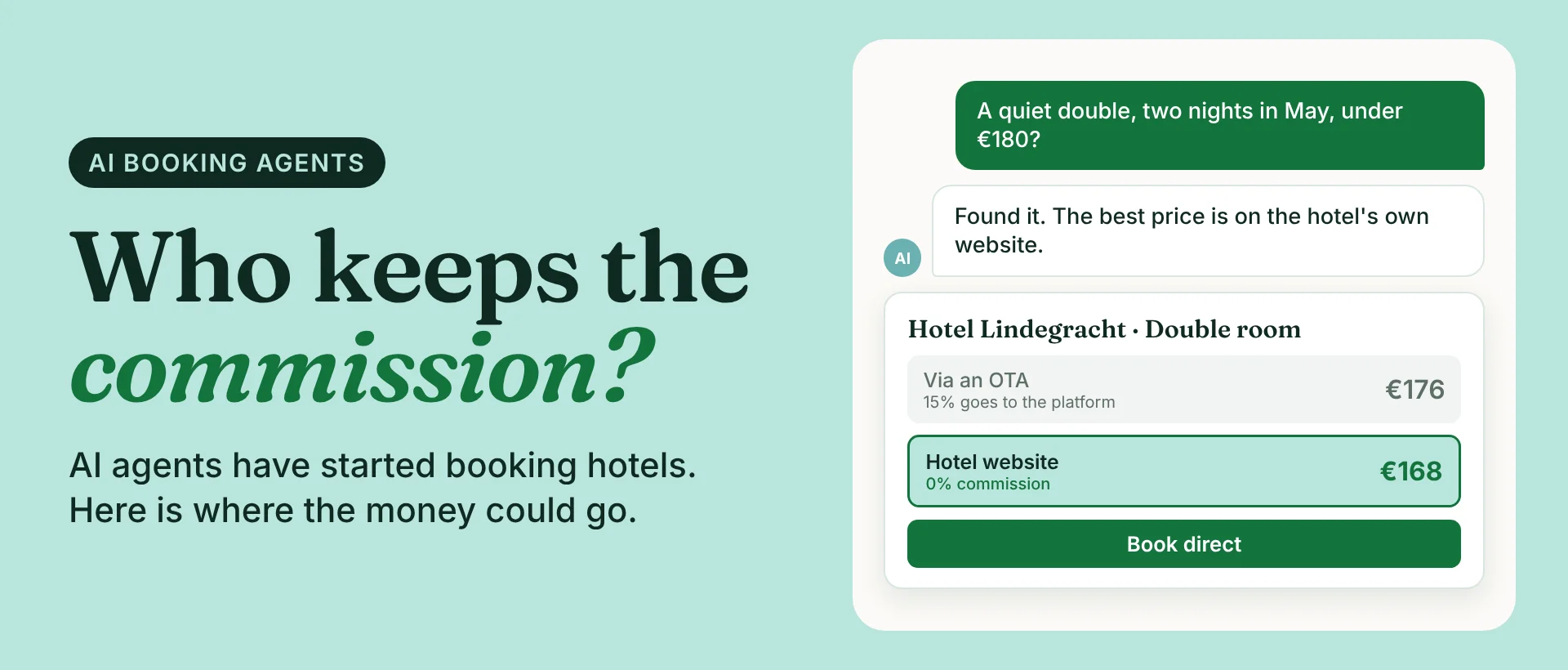
A couple planning a weekend away types a message into WhatsApp: a quiet double room, two nights in May, close to the old town, under €180 a night. A few minutes later the room is booked and paid. They never opened a booking site. They never saw your website, or anyone else's.
That is no longer a demo. In September, Meta launched an AI agent called Muse that does exactly this for people in the United States, and investors reacted within days. It is not available in Europe yet, and booking through agents is still early everywhere, but the direction is clear. In UCP for hotels we covered the formal side of this shift: the shared standard that lets AI assistants book through a direct connection. This piece covers the other two questions hoteliers keep asking. Where does the commission go when an agent makes the booking? And what about agents that do not wait for any connection, and simply use your website?
What happened in September
Meta launched Muse on 8 September 2026. Unlike a chatbot that only answers questions, Muse carries out tasks for the person using it: it sends emails, buys tickets and books trips, using the apps and accounts that person chooses to connect. It runs in its own app and inside WhatsApp, and at launch it is only available to adults in the United States.
Travel was part of the pitch from day one. Expedia announced that travellers will be able to search and book its hotels inside Muse, with Expedia acting as the merchant, starting in the US. That came only weeks after Google started taking hotel bookings in AI Mode, its conversational search, also in the US for now.
Investors read all of this as a threat to the online travel agencies. In an analysis published on 24 September, Thomas Reiner of the Platform Aeronaut newsletter noted that Booking Holdings shares had fallen 21% that month and Expedia and Airbnb around 18% each, roughly $54 billion wiped off the sector in about two weeks.
How an AI agent books a hotel today
The useful detail is how Muse actually books. When the travel publication Skift tested it, it found two separate paths. Flights go through a direct connection to Duffel, a travel technology company that feeds the agent live airline inventory. Hotels do not. For a room, Muse opens a browser and shops consumer websites the way a person would, sites like Expedia and Hotels.com, and the agent itself decides where to search and where to book.
That matters for you, because it is a different route from UCP. There is no integration to sign up for and no list of partners. In principle the agent can book on any website it can read and complete, including yours. In practice, analysts testing these agents found they mostly end up on Booking.com or Expedia unless the user explicitly asks for the hotel's own price.
The reasons are easy to understand. An OTA page is easy for a machine to work with: the price is visible, the policies are written out, checkout works the same way every time, and the site holds the payment and handles any problem afterwards. Many hotel websites make the same job harder. The price hides behind a widget that needs several clicks, the cancellation policy sits in a PDF, or the website is not linked from the hotel's Google listing at all, so the agent never finds it. We wrote about the human version of this in The Second Tab: guests find you on Booking.com and then go looking for you elsewhere. An agent runs the same search much faster, and it is far less patient with a site that gets in the way.
It is also still early. One survey found that 43% of US travellers had used an AI assistant to plan a trip, but only 22% of those went on to book inside the chat. Most guests still finish the booking somewhere else. This is a shift to prepare for, not one that will change your occupancy next month.
Three ways AI booking could go
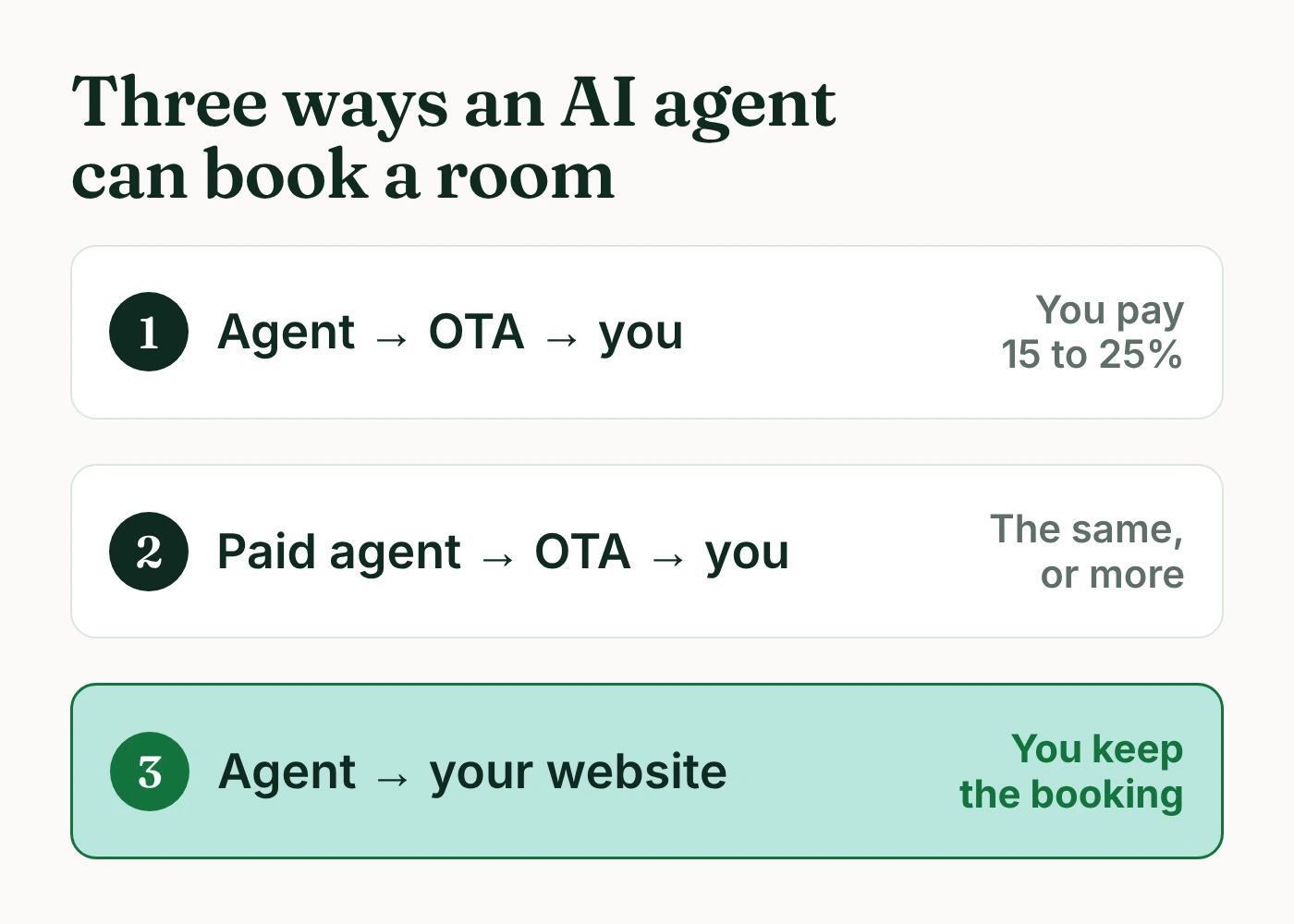
Nobody knows yet how the agents will make money from travel, or where they will send the booking. Reiner's analysis lays out a useful set of scenarios. In plain terms for a hotel, there are three.
1. The agent becomes a new front door to the OTAs. This is roughly where things stand today. The guest talks to an agent, the agent books on Booking.com or Expedia, and you pay the same 15 to 25% commission you pay now. Nothing changes for you, except that the guest's first conversation happens somewhere new.
2. The agent starts charging. Today these agents send traffic for free, and that rarely lasts. The OTAs already spend a large share of their revenue on advertising, most of it with Google, and some of that budget will move to whoever controls the agent. If the agent's fee simply replaces an advertising cost, your commission stays where it is. If it comes on top, expect the OTAs to look for ways to pass it on.
3. The agent goes direct to the hotel. The agent finds the property, reads live rates and availability from the hotel's own system, and sends the guest to the hotel's own booking page. The hotel takes the payment and looks after the guest. The OTA commission falls away, or is replaced by a much smaller fee to the agent. This is the scenario investors are worried about, and as Reiner points out, it does not need Meta to become a travel agency. "It just requires hotels to become bookable."
The third path is the interesting one for an independent property, but it will not happen on its own. An agent can connect once to a hotel chain and reach thousands of rooms. It cannot sign a contract with every independent guesthouse in Europe. That fragmentation is exactly why the OTAs exist, and why the agents route through them today. There is also trust: when a hotel cancels on the day of arrival, the guest wants someone to fix it, and right now that someone is usually the OTA. For a small property, the direct path has to be as easy to find, as easy to finish and as reliable afterwards as the OTA path.
What it could mean for your commission
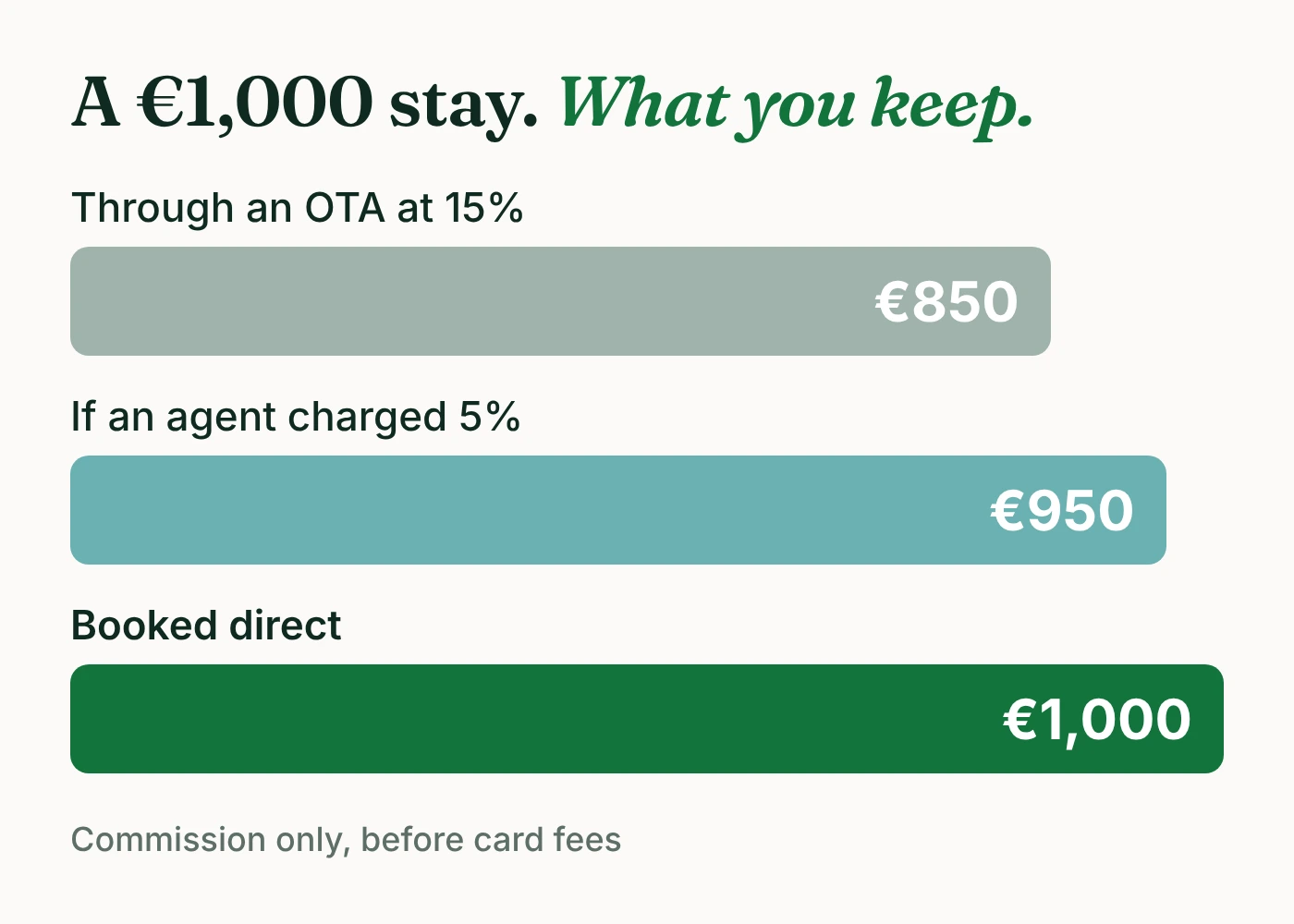
The difference is easiest to see on a single stay. Take a €1,000 booking:
- Through an OTA at 15%, you keep €850.
- If an agent sent the guest to you and charged, say, 5%, you would keep €950.
- Booked direct on your own website, you keep the full €1,000.
Card fees come off a direct booking too, so the real gap is a little smaller, but the order does not change. For a fuller picture of what an OTA booking really costs once you add payment charges and visibility programmes, see The real cost of an OTA booking, or run your own numbers in the OTA calculator.
Why Europe will move later, and why that helps you
None of this is live in Europe yet. Muse has not launched in the UK or the rest of Europe, and Meta has not given a date. That gives European independents something rare: time to get ready. They also have an advantage American hotels do not. Under the EU Digital Markets Act, Booking.com no longer applies rate parity clauses in the European Economic Area, so you are free to sell a room for less on your own website than on Booking.com. That matters much more once agents are involved, because an agent compares every channel, every time. A guest might not notice that your direct price is €8 cheaper. An agent will.
There is a caveat. Hotel associations have complained that properties which sell cheaper elsewhere can still slip down Booking.com's rankings, which is one reason many hotels still keep the same price everywhere. We go through the rules and the risks in Rate parity is gone in Europe.
How to get your property ready for AI booking agents
Formal connections like UCP will reach your property through your booking engine or channel manager. An agent that shops the web needs nothing from you except a website it can use, and that part is in your hands today. Everything on this list also helps human guests, so none of it is wasted if the agents take longer than expected.
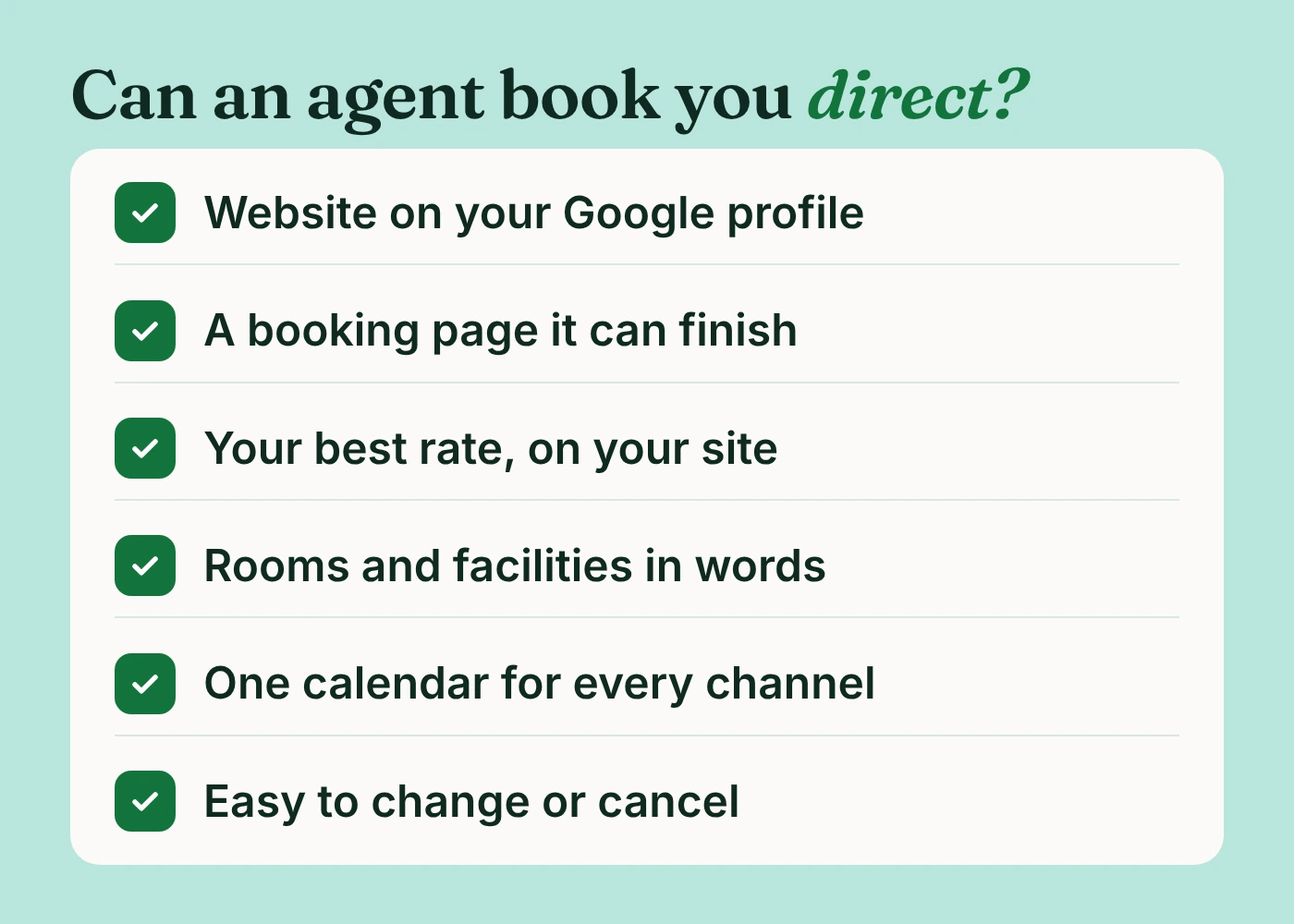
Put your website where agents look. Agents start where people start: a search, a map, a listing. Make sure your website is linked on your Google Business Profile and on every listing you control. A property with no website on its Google listing sends every agent straight to an OTA.
Have a booking page an agent can finish. Show live availability, the total price including taxes, the cancellation policy in plain words, and let guests check out without creating an account. No puzzles just to see a price. If a person can book in two minutes without help, an agent probably can too.
Make your direct rate the best one it will find. An agent compares channels perfectly. If your direct price is higher than your Booking.com price, the agent books Booking.com, and it is right to. A small direct discount or a members rate is the clearest signal you can send.
Describe your property in words, not only photos. Agents match on details: parking, a quiet room, step free access, breakfast included, ten minutes from the station. Write them out on your website, room by room, and add structured data so machines can read them. A beautiful photo of the terrace tells an agent nothing unless the text says there is a terrace.
Keep one calendar for every channel. If an agent sees a room available on Booking.com but sold out on your website, it books Booking.com. Rates and availability should come from one place and reach every channel at the same time.
Make the stay easy to service. Send a clear confirmation email, list a phone number and an email address that someone actually answers, and make it simple to change or cancel. Guests and agents choose OTAs partly because someone sorts out the problems. Show that you will too.
Test it yourself. Ask an AI assistant to find and book a room at your property for real dates, and watch where it goes. If it ends up on an OTA, the reason is usually somewhere on this list.
For more ways to win direct bookings from human guests today, see Twelve ways to get more direct bookings at a small hotel.
Where Tribii fits
We build Tribii for exactly this kind of shift: independent properties that want the booking, the guest and the margin to stay with them.
The free booking engine gives you a booking page with live availability that works as a widget on your current website, as a hosted page of its own, or inside a free Tribii website. Guests pay straight into your own Stripe account, and there is 0% commission on every direct booking. It is free for properties with up to 20 rooms.
On the Pro plan, Tribii gives your property its own MCP server, a standard connection AI assistants can use to read your rooms, rates, facilities and photos and to check a live quote for real dates. It is queryable, not bookable, by design: an assistant can find you and quote you, and the guest then books on your own booking page, at your price, paying you directly. We explain how MCP works in MCP for hotels.
Also on Pro, the Direct Booking Booster checks whether ChatGPT, Claude and Gemini can find and correctly recommend your property, scores how complete your public information is, and points you to the fixes. Our guide to AI visibility for hotels goes deeper on that. The Booster also lets you reward direct guests with member rates and perks, and wins back guests who left a booking half finished. On Max, the channel manager keeps every OTA in sync from one calendar, so an agent sees the same rooms wherever it looks.
Not sure where you stand? The free website audit grades your hotel website in seconds.
Nobody can promise that an AI agent will choose your property over an OTA. What you can control is whether the direct path exists, is easy to find and is easy to finish when the agent comes looking.
Common questions
Can an AI agent book my hotel today?
In the United States, agents such as Meta's Muse can search and book hotels, mostly through OTAs or by completing a booking on a website in a browser. In Europe these agents are not available yet, and no launch date has been announced.
Is this the same as UCP?
No. UCP is a shared standard that lets an AI assistant book through a formal connection with an OTA or a hotel's booking system. Today, Muse books hotels another way: it uses websites in a browser, the way a person would. Both routes are growing, and a property should be ready for both.
Will AI agents replace Booking.com and Expedia?
Not soon. The OTAs are already connecting their inventory to the agents, and most agent bookings still run through them. What is changing is where the guest starts. Over time, more bookings could move to hotels that make the direct path easy, but that will take years, not months.
Do I need an MCP server to be booked by an AI agent?
No. Agents can read and use a normal website, so a clear booking page that is easy to finish is the first step. An MCP server adds a structured way for AI assistants to read your live rates and availability, which makes it easier for them to quote you correctly.
Will AI agents charge hotels a commission?
Nobody knows yet. Today they send traffic for free. Analysts have floated referral fees of around 4 to 6% of the booking, which would still be well below a typical OTA commission, but nothing has been announced and it is not yet clear whether hotels or OTAs would pay.
Can I sell rooms cheaper on my own website than on Booking.com?
In the European Economic Area, yes. Booking.com dropped its rate parity clauses under the Digital Markets Act. Some hoteliers report losing ranking when they undercut, so test it carefully. Our guide to rate parity in Europe covers the details.
In short
AI agents that book hotels have arrived in the US and will reach Europe, though nobody yet knows when. Today they mostly book through the OTAs, because the OTA path is the easiest one for a machine to find and finish. Whether that stays true depends partly on hotels. A property with a findable website, a booking page an agent can finish, its best rate on its own site and one calendar for every channel is ready for whichever way this goes, and those same steps win more direct bookings from human guests right now.
Tribii
The free booking engine for independent hoteliers. Editorial notes.
More for the kitchen table.
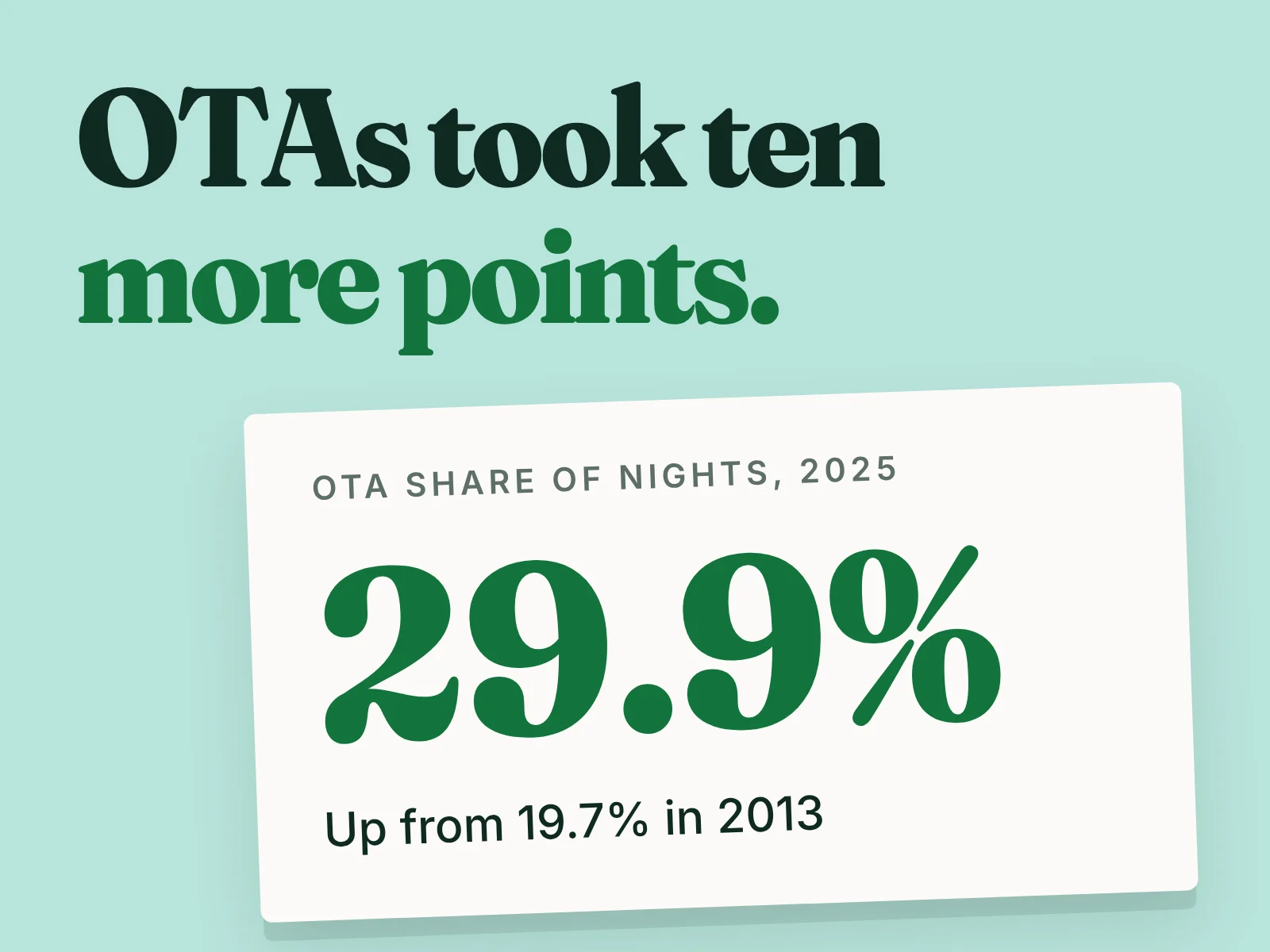
Three in ten hotel nights in Europe now go through OTAs. What the 2026 study means for a small hotel
HOTREC's 2026 study found 51.3% of hotel nights in Europe were booked direct and 29.9% through OTAs, with Booking Holdings taking 68.8% of OTA bookings. What the averages hide, and how to compare your own property.
 Tribii
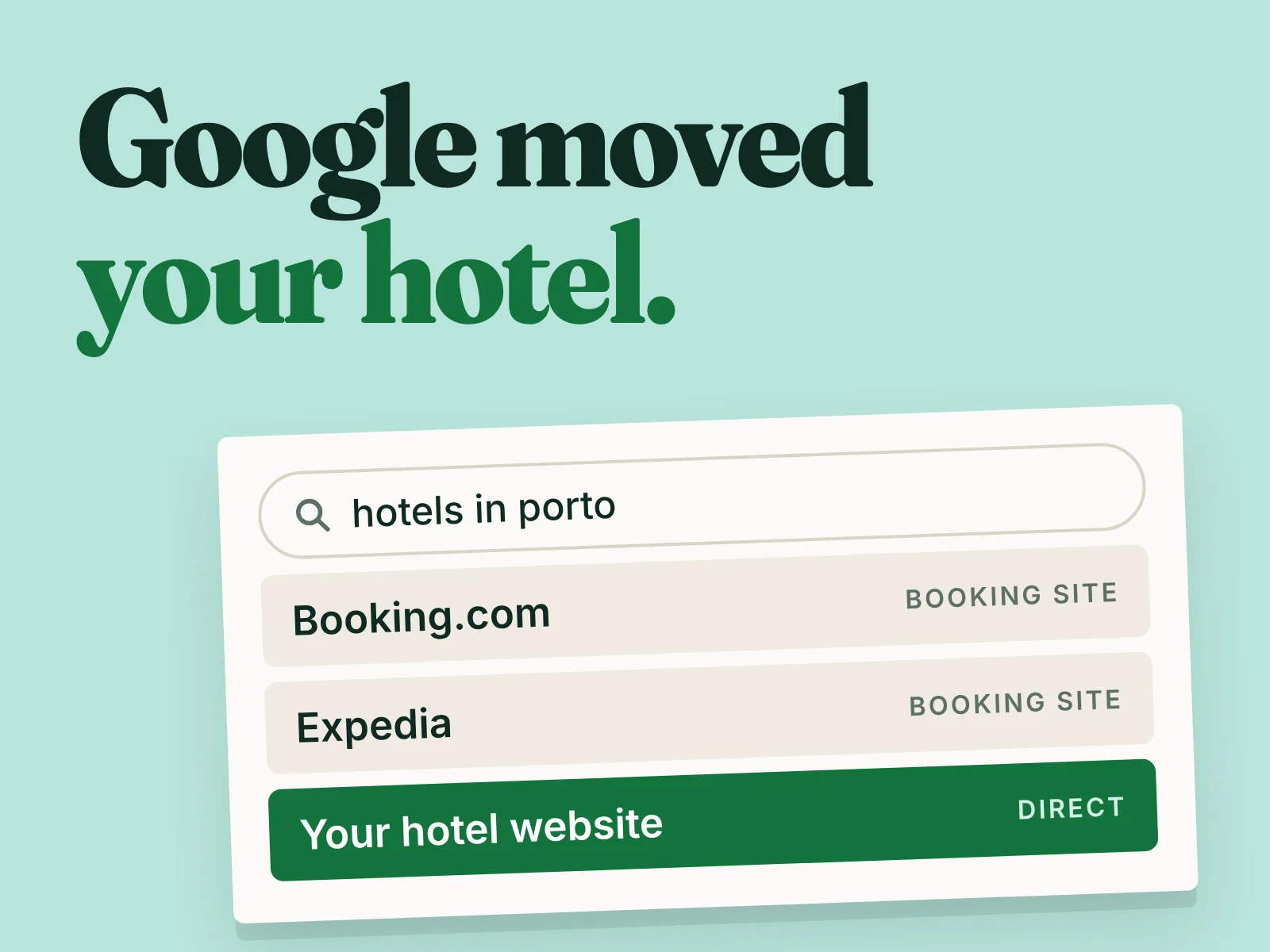
Google changed hotel search in Europe. What it means for your direct bookings
Since 8 September 2026, generic hotel searches in Europe open with booking sites, while hotels' own websites sit lower without live prices. What changed, what has been measured and what your property still controls.
Tribii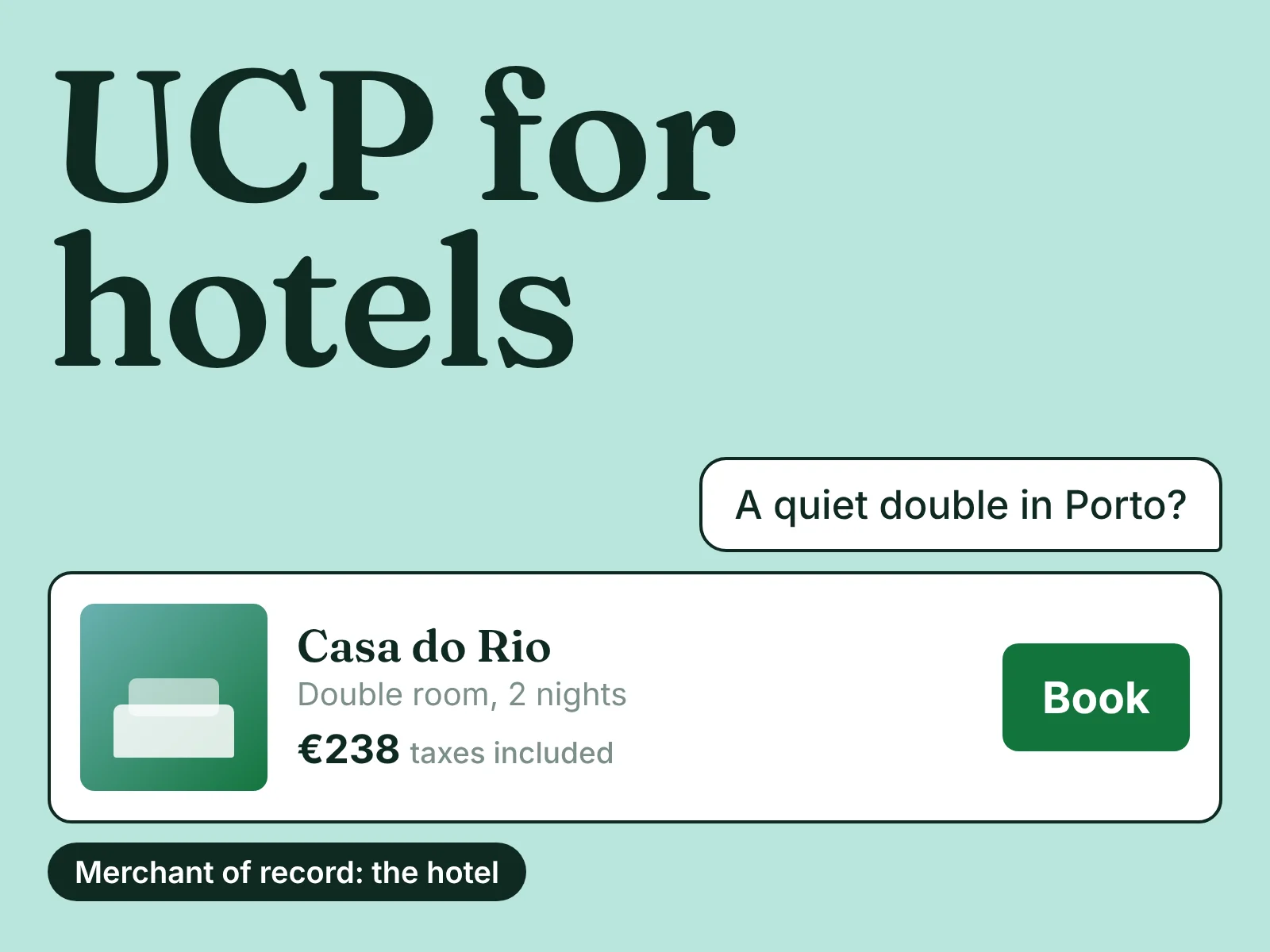
UCP for hotels: the Universal Commerce Protocol and the future of online booking
Google and the biggest names in travel have written a shared language that lets AI assistants book a hotel room inside a conversation. It is called UCP. Here is what it is, who keeps the guest, and what independent hotels should do before it reaches Europe.
Tribii