Three in ten hotel nights in Europe now go through OTAs. What the 2026 study means for a small hotel
HOTREC's 2026 study found 51.3% of hotel nights in Europe were booked direct and 29.9% through OTAs, with Booking Holdings taking 68.8% of OTA bookings. What the averages hide, and how to compare your own property.
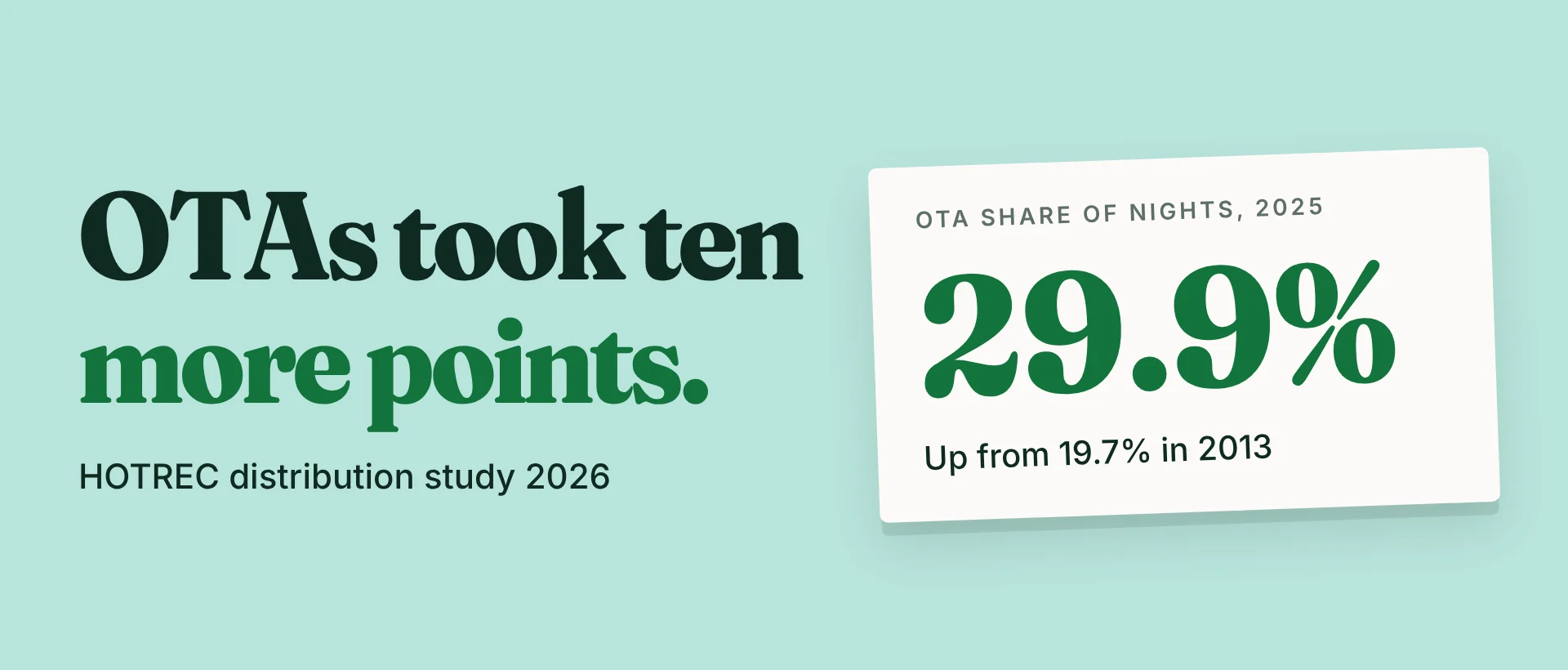
Every two years, Europe's hotel associations ask their members where their guests came from. The answers for 2025 were published on 15 September 2026 in the seventh European Hotel Distribution Study by HOTREC, the European association of hotels, restaurants and cafés.
Hotels still sell more than half of their nights directly. The detail is less comfortable. Online travel agencies (OTAs) now account for almost three in ten nights, up from one in five in 2013, and two groups take 85.4% of that OTA business.
This piece covers what the study found, why the average can hide how dependent one property is, the debate that followed, and how to compare your own numbers.
The short answer
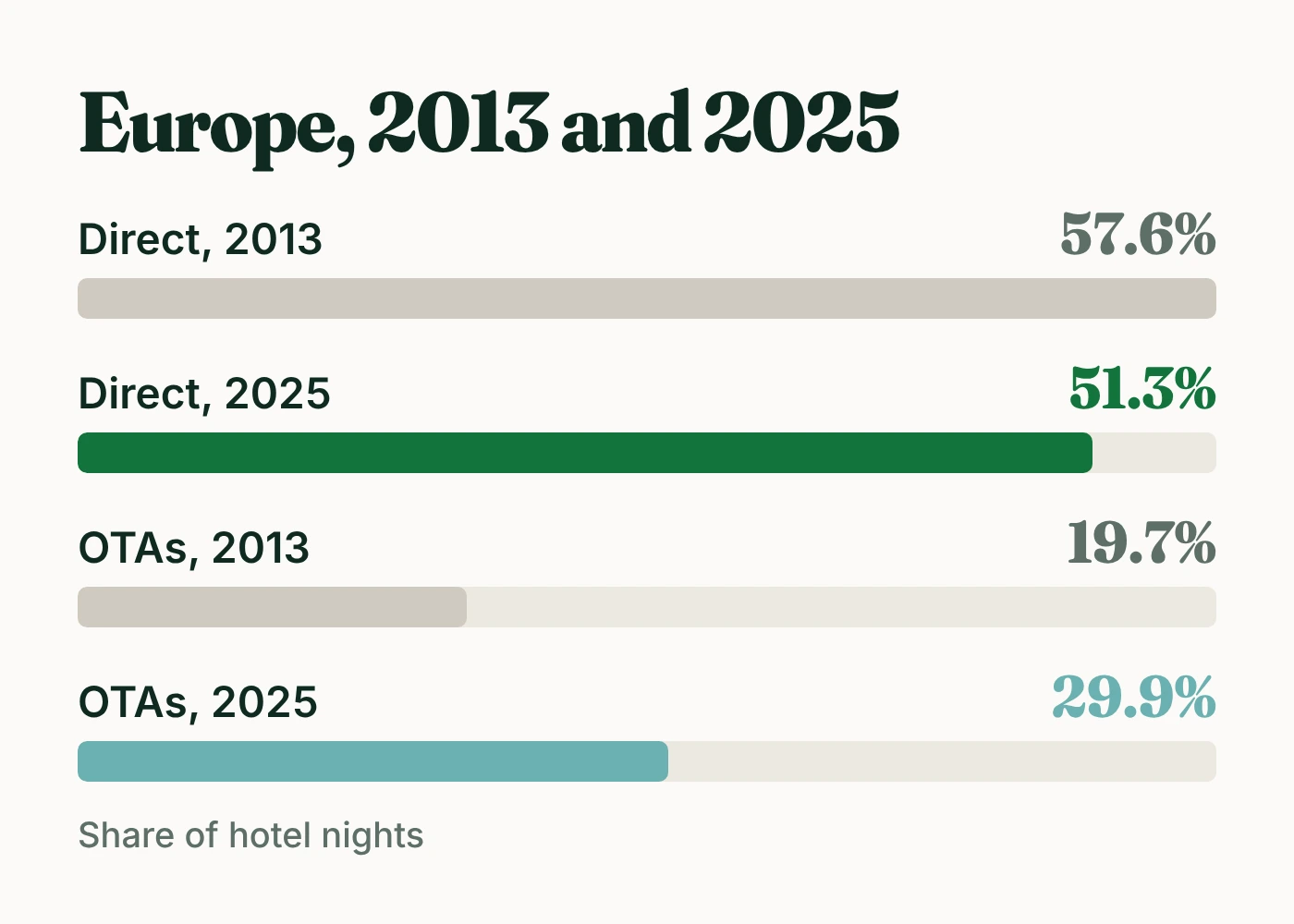
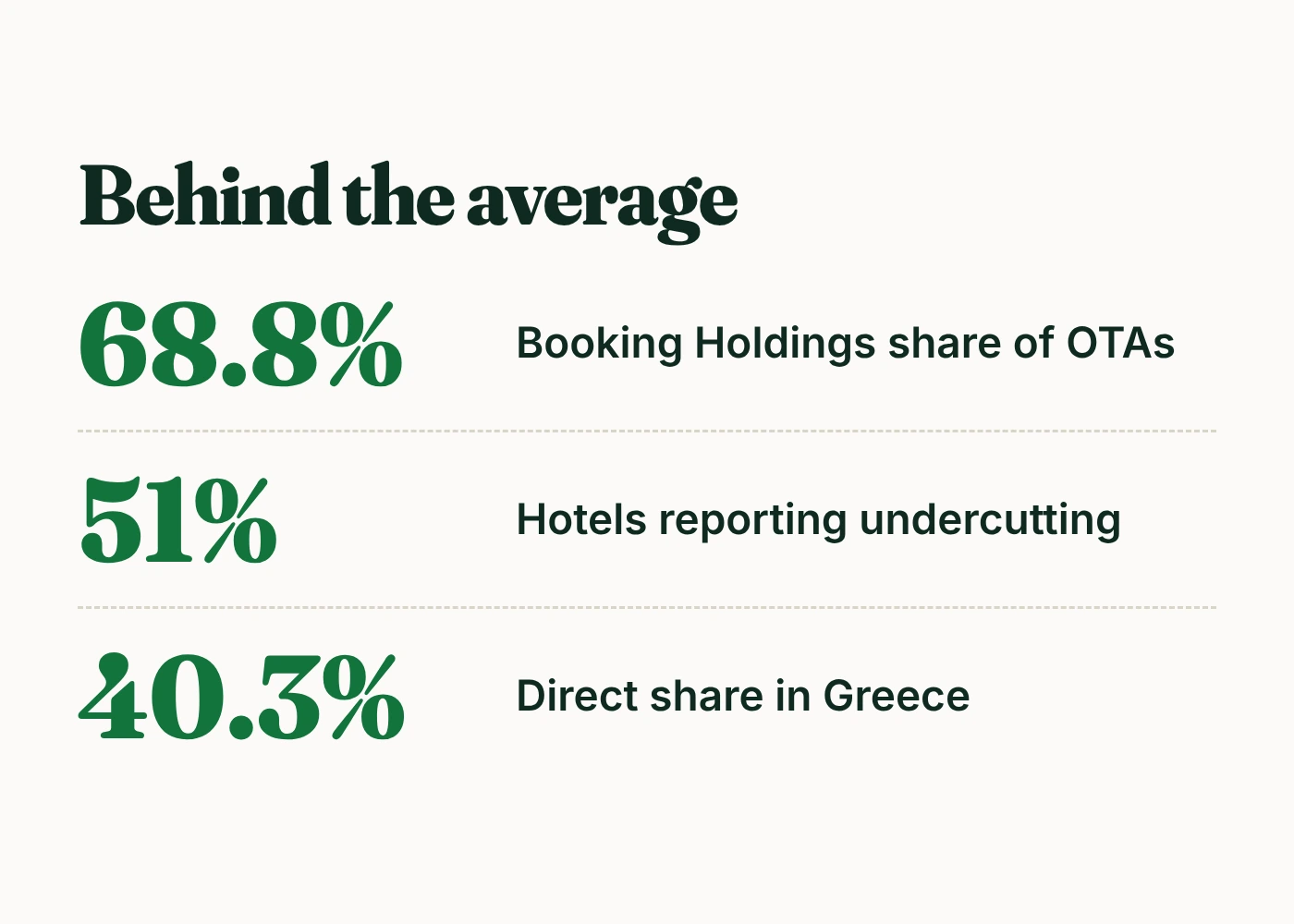
In 2025, 51.3% of hotel nights in Europe were booked directly with the hotel, down from 57.6% in 2013. OTAs took 29.9%, up from 19.7%. Booking Holdings had 68.8% of OTA bookings and Expedia Group 16.6%. And 51% of hotels say OTAs frequently or occasionally sell their rooms below the hotel's own price, up from 43% in 2023.
For a small hotel, the useful number is not the European average but your own mix. Pull last year's room nights by channel, work out what each channel really cost, and compare. If more than half your nights come through OTAs, or one platform supplies most of them, you are more exposed than the typical hotel in the study, and one clear target for your direct share is a sensible place to start.
What the 2026 study found
The study was led by Professor Roland Schegg of HES-SO Valais-Wallis in Switzerland, with HOTREC and national hotel associations. Fieldwork ran from February to May 2026. It covers 2,713 hotels: 1,882 individual responses from 28 countries plus aggregated data from 831 chain properties. The median hotel has 39 rooms, so the sample leans towards smaller properties.
One detail matters when you compare: the channel shares are shares of overnight stays, not reservations. Your PMS can report the same measure.
Direct is still the largest channel. It took 51.3% of nights in 2025, against 57.6% in 2013. Over the last two years it has barely moved: the figure for 2023 was 50.9%.
The direct channel has changed shape. Phone bookings fell from 20.5% of nights in 2013 to 14.1%. Bookings through a real-time booking engine on the hotel's own website nearly doubled, from 7.4% to 13.9%. Email slipped from 14.9% to 13.5%.
OTAs hold their ground. Their 29.9% share is 10.2 points above 2013 and roughly level with the 29.6% reported for 2023.
Two groups hold the OTA layer. Booking Holdings, which owns Booking.com, Agoda and Priceline, had 68.8% of OTA bookings, up from about 60% in 2013, with Booking.com alone at 66.1%. Expedia Group had 16.6%. Since 2023, Booking Holdings has slipped from 71.0% and Expedia has risen from 14.4%, but their combined 85.4% is unchanged.
Undercutting is more common. 51% of hotels say OTAs sell their rooms below the hotel's own price frequently or occasionally, eight points more than in 2023. Four in five of those affected say they never agreed to it.
Resale is widespread, and often invisible. 44% of hotels report that their rates or rooms are passed on to other sites through platforms or partners. Another 26% do not know whether it happens to them.
Cancellations differ by channel. Average reported cancellation rates were 9.1% for bookings on the hotel's own website, 11.7% for Expedia and 19.0% for Booking.com.
The tools are spreading unevenly. 66% of hotels use a channel manager, 58% have a permanent connection to metasearch (83% of those through Google Hotel Ads) and 26% use AI in some form.
Why the average is not your number
Averages smooth over what matters to a single property. Four findings suggest a small independent hotel can be more exposed than the headline implies.
1. Independents lean on Booking.com more than chains do. Within OTA bookings, Booking.com's share was 69.4% at independent hotels and 56.3% at chains. At chains, Expedia takes around a third. If you run an independent property, your largest OTA is very likely Booking.com, as it is for most of your competitors.
2. OTAs grew faster than direct shrank. Since 2013 direct lost 6.3 points, but OTAs gained 10.2. Much of the difference came from traditional intermediaries: tour operators and travel agencies fell from 10.3% to 8.1% of nights, and wholesalers from 3.4% to 1.8%. A hotel can hold its direct share steady and still see its intermediary business concentrate.
3. Undercutting is rising. A cheaper price for your room on another site works against your direct rate, whether or not you agreed to it. Under the Digital Markets Act, Booking.com can no longer stop you offering a lower price on your own website, which gives you room to respond, as our guide to rate parity in Europe explains.
4. Country and location change everything. In Greece, direct channels fell from 54.7% of nights in 2013 to 40.3% in 2025. Only 8.7% came through real-time bookings on hotel websites, while tour operators and travel agencies supplied 25.4%.
In Germany, direct was 59.7% and OTAs 31.9%, yet Booking.com took 69.2% of German OTA bookings. In Austria, direct was 59.9% and Booking Holdings had 73.9% of the OTA market. Strong direct sales and heavy concentration can sit side by side.
The study itself notes that small independent hotels show the strongest direct performance, while large, urban and chain hotels, and those with more stars, rely more on OTAs. If you sit well below the 51.3% average, there is probably room to improve. If you sit above it, still check how much of your OTA business runs through one platform.
The 20% debate, and what the court said
On 22 September 2026, Peter Lochbihler, Booking.com's global director of public affairs, argued on Hospitality Net that European distribution is balanced and competitive. Citing the study, he wrote that direct remains the largest channel, that hotels use several channels, and that "no single online travel agency accounts for more than 20% of all bookings". He also cited the reach and reviews platforms give smaller properties.
On 7 October 2026, Markus Busch, publisher of hospitality.today, replied on the same site. OTAs had 29.9% of nights and Booking Holdings 68.8% of those, which comes to about 20.6% of all nights, or about 19.8% for Booking.com alone. Lochbihler's piece used a figure of 27.8% for online platforms, which keeps every group under 20%.
The gap is about one point. Busch's more useful point is that 20% is an average across hotels, many of which sell far more through OTAs. At an independent hotel selling 60% of its nights through OTAs, a 69.4% Booking.com share means about 42% of all its nights come from one platform.
Both things can be true. Booking.com brings guests many small hotels would struggle to reach alone, and the average hotel does still sell just over half its nights directly. What matters is where your property sits.
The court. On 9 September 2026 the EU General Court dismissed Booking's challenge to the European Commission's 2023 decision blocking its purchase of Etraveli, a flight booking company. The court accepted that the deal would have strengthened Booking's already dominant position in the market for online travel agencies in the hotel sector. Booking said it disagreed on the facts and the law and was considering an appeal to the Court of Justice.
The regulators. Booking is a designated gatekeeper under the Digital Markets Act. HOTREC wants the Commission to enforce the act effectively and to keep the safeguards of the P2B Regulation, the EU rules that make platforms give businesses notice of changes to their terms and explain how ranking works. The Commission's proposed Digital Omnibus would repeal that regulation, which HOTREC says puts those protections at risk.
An illustrative example: one hotel against the study
Take an illustrative 20-room independent hotel that sold 4,000 room nights last year at an average of €110, or €440,000 of room revenue. Its PMS shows:
Booking.com: 2,000 nights (50%), €220,000.
Expedia: 400 nights (10%), €44,000.
Own website booking engine: 600 nights (15%), €66,000.
Phone and email: 800 nights (20%), €88,000.
Front desk and other direct: 200 nights (5%), €22,000.
Against the study, the hotel's direct share is 40%, eleven points below the European 51.3% and close to the Greek figure. Its OTA share is 60%, twice the 29.9% average. Booking.com supplies 83% of its OTA nights, against 69.4% at independents, and half of all its nights, against roughly a fifth on average. The website performs well: 15% of nights through the booking engine, slightly above the European 13.9%.
Now the cost. Add up commission, visibility programmes, funded discounts and payment fees, as in the real cost of an OTA booking. Say Booking.com came to €46,200, an effective 21%, and Expedia to €8,800, or 20%.
That is €55,000 a year, or €13.75 on every night the hotel sold through any channel. Website bookings cost about 1.5% in card fees, €990.
The target: move ten points of nights, 400 nights, from Booking.com to direct over two years. At 21% against 1.5%, each €110 night moved keeps about €21.45 more, so 400 nights is worth about €8,580 a year once the target is reached. Direct would then be 50%, close to the European average, while OTAs would still supply half of all nights. That is fine, as long as it is a choice.
How to compare your own property
1. Pull last year's nights by source. Export room nights for the last twelve months by channel: each OTA, your booking engine, phone, email, the front desk, tour operators and groups. Use nights, as the study does, not reservations.
2. Work out three shares. Your direct share of nights, your OTA share, and the share of your OTA nights from your largest platform. Put them next to 51.3%, 29.9% and 69.4%.
3. Add up what each channel really cost. Headline OTA commission rates are only the first line. Include visibility programmes, discounts you fund, payment fees and the cost of cancellations, then divide by the revenue each channel brought.
4. Compare like with like. Use your country's figures where your national association publishes them. A Greek resort and a German business hotel will never have the same mix.
5. Set one target and track it monthly. For example, five more points of direct share by the end of next year. One number reviewed monthly beats a long plan nobody checks.
6. Decide which channels earn their place. A channel that brings guests you would not otherwise reach, in low season or from distant markets, can be worth its effective rate; one that mostly sells to guests who would have found you anyway is the one to work on. Many guests find a hotel on an OTA, then open a second tab to look for its website, so make sure yours shows rates and takes the booking. It is also worth checking how your hotel now appears in Google search, since Google changed its hotel results in Europe on 8 September.
Where Tribii fits
The exercise above needs two things: your nights and revenue by channel, and a booking engine that charges no commission on the guests you win back. Any good PMS and booking engine should give you both.
Tribii's reports and booking engine are ours. The free OTA commission calculator estimates what OTAs cost you each year from your rooms, rate, occupancy, OTA share and commission, and what moving 20% of reservations to direct would save. The reports on the Free plan include your payment and channel mix. Pro, at €55 a month, adds advanced reports with revenue, bookings, ADR and length of stay by channel, which you can export to CSV, Excel or PDF.
The booking engine is free for up to 20 rooms, then €5 a month per extra room. It takes 0% commission, and guests pay you through your own Stripe account, so Tribii never holds the money. If you sell on several OTAs, the channel manager on Max, at €95 a month with 60 rooms included, keeps rates, availability and reservations in two-way sync with Booking.com, Airbnb, Expedia and others, and Max also includes an AI OTA reconciliation tool.
None of this replaces an OTA that brings you guests. It makes it easier to see which ones do.
Common questions
What is the HOTREC European Hotel Distribution Study?
A survey of how hotels in Europe sell their rooms, run every two years by HOTREC with HES-SO Valais-Wallis and national hotel associations. The 2026 edition, the seventh, was published on 15 September 2026 and covers 2,713 hotels in 2025.
What share of hotel bookings in Europe go through OTAs?
29.9% of hotel nights in 2025, up from 19.7% in 2013. Direct bookings with the hotel accounted for 51.3%, and the rest came through tour operators, travel agencies and other intermediaries.
What is Booking.com's market share in Europe?
Booking Holdings, which owns Booking.com, had 68.8% of OTA bookings at European hotels in 2025, and Booking.com alone 66.1%. At independent hotels, Booking.com's share of OTA bookings was 69.4%. As a share of all hotel nights, that works out at roughly a fifth on average.
Is a 60% OTA share too high for a small hotel?
It is twice the European average, so you are more exposed than most hotels in the study. Whether it is too high depends on what those nights cost and how many you could win directly, so work out your effective rate per channel first.
Do the headline figures include chain hotels?
Only partly. The European channel shares are weighted estimates that leave out the aggregated data from 831 chain properties, so they mainly reflect independent and smaller hotels, although about a quarter of individual respondents belong to a chain. Chain data is used for comparisons, such as Booking.com's 56.3% share at chains.
The honest summary
Europe's hotels still sell just over half their nights directly, and that share has held steady since 2023. But OTAs have gained ten points since 2013, two groups hold 85.4% of that business, and more hotels say their prices are being undercut.
The European average is a benchmark, not a verdict. Put your own nights by channel next to it, work out what each channel costs, and choose one target for the year. Your own direct share and effective OTA rate will tell you more than any average.
Figures reviewed October 2026 from the HOTREC European Hotel Distribution Study 2026 (press release, executive summary and full study), its German and Austrian summaries, HOTREC's 2024 study for some 2023 comparisons, the EU General Court's press release of 9 September 2026 and opinion pieces on Hospitality Net. Channel shares are shares of overnight stays, and country figures are unweighted survey results. The worked example is illustrative. This is not legal or financial advice.

Tribii
The free booking engine for independent hoteliers. Editorial notes.
More for the kitchen table.

Google changed hotel search in Europe. What it means for your direct bookings
Since 8 September 2026, generic hotel searches in Europe open with booking sites, while hotels' own websites sit lower without live prices. What changed, what has been measured and what your property still controls.
 Tribii
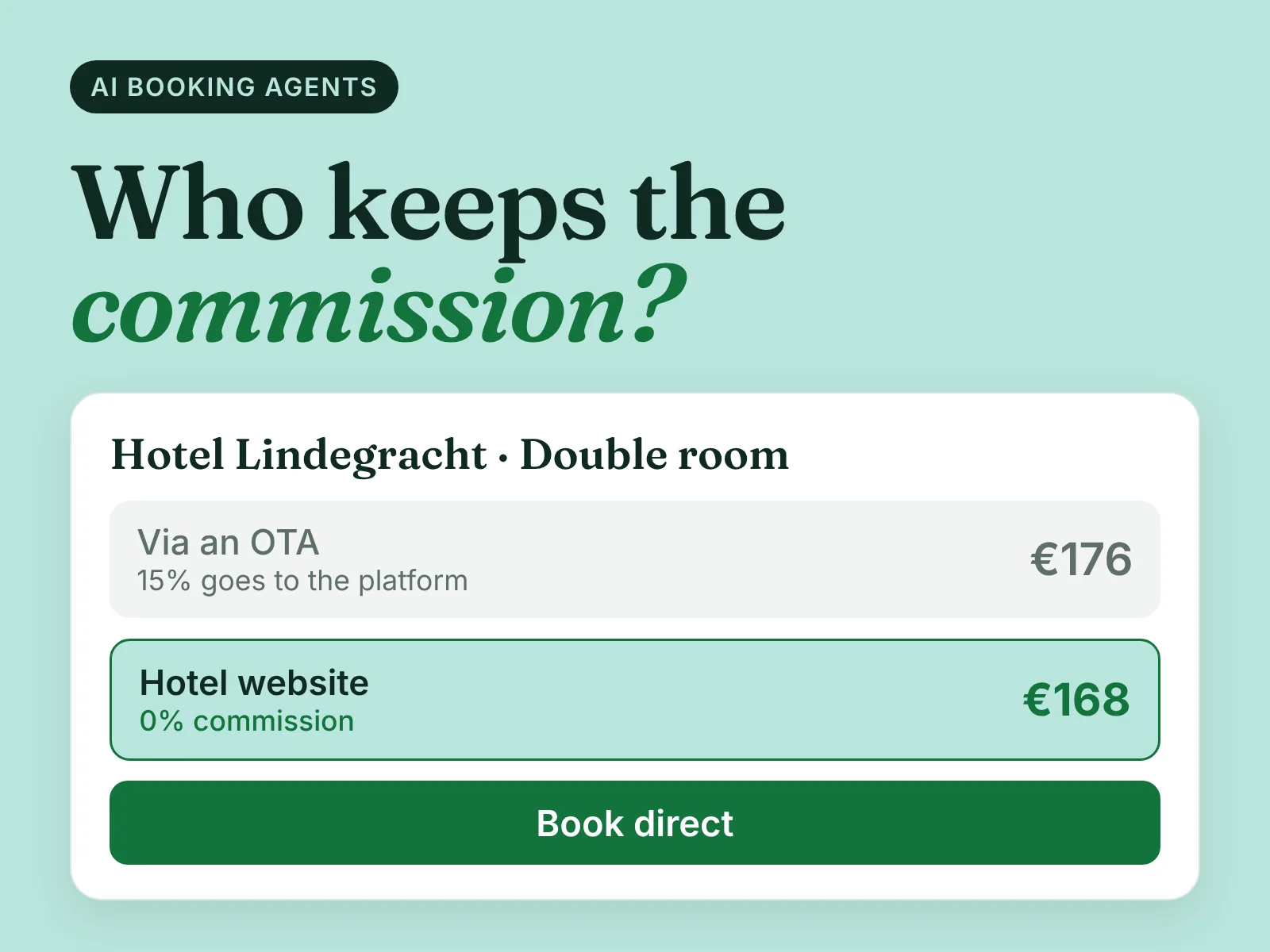
AI agents have started booking hotels. Who keeps the commission?
In the US, a guest can now ask an AI agent in WhatsApp to find and book a hotel, and investors wiped billions off the big OTAs in two weeks. For now those agents mostly book through Booking.com and Expedia. Here is how that could change, what it means for your commission, and what to get ready on your own website.
Tribii
UCP for hotels: the Universal Commerce Protocol and the future of online booking
Google and the biggest names in travel have written a shared language that lets AI assistants book a hotel room inside a conversation. It is called UCP. Here is what it is, who keeps the guest, and what independent hotels should do before it reaches Europe.
Tribii