Google changed hotel search in Europe. What it means for your direct bookings
Since 8 September 2026, generic hotel searches in Europe open with booking sites, while hotels' own websites sit lower without live prices. What changed, what has been measured and what your property still controls.
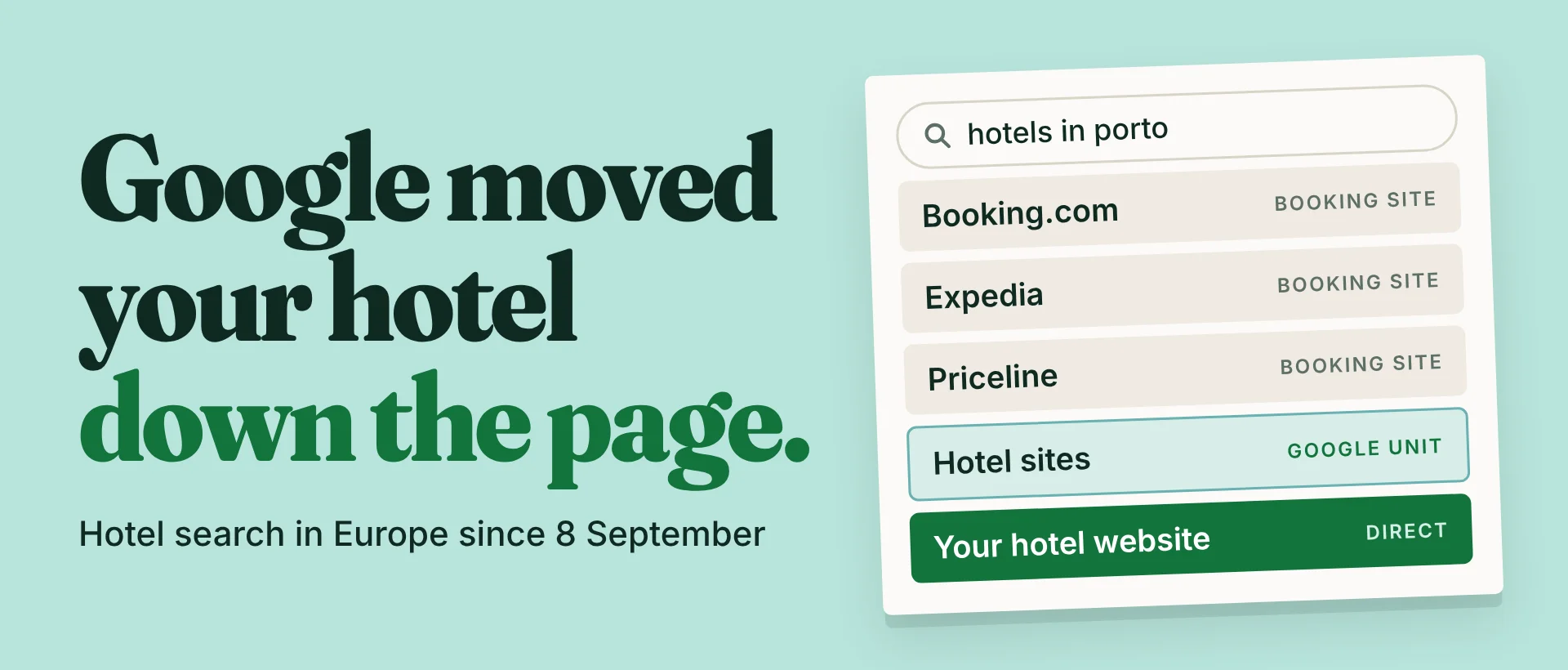
On 8 September 2026, Google changed what people in Europe see when they search for a hotel. A search such as "hotels in Porto" now opens with a block of booking sites. Individual hotels still appear, but in a separate unit further down, with fewer details and no live prices.
A Google official told Reuters it was the "largest reduction in quality of service" in the 29 years of Google Search. Google has a reason to say that loudly: it is in a dispute with the European Commission over these rules. The change is real all the same, and it touches the free visibility small hotels have relied on for years.
This piece sets out what changed, what has actually been measured and by whom, and what a small property can still control. Most of it is housekeeping you can do in an afternoon.
The short answer
For generic hotel searches in the European Economic Area (EEA), Google now shows booking sites such as Booking.com and Expedia first, then a separate unit for hotels' own websites with less detail and no live rates. Your direct channel loses some free visibility on searches like "hotel in [your town]". Hotels have not been removed, and Google says you do not need to apply to appear.
What you control is everything around that: the website link on your Google Business Profile, a website that shows rates and takes bookings, guests who already know your name, your reviews and your OTA listing. Measure your own Search Console data before you decide anything costly.
What changed on 8 September
The background is a fine. On 23 July 2026 the European Commission fined Google €460 million under the Digital Markets Act (DMA) for ranking its own shopping, hotel, transport and sports results above rival services. That was part of a €890 million total that also covered Google Play. Google had 60 days to comply or face periodic penalty payments, and the new layout is its answer.
Google's Search Central documentation describes two new units for hotel searches made by users in the EEA.
The aggregator unit. This is for booking sites that Google has approved as vertical search services: OTAs, metasearch sites and directories. Only one aggregator unit appears on a page, and every click in it goes to a booking site. Inside it, the provider Google ranks first is expanded by default with photos, prices or star ratings, and searchers can switch to another. Reuters described it as one provider at the top and two others with fewer details.
The supplier unit. This is for direct providers, such as an individual hotel, and it only appears when the aggregator unit does. The hotel SEO specialist Lluc B. Penycate, who documented the rollout, calls it a Hotel sites module, with individual hotels and links to their official websites.
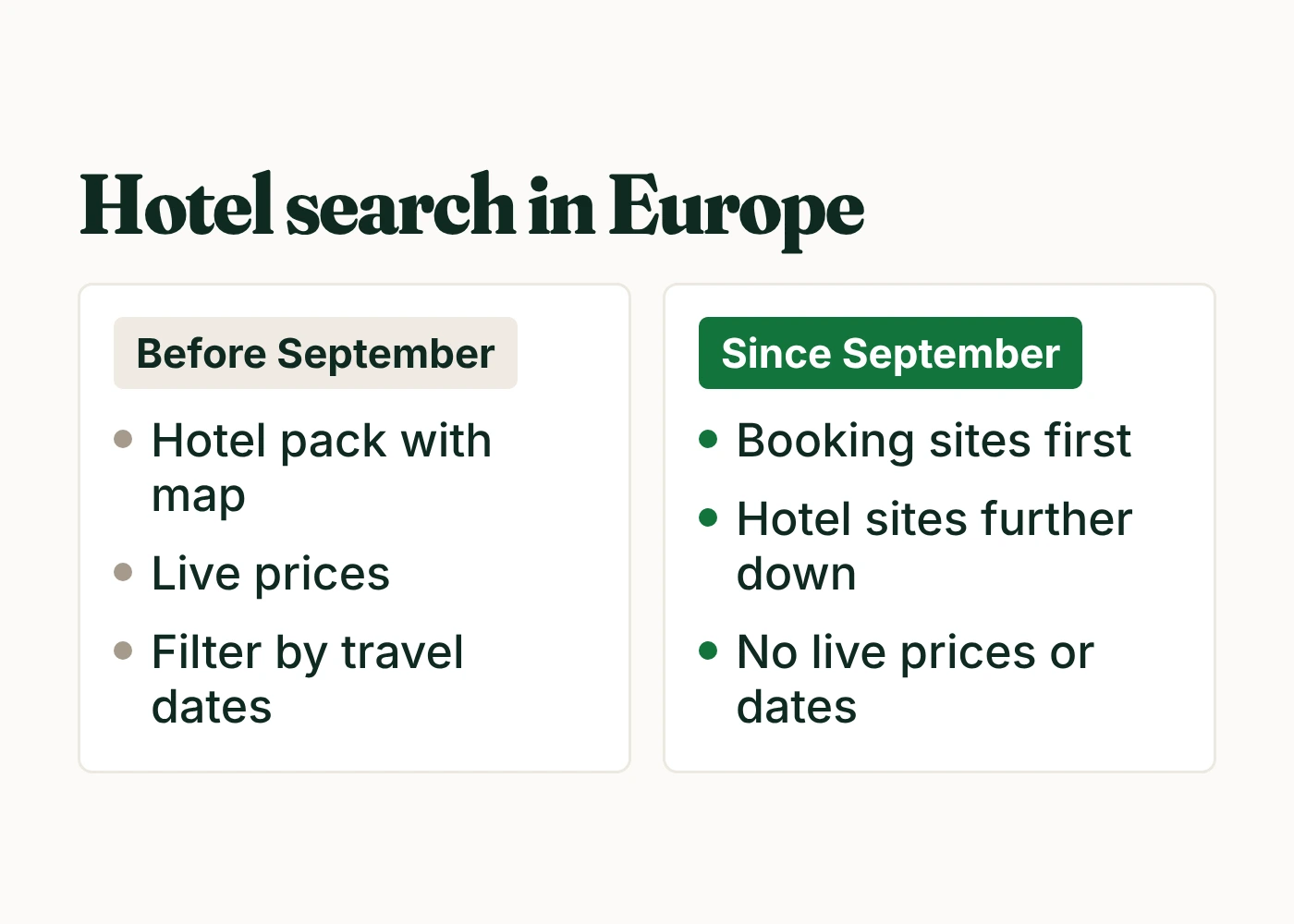
Reports on prices differ: Penycate saw prices in the module, while Reuters reported that real-time prices were stripped from the hotel carousel. Skift reported that searchers can no longer filter it by travel dates.
The map. The traditional Hotel Local Pack is gone from these searches, replaced by the block of booking sites. The SEO specialist Malte Landwehr reported that the hotel map that remains no longer clicks through to Google Maps.
Holiday rentals. Skift reported that Google removed its holiday rentals unit from European results. Rental feeds still power Google Maps and Google's dedicated hotel pages.
Two limits matter. Google documents these units for users in the EEA only, so a guest searching from the UK, Switzerland or the United States should see the standard layout. And when we reviewed this in October 2026, we found no public verdict from the Commission on whether the new design complies, so it may change again.
What has actually been measured
There are three sets of numbers worth knowing, and none of them measures the September 2026 layout itself.
Google's own test. In late 2024 Google removed the hotel map and hotel results in Germany, Belgium and Estonia and showed plain links instead. It reported that searchers were less satisfied, that hotels lost more than 10% of their traffic and that traffic to booking sites stayed largely flat. Google stopped the test and did not publish the underlying method.
Google's 30% figure. Google says its earlier DMA changes cut free direct booking clicks to some European businesses by as much as 30%. When it first gave this figure in 2024, it described it as what airlines, hotels and small retailers had reported to it. Google is a party to the dispute, so read its numbers with that in mind.
Industry data from 2024. Mirai, a hotel technology company, compared 3,450 hotels from January to April 2024. It found Google Hotel Ads clicks about 30% lower in DMA markets than elsewhere, with direct bookings down by as much as 36%. D-EDGE, another hotel technology company, analysed independent hotels and small groups in the EU over the same months and found organic traffic to hotel websites down 20% year on year and free booking link revenue down 32%. Total digital revenue for the same hotels still rose 11%.
So the direction is consistent. When Google gives booking sites more room, hotel websites get fewer free clicks from generic searches. The size of the effect varies by hotel, and when we reviewed this we found no independent figures for the new layout. Your own data is the best measure you have.
What you control, and what you do not
Out of your hands. The order of the units, which booking site is expanded first, whether live prices return to the main results, and what the Commission decides next.
Partly yours. Whether and how you show in the supplier unit. Google says it needs no data beyond what it can crawl on your website, and that you must serve guests in the EEA and be a direct provider. Data feeds can enrich the listing but are optional. In practice, your website is the raw material Google works from.
Fully yours. Your Business Profile, your website and its booking engine, your direct rate, your reviews, your OTA listing, and how you treat guests who already know your name.
That last group matters more than it looks. The reported changes centre on generic searches, and Google's 2024 test left searches for a specific hotel alone.
Many guests find you on Booking.com and then search your name to check you out, a habit we described in the second tab. Those guests are looking for you, not for a list. If the result they land on is clear and bookable, the new layout above it matters much less.
What to check this month
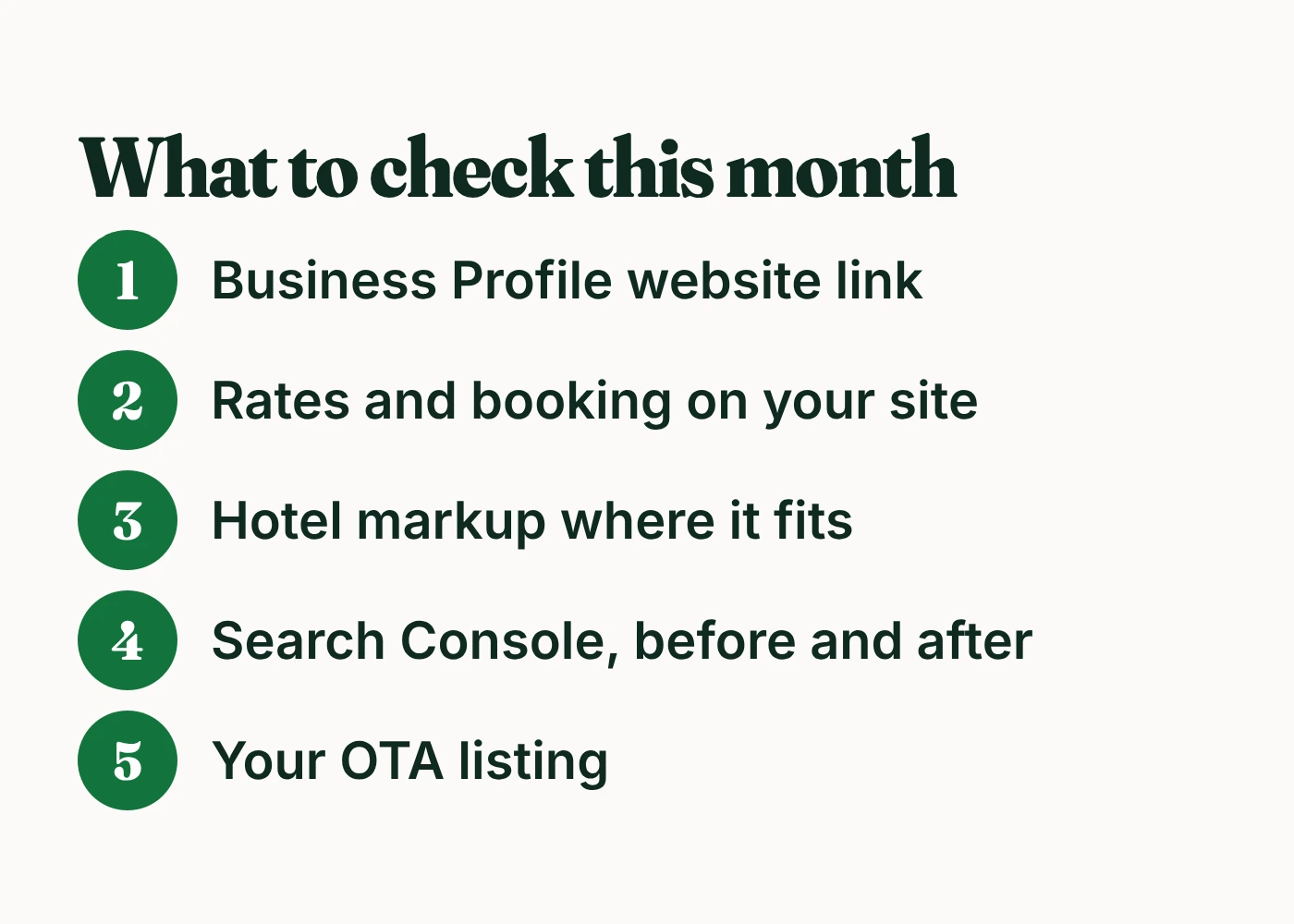
1. Your Business Profile website link. Search your property's name and look at the Website button in the panel. Many small properties leave it empty or point it at their OTA listing, which means paying commission on guests who searched for you by name. Point it at your own website, ideally the page where guests can book. We explain why this is the quickest win in twelve ways to get more direct bookings.
2. Rates and booking on your own website. If Google builds the supplier unit from what it crawls, a site that says "contact us for prices" gives it little to show and the guest little reason to stay. Show your rooms, a starting price per night and a booking engine on the site itself. Booking.com no longer requires rate parity in the EEA, so your direct rate can also be your best one, as we covered in our guide to pricing your direct rate.
3. Hotel markup where it fits. Structured data using the schema.org Hotel and Offer types tells search engines and AI assistants your name, address, rooms and prices without guesswork. Google does not list it as a requirement for the supplier unit, but it removes ambiguity. Google's separate structured data carousel for the EEA needs a page listing at least three properties, each with its own page, so it mainly suits small groups. The practical detail is in our guide to AI visibility for hotels.
4. Search Console before and after 8 September. In the Performance report, compare clicks and impressions for the weeks after 8 September with the weeks before. Demand shifts with the season in September, so also compare with the same weeks of 2025. Filter by country to separate searchers in the EEA from those in the UK or the US, and split queries containing your name from generic ones. If generic clicks fell while brand clicks held, the change hit discovery rather than demand.
5. Your OTA listing. Guests now see booking sites first, so your OTA listing is often the first impression. Keep photos, descriptions and policies current, and answer reviews there as you do on Google. A strong listing is also what sends guests to search your name afterwards.
6. Hotel Ads, on numbers rather than nerves. Paid Hotel Ads and free booking links both need your rates sent to Google through an approved integration partner, and Google says direct integration is currently unavailable because of high demand. After 30 September 2026 Google stopped filling Hotel Ads with rates it had sourced from third parties, so Hotel Ads now need a direct price feed. If your booking engine or channel manager already works with Google, test a small budget and compare the cost per booking with your OTA commission. If it does not, weigh the cost of a separate connection against the commission those bookings would save.
Writing in Hospitality Net, Markus Busch noted that hotel rates still appear on Google Maps and Google's dedicated hotel pages in Europe, one click away from the main results. That is worth knowing before you decide how much the free view matters to you.
Search is not only blue links any more
Skift reported that the changes also apply to AI Overviews and AI Mode where relevant, and in July the Commission said it was still discussing with Google how its decision applies to them. Meanwhile, more guests ask ChatGPT, Gemini and other assistants where to stay.
Many of these assistants draw on your website, much as Google's crawler does. The work above, a clear official site with visible rates, consistent details and a working booking engine, is also what helps you get recommended. We look at who keeps the commission when an assistant does the booking in AI agents have started booking hotels.
Where Tribii fits
The job is simple to describe: an official website that states your rates and takes the booking on the spot, so that whichever unit, profile or assistant sends a guest, the click lands somewhere it can convert. Any good website builder paired with a commission-free booking engine can do this.
Tribii's free hotel website is ours. It is free up to 20 rooms, shows every room with its photos and price, and has the booking engine built in, with 0% commission and payments into your own Stripe account. Pro (€55 a month) adds the website SEO tools, including an AI SEO audit, a page per room, FAQ content and Search Console and Google Analytics connections, plus Direct Booking Booster with AI search visibility checks. Your own domain comes with Max (€95 a month).
Our free website audit works on any hotel website. It checks titles, Schema.org markup, the sitemap, whether bookings happen on your own domain and your Google review count, and it needs no account, only an email address for the report. Tribii does not send rates to Google, so it cannot switch on free booking links or Hotel Ads for you.
Common questions
Has Google removed hotels from search results in Europe?
No. Hotels appear in a separate unit for direct providers, below the booking sites, with links to their own websites. What they have lost on generic searches is space, live prices and the date filter.
Do I need to apply to appear in the Hotel sites unit?
No. Google says you need to serve users in the EEA and be a direct provider, and that it needs no data beyond what it can crawl on your website. Feeds can enrich your listing but are optional.
Does this affect guests searching from outside Europe?
Google documents these units for users in the EEA only. A guest searching from the UK, Switzerland or the United States should see Google's standard layout.
Are free booking links gone?
No. Google's help pages still describe them, but your rates must reach Google through an approved integration partner, since self-service rates in the Business Profile ended in July 2025. Hospitality Net reports that in Europe, hotel rates now show mainly on Google Maps and Google's hotel pages rather than in the new search units.
Will the layout change again?
Possibly. The Commission had not said publicly whether it accepts the design when we reviewed this, and Google said in July that it was weighing an appeal. Check your Search Console data monthly rather than reacting to each headline.
The honest summary
Google has given booking sites the top of generic hotel searches in Europe and moved hotels' own websites into a smaller unit without live prices. Google's own figures and industry data from 2024 point to fewer free clicks for hotel websites, though we found no independent numbers for this layout yet.
What you control has not changed much: a Business Profile that points to your own website, a site that shows rates and takes bookings, a healthy OTA listing and guests who search your name. Do those well, measure before and after 8 September, and spend on ads only when the numbers say so.
Facts reviewed October 2026 from the European Commission's decision of 23 July 2026, Google Search Central and Google help pages, Google's statements to Reuters, Google's 2024 test report, Mirai and D-EDGE data, and reporting by Search Engine Roundtable, Skift and Hospitality Net. Google's layout in the EEA may change again, and results vary by market and query. This is not legal advice.
Tribii
The free booking engine for independent hoteliers. Editorial notes.
More for the kitchen table.
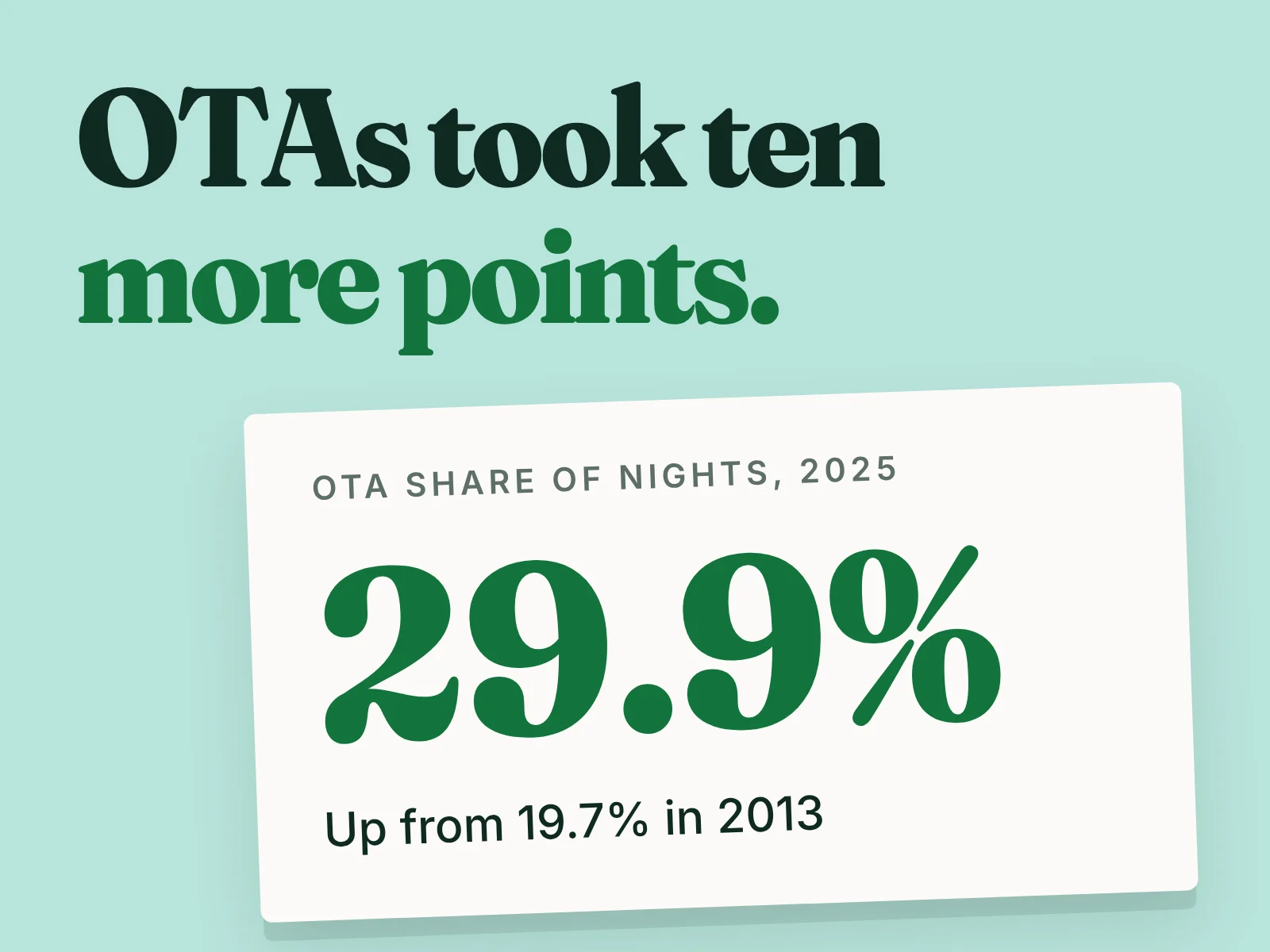
Three in ten hotel nights in Europe now go through OTAs. What the 2026 study means for a small hotel
HOTREC's 2026 study found 51.3% of hotel nights in Europe were booked direct and 29.9% through OTAs, with Booking Holdings taking 68.8% of OTA bookings. What the averages hide, and how to compare your own property.
 Tribii
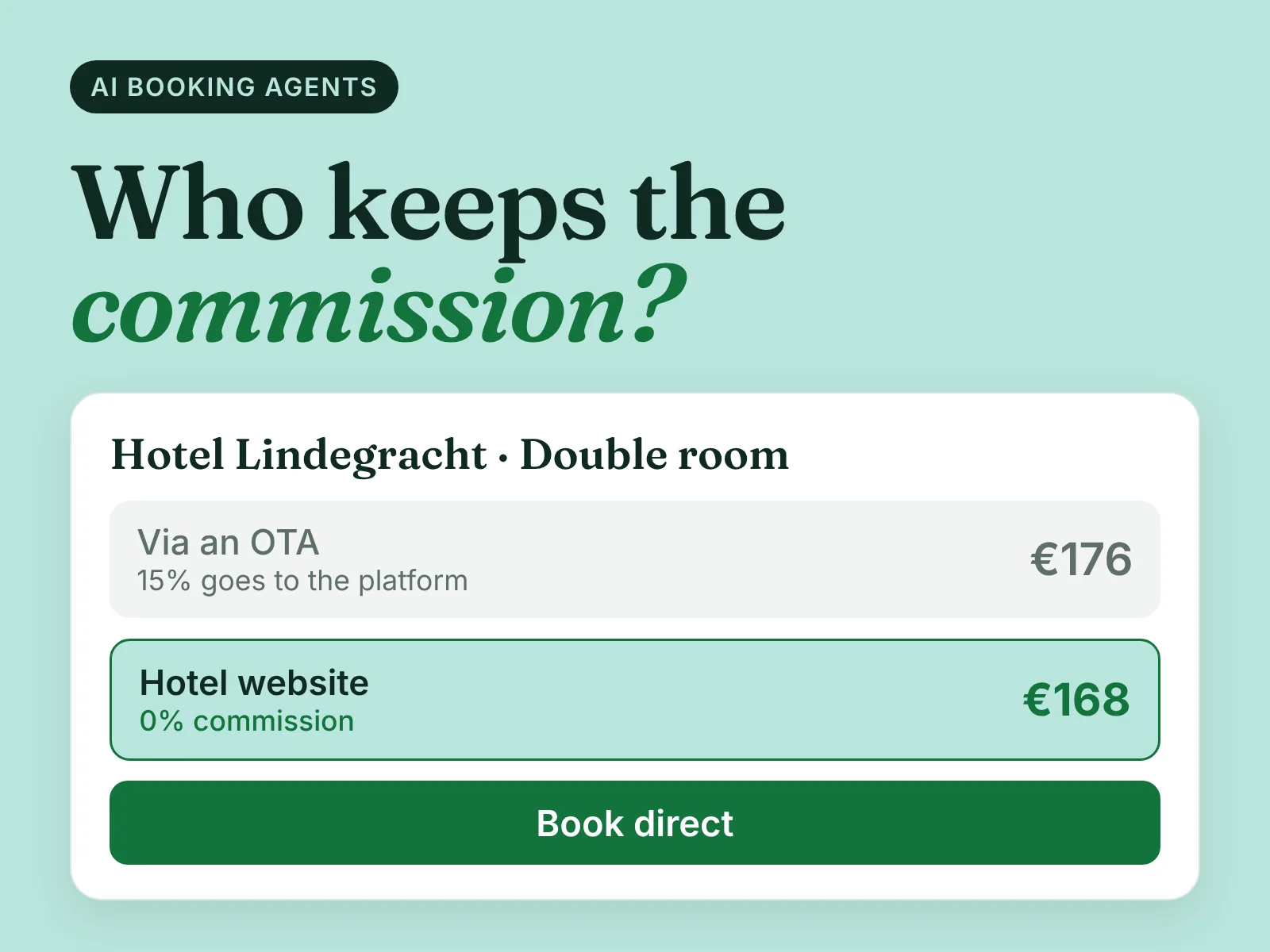
AI agents have started booking hotels. Who keeps the commission?
In the US, a guest can now ask an AI agent in WhatsApp to find and book a hotel, and investors wiped billions off the big OTAs in two weeks. For now those agents mostly book through Booking.com and Expedia. Here is how that could change, what it means for your commission, and what to get ready on your own website.
Tribii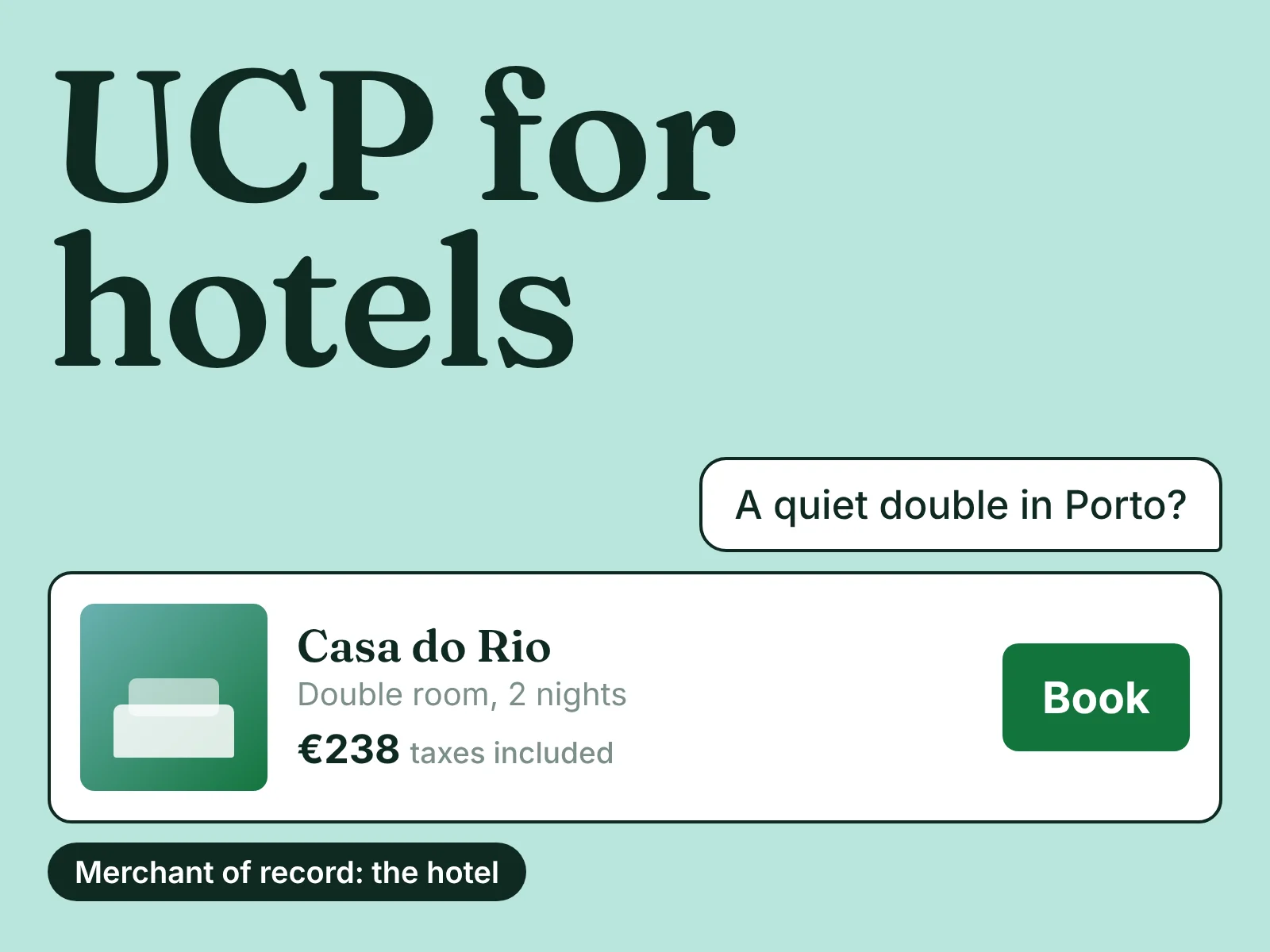
UCP for hotels: the Universal Commerce Protocol and the future of online booking
Google and the biggest names in travel have written a shared language that lets AI assistants book a hotel room inside a conversation. It is called UCP. Here is what it is, who keeps the guest, and what independent hotels should do before it reaches Europe.
Tribii