Own your guests
An OTA booking doesn't hand you a guest. It hands you a stay, and the OTA keeps the name, the email and the right to ever talk to that person again. Here's what that costs an independent hotel, and how Tribii is built on the opposite assumption.

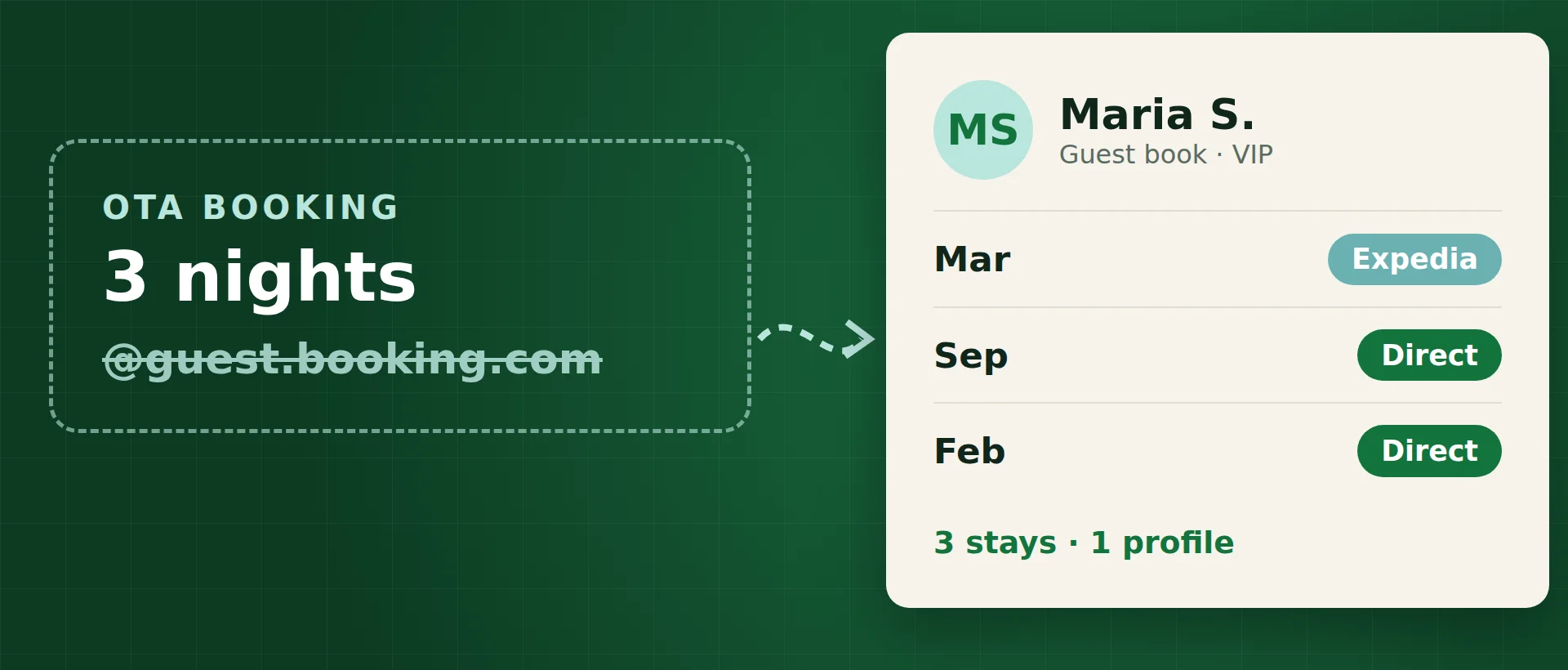
A guest books your double room on Booking.com for three nights in May. The reservation lands in your system with a name, a country, a price and an email address that ends in guest.booking.com. They arrive, they sleep well, they leave a nine out of ten. A week later that email address no longer reaches anyone.
You didn't get a guest. You got a stay.
The name, the real email, the history, and the right to ever speak to that person again all stayed on the other side of the transaction. Next spring, if they come back, they'll most likely find you the same way. And you'll pay the same commission to host someone you already know.
This piece is about that gap: what an OTA booking actually hands over, what it keeps, what the law now says about it, and how we built Tribii on the opposite assumption. The guest record belongs to the property.
The rented guest
Start with the scale of it. The European Hotel Distribution Study, run by HOTREC with HES-SO Valais-Wallis across more than 3,000 hotels, is the most reliable picture we have. Its 2024 edition (reference year 2023) found:
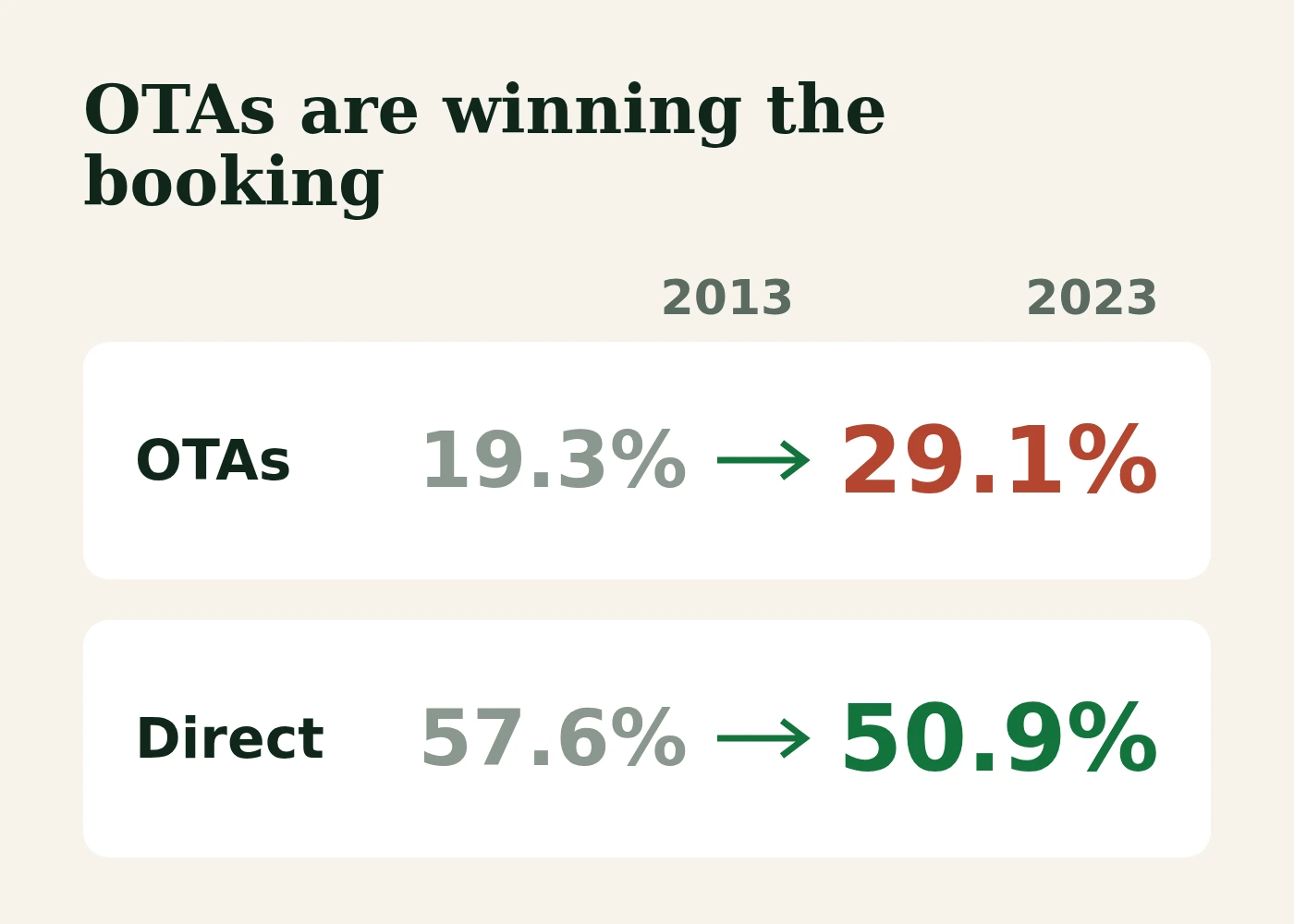
- OTAs handled 29.1% of overnight stays, up from 19.3% in 2013. That's ten points in a decade.
- Direct bookings fell from 57.6% to 50.9% over the same period.
- Booking Holdings holds 71% of the OTA market, up from 60% in 2013. With Expedia Group, two companies control around 86% of it.
- Every fifth hotel gets more than half its business from OTAs; another 28% get between 30 and 49%.
- Hoteliers list the lack of direct guest contact among the main problems with platforms.
That last point is the one that compounds. Since 2015, Booking.com has replaced guests' real email addresses with anonymous aliases. Its own partner help centre says it plainly: "we don't share private email addresses." The alias works for messages about the stay and stops working shortly after checkout. What you're left with is a reservation record that looks like a customer and behaves like a receipt.
So what does renting a guest actually cost?
You pay for the introduction every time. Commission on Booking.com starts around 15% in Europe and climbs with visibility programmes; Expedia typically sits higher (we broke the numbers down here). Paying that to meet someone new is a marketing cost you can reason about. Paying it again on their second, third and fourth stay is a tax on a relationship you already earned.
You can't prepare for them. Without a history, the returning guest arrives as a stranger. The receptionist asks for their address again. Nobody knows they always book the late breakfast or the wine tasting.
You can't ask them back. No email, no consent, no way to say "we have your room free the week you came last year."
Your numbers lie to you. If the same person books twice through two channels and your system creates two records, you can't even tell what share of your guests come back. That share is the single best measure of whether a hotel is building something or just filling rooms.
What the law now says, and what it doesn't
Things have moved. In May 2024 the European Commission designated Booking as a gatekeeper under the Digital Markets Act, and since 14 November 2024 Booking has had to comply. Two obligations matter here:
- Parity clauses are banned. Booking can no longer stop you offering a better price or better conditions on your own website than on its platform.
- Data access. As a business user, you are entitled to real-time, continuous access to data provided or generated through your use of the platform.
That's real progress. But read the second one carefully. Under the DMA, personal data is only shared where the guest has opted in. The regulation opens a door; it doesn't hand you the guest. The address a guest types into your own booking page, the consent they give you directly, the history you keep in your own system: that is still how ownership is earned. And the parity ban only helps if you have a direct channel worth being cheaper on.
In other words: the law now lets you compete for the relationship. It doesn't compete for you.
Ownership is a decision made in the schema, not the copy
Every hotel software company says it gives you your data. The question is what the software does when the rules get awkward.
In Tribii, the hotel is the data controller for its guests. Tribii only executes. That reads like a line from a data processing agreement, and it is. But it's also the product philosophy, because it decides who may write to a guest's record, who may email them, who may erase them, and who keeps the relationship after checkout.
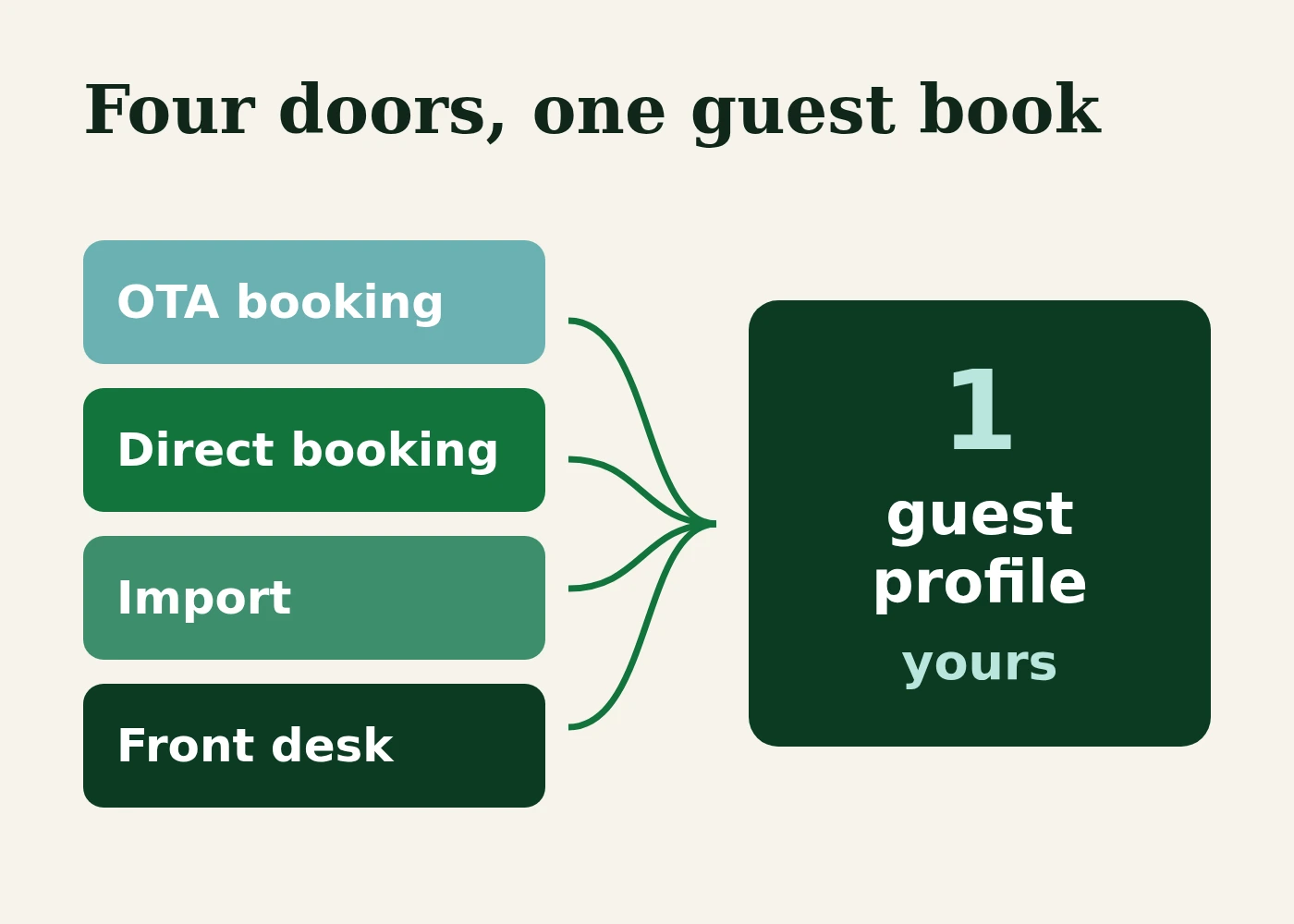
It starts with how guests arrive. There are four doors into a Tribii guest book, and they all lead to the same place:
- a reservation arriving from an OTA through the channel manager
- a booking taken at the front desk, on the hotel's own booking page, or through the widget on its website
- a bulk import of years of history from the PMS the hotel is leaving behind
- a profile a receptionist types in by hand
The Booking.com ones included. The OTA introduced them; the property keeps the record. A guest who booked on Expedia in March and direct in September is one person with two stays, not two strangers.
The import matters more than it sounds. A hotel switching systems should bring its history with it. Ownership that starts on install day isn't ownership. It's a fresh start nobody asked for.
One person, one profile, and the restraint that makes it trustworthy
Matching sounds easy until you do it at a real front desk.
In Tribii, email is the identity key. When a property lets staff take bookings without one (walk-ins, phone reservations), there's a narrow fallback: phone number plus surname, and only when there's no email at all. Phone numbers match on their last nine digits, because +34 600 123 456 and 600123456 are the same person, typed two ways by two receptionists on two different days.
What we will never do is match on a name alone. A phone number is a real identity key. A name on its own is not. Merging two guests called Maria Silva into one profile would show a stranger another person's stays. That's far worse than a duplicate.
We learned why this matters the hard way. Before this logic existed, every stay by the same repeat guest created a brand-new row. Stay history, preferences and upsell targeting all fragmented, with no way to merge them back. A hotel could host someone eleven times and know nothing about them.
A stranger's booking may create a profile. It may not edit one.
A returning guest shouldn't be asked for their address twice. So a booking can teach the profile things it doesn't know yet: country, address, city, postcode, date of birth, nationality. It only fills in blanks. It never overwrites an answer the guest already gave.
And a booking made on the public booking page or the widget can create a profile, but never edit one.
Here's why. On a public form, the only thing proving the person typing is the guest is that they entered an email address someone might know. Let that form write freely, and anyone could stamp a date of birth and a nationality onto a stranger's record. Those fields don't stay in the CRM. In Spain, for example, they're what gets filed with the traveller register under that guest's name.
Ownership without limits is a liability. The same goes for what your team decides: VIP level, tags and private notes are never touched by an incoming booking. A booking doesn't get to overrule a human.
There was a quieter bug behind this, too. A property that switched on the address field was asking returning guests for their address on every stay, forever, because the answer reached the booking and stopped there. That phrase is the whole problem in miniature. Most hotel data reaches the booking and stops there. It never becomes a relationship.
What's in a guest record
When it does become one, this is what the hotel holds:
- Identity: name, email, phone, country, nationality, date of birth, address, preferred language.
- Commercial history: every reservation past and upcoming, total stays, lifetime spend, average length of stay, last visit, preferred room type, every payment with refunds netted, and an open balance calculated exactly the way the folio calculates it, so the guest list and the bill never disagree.
- Staff knowledge: VIP level, tags, pinned notes.
- Corporate details: business name, VAT number, billing address, PO reference, kept separate from the personal profile.
- Compliance identity: ID or passport number encrypted at rest and revealed only on demand through an authorised route; the check-in signature on a private disk.
- Consent: when GDPR consent was given, marketing opt-in state, which version of the terms was accepted and when.
- Linked guests: co-travellers on a reservation get their own profiles, so a family books once and everyone still has a record.
The guest book is searchable by name, email or phone, and filterable by VIP level, country, number of stays, lifetime spend, average nights, date range and outstanding balance. Groups with several properties see one combined guest book.
One inbox, two kinds of conversation
The most honest expression of all this isn't a feature list. It's a design decision in the messaging screen.
Tribii's community inbox receives three kinds of thing: direct conversations from the guest app and the hotel's booking page; guest chat from Booking.com, Airbnb and other channels, mirrored in through the channel manager; and OTA reviews, with scores and category breakdowns.
The "all" view merges them into one rail, newest first. "Did anything come in?" is one question, not three tabs, and an OTA guest waiting on a reply is no less urgent for having arrived through Booking.com.
But the rail merges. The compose boxes never do.
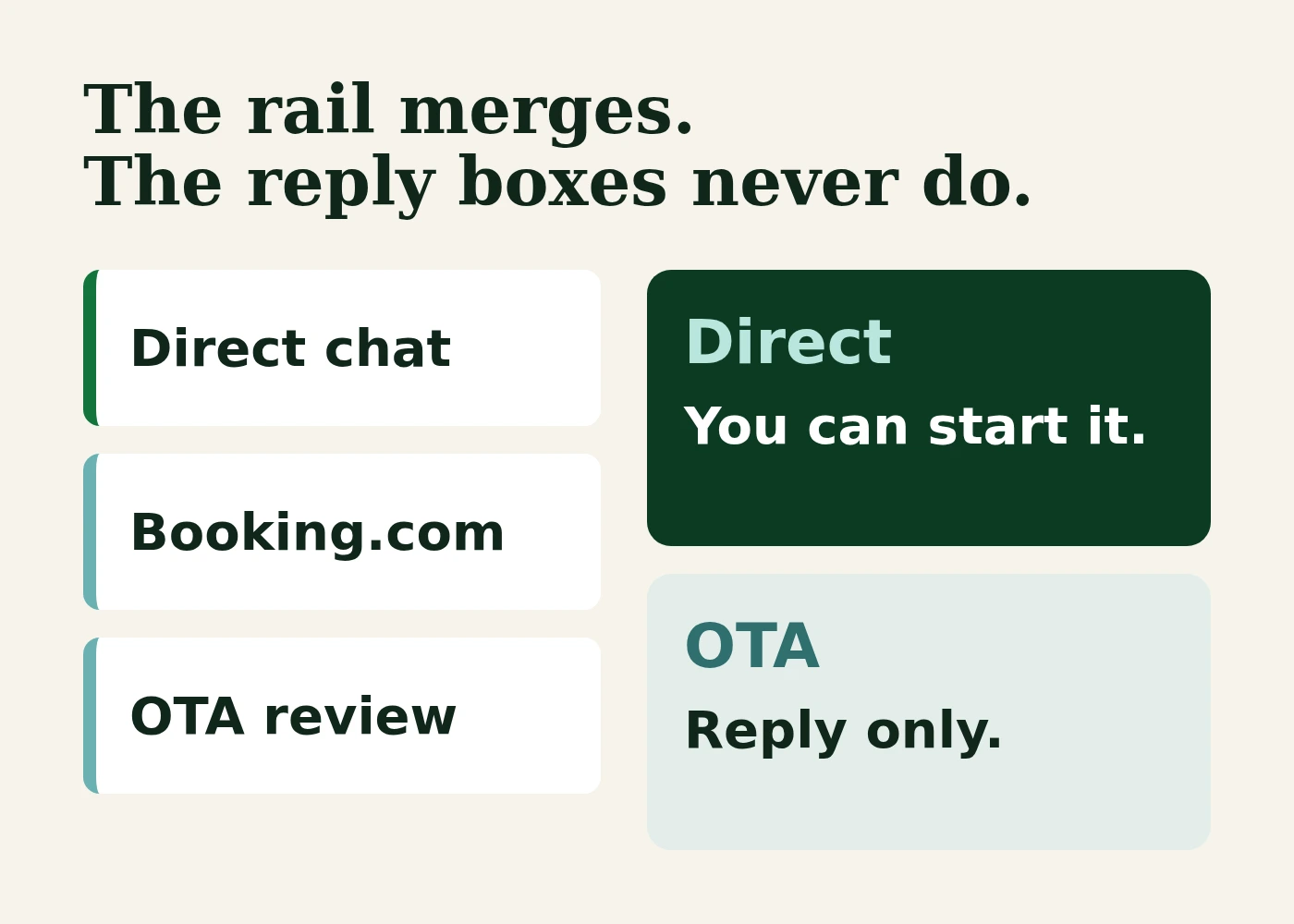
A channel thread is answered in place, inside the OTA's thread. A review is answered in place. A direct conversation opens in the direct pane, because Tribii owns a direct conversation and can start one, while an OTA owns its thread and never gives us the guest's address.
We could have hidden that difference behind one friendly reply box. We didn't, because it would be a lie. You can see every conversation in one place. You can only begin one where you own the guest. That's the argument of this article, rendered as an interface.
A few details that follow from taking it seriously: replies to OTA threads are sent live, never queued, because a queued reply that silently failed would read as answered while the guest is still waiting and the OTA is counting the minutes. Thread states are named the same as the direct inbox (open, answered, closed), so staff meet one vocabulary. On Booking.com, the response-time clock can be stopped on an enquiry that needs no answer.
(OTA guest chat and reviews need the channel manager plus a messaging application billed per property by the connectivity provider, so installing it is always an explicit admin action.)
What ownership buys
Owning the record is only worth it if it changes what you can do. Three places where it does:
Suggestions built from your own history. For every upcoming arrival, Tribii looks at what that guest booked on past stays at the same property over the last two years, extras and experiences included, and surfaces the top five. Staff can drop a suggestion into the reservation notes, preview the email, or send it. No machine learning, no guessing: just your own history with this person, put in front of the right person at the right time. It never crosses property boundaries, and a guest with no history produces nothing.
That's the economics in one mechanism. It's worth exactly nothing on a first-time OTA guest. It's worth real money on their second stay.
Upsells in your name, with your discounts. Upsell campaigns go out just after booking, a set number of days before arrival, or on the morning of arrival, in the hotel's branding and language, offering the hotel's own extras and experiences. A campaign can carry a promo code, but the codes live in the hotel's own Stripe account. Tribii never creates, funds, prices or edits a code; it reads what's there and lets Stripe enforce the limits. The offer and the money both stay on your side. Every send is guarded: nobody is mailed twice, unsubscribes are tracked per hotel and per category, and marketing mail runs under a monthly cap. Confirmations and invoices are never metered.
The bookings that nearly happened. When someone starts a booking on your site and doesn't finish, the Direct Booking Booster sends up to three emails: one when they go idle, one at 24 hours and one at 72. Each can be switched off on its own, and the last can include an extra you choose. It only runs with consent and only while arrival is at least 24 hours away, and the link drops the guest back into the booking they left. The same person half-booking on a laptop and then a phone is one lead, not two emails.
The growth section then counts it: sessions captured, bookings recovered, revenue recovered, and the commission saved beside it, calculated at an assumed 17% OTA rate. Every time you open that tab, the software is putting a number on what owning the booking was worth. (Run your own numbers here.)
The hotel's name on the guest's home screen
An OTA's app owns the guest's relationship with the OTA. We wanted the opposite.
The Tribii guest app is live on Google Play for Android, and it's free on every plan. There's no signup to abandon: the booking creates the account, and the sign-in link arrives in the confirmation email the hotel already sends. Inside, the guest sees the whole stay on one card (dates, room, party, what's paid and what's due) and has a line straight to reception that lands in the hotel's inbox, answered under the hotel's name.
Guests can change their own dates within the hotel's rules (live availability, minimum stays, new nights priced at what you actually charge), request the experiences you curate, and, if they choose, say hello to other travellers staying nearby on the same dates. Six languages, and one account across every Tribii property they visit.
Using it is entirely the guest's choice. Ignore it, and they book, pay and arrive exactly as before. Email still does everything that matters for guests on any other phone.
That it's free is the point. We're not charging hotels for the relationship. We're handing it over.
What ownership costs
Here's where most "own your data" pitches go quiet. Owning guest data means owning the obligations that come with it, and a product that lets you handle them carelessly isn't protecting you.
Consent is a gate, not a checkbox. Marketing mail requires it; every marketing send carries a signed unsubscribe link; transactional mail is never gated.
Retention runs on two clocks. Most data has a legal floor: tax and accounting law says how long you must keep it. Guest registration data often has a legal ceiling instead, and countries disagree wildly: six months in France, seven years in Austria, and Italy wants it gone as soon as the filing is through. Across the thirty-nine countries Tribii serves there is no single lawful number, which is why the rules are per country, and why registration data is stored separately enough to be destroyed on its own clock without touching invoices.
Some floors protect you from yourself. Guest profiles can't be set to anonymise sooner than 540 days, which is the outer edge of the card-scheme chargeback window. Wipe a guest at 90 days, receive a dispute at 120, and you've destroyed your own ability to show who stayed. Abandoned bookings can't be purged in under seven days, because the recovery sequence itself runs to 72 hours.
Erasure is not deletion. Archiving a guest is reversible, with a restore button beside it. Erasing is permanent, so it lives somewhere else entirely: admin-only, password re-check, mandatory preview first. The preview shows what survives and why, so a hotel answering a guest can say truthfully that the invoice remains because tax law requires it, not because the delete half-worked. Erasure is refused while the guest is mid-stay, and an erased guest is never quietly revived by a later booking. The self-serve erasure button is off until a hotel switches it on. That gates the button, never the right. Requests can always be actioned through support.
And you can leave. Hotels can export their own data, date-scoped or complete, with row counts and a fingerprint. Ownership you can't walk away with isn't ownership.
The two numbers that tell you how much you own
If you take one thing from this piece, make it a habit: look at two numbers every month.
The first is your repeat versus first-time split. In Tribii's reports, it sits in the Guest Intelligence tab next to source countries, languages and channel preferences. It's the closest thing the industry has to a direct measure of how much of your guest base you own rather than rent, and it only works because one person is one profile.
The second is the channel performance table: revenue, bookings, ADR and average stay per channel, over time. Direct versus OTA, in money. That's where this stops being philosophy.
If the first number is climbing and the second is shifting towards direct, you're building a hotel people come back to on their own. If not, you're paying rent on your own guests.
The OTAs will keep doing what they do well: introducing you to people who'd never have found you. Let them. Just make sure that when the introduction is over, the relationship stays with you.
Tribii's PMS, guest book and booking engine are free, and the guest app, guest messaging and experiences are free forever for properties up to 20 rooms. See the plans or try the demo.
FAQ
Can hotels get the real email address of Booking.com guests? Not by default. Booking.com replaces guests' email addresses with anonymous aliases that stop working shortly after checkout. Under the EU Digital Markets Act, hotels have a right to access data generated through their use of the platform, but personal data is only shared where the guest has consented. The reliable way to get a guest's real contact details is to earn them directly: at check-in, through your own booking page, or through your own guest app.
Who owns guest data when a booking comes from an OTA? Both the OTA and the hotel process the guest's data for their own purposes. For everything that happens at your property (the stay, the invoice, the traveller registration, your guest records), the hotel is the data controller. In Tribii, OTA reservations become profiles in the hotel's own guest book the moment they arrive.
Does the Digital Markets Act let hotels offer lower prices on their own website? Yes. Since 14 November 2024, Booking.com is prohibited in the EEA from using parity clauses that stop hotels offering better prices or conditions on other channels, including their own websites.
How do I measure how many of my guests I actually own? Track your repeat-versus-first-time guest split and your revenue by channel over time. Both only work if your system recognises the same person across different channels as one guest profile.
Is Tribii's guest CRM free? Yes. The guest book is part of Tribii's free PMS, and the guest app, guest messaging and experiences are free forever for properties up to 20 rooms. Guest activity notifications and abandoned-booking recovery are on paid plans; upsell campaigns and online self check-in are on the top tier.

Tribii
The free booking engine for independent hoteliers. Editorial notes.