Open-source hotel software vs free SaaS: the real cost of self-hosting
The licence costs nothing. The server, the updates, the backups and the person who fixes it during check-in are not included.
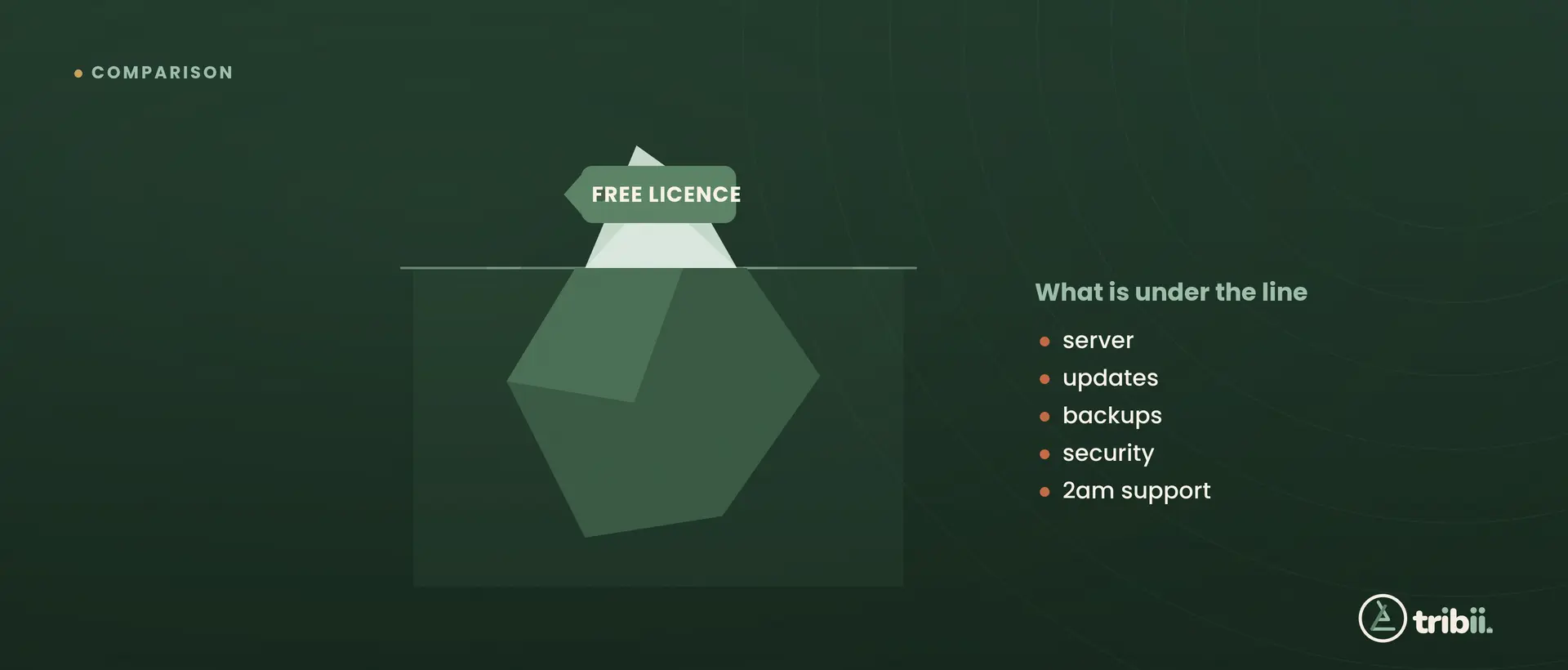
Open-source hotel software is real, it is capable, and for a specific kind of operator it is the correct answer. It is also recommended most enthusiastically by people who have never had to restore its database on a Saturday.
This is an attempt at the honest comparison. Not a hit piece: there are properties for which self-hosting is genuinely better, and I will say where. But "free" means something different in each column, and the difference is mostly invisible until you have committed.
What open source gives you
The licence. That is the actual, precise thing that is free.
You may download the software, run it on your own server, read its source code, modify it, and never pay anyone a subscription. Projects like QloApps and HotelDruid have been doing this for years, and they are not toys: real properties run on them.
What you gain, beyond price:
Control. Nobody can change the interface on a Tuesday, deprecate a feature you rely on, or triple the price at renewal. The version you run is the version you run.
Data locality. The guest data sits on infrastructure you choose. For properties with unusual regulatory constraints, or a genuine institutional reason to keep data in a particular jurisdiction on a particular machine, this is not paranoia, it is a requirement.
Extensibility. If you need the system to do something strange, you can make it. With cloud software you can only ask.
These are real advantages. If any of them is load-bearing for your property, read on with a sympathetic eye, because the rest of this article is about the bill.
What open source costs
Hosting. A server that is up at 4pm on a Friday in August. Budget a real VPS, not the cheapest shared plan, because the cheapest shared plan is where your booking engine goes to die during a heatwave.
Setup. Installation, database, web server, SSL certificate, mail delivery so that confirmation emails do not land in spam. If you can do this yourself, it is an evening. If you cannot, it is a contractor.
Updates. Security releases arrive on the project's schedule, not yours. Somebody must apply them, and somebody must notice when an update breaks the rate calendar. That somebody is you or someone you pay.
Backups, and restores. Everyone has backups. Very few people have tested a restore. The difference between the two is discovered exactly once.
Security and GDPR. You are storing guest names, contact details, stay history and payment-adjacent data. Self-hosting means the responsibility for that data's protection sits with you, in a way it does not when a vendor is the processor with a signed agreement and a security team. This is the cost that is easiest to ignore and most expensive to get wrong.
Integrations. A payment gateway, possibly channel connections, possibly a website. Often modules, sometimes paid modules, occasionally a developer.
The 2am problem. There is no support line. There is a forum, a maintainer with a day job, and your own reading of a stack trace while a guest waits.
Most of these projects also sell hosted editions and support contracts, which is the honest business model behind the free licence and a perfectly good deal. Note what has happened, though: once you buy hosting and support, you are paying for cloud software. The comparison is no longer "free versus paid", it is "this cloud software versus that one".
What a free cloud tier costs
Nothing in money, up to a limit. The cost is constraint, and it comes in three shapes.
A limit. Rooms, usually. The entire question is where it sits. A one-room free tier is a demonstration. A 20-room free tier covers most independent European properties, which makes it a product rather than a teaser.
Feature boundaries. Something is above the line. The critical check is whether the booking engine is inside the free tier or is the thing the free tier exists to sell you. A free PMS that cannot take a reservation is a filing cabinet.
Dependence. You are trusting a company to exist, to keep the price honest, and to let you leave with your data. That trust is not free, and the way to price it is to ask for the export format before you sign up, not after.
What you get in exchange is everything from the cost list above, done by someone else: the server, the updates, the restores, the security posture, the data-processing agreement, the person awake at 2am.
Which one suits you
Choose open source if you have technical capacity in-house or a developer you trust and already pay, you have a genuine regulatory or philosophical reason to hold the data yourself, your requirements are unusual enough that you will need to modify the software, or you enjoy this. That last one is not a joke. Some operators like running their own infrastructure and are good at it, and the software is better for having them.
Choose a free cloud tier if your technical capacity is one person who also does breakfast, you would rather the security patching happened without your involvement, you need a booking engine and website working this month, and your requirements are the ordinary requirements of a small hotel.
Choose paid cloud software if you have outgrown the free tier's limit and the depth you now need is worth its price. That is what tiers are for, and any vendor pretending otherwise is hiding something.
The comparison that matters
Do not compare €0 against €0. Compare total annual cost of ownership against total annual cost of ownership, and put a real number on your own time.
Self-hosted, realistically: hosting, plus a contractor day or two a year for updates and the incident that will happen, plus your hours. Cloud free tier: nothing, plus the risk that the vendor changes, priced by how easily you could leave.
Then compare what each actually does on day one. Tribii's free PMS covers reservations and calendar, rooms and rates, guest profiles, inventory and restrictions, free forever up to 20 rooms, with the booking engine and website builder included rather than upsold, and guests paying into your own Stripe account. What is not free, the full front desk, housekeeping, self check-in, night audit, the reservation hub, is stated on our pricing page rather than discovered at room 26.
That is a specific offer with specific limits, and you should hold open-source alternatives to the same standard: what exactly do I get, what exactly does it cost me to run, and what happens when it breaks.
The honest summary
Open source is free as in licence. Cloud free tiers are free as in price, bounded by a limit. Neither is free as in nothing.
The right question is not which is cheaper. It is which cost you would rather carry: money, or responsibility. Small properties with a technical operator often prefer responsibility. Small properties whose operator is also the one making breakfast, almost never do.
*QloApps and HotelDruid are named as well-known examples of the open-source category; check their current licensing, hosting and support offerings on their own sites, as these change. Tribii's plans and limits reviewed July 2026, and set out on our comparison pages.*

Tribii
The free booking engine for independent hoteliers. Editorial notes.
More for the kitchen table.
What is a hotel PMS? A plain-language guide for independent hoteliers
Not a definition from a brochure. What the software actually does between 7am and midnight at a twenty-room property, and which words mean what.
 Tribii
How to move your small hotel off spreadsheets
The spreadsheet got you here, and it is not stupid. But there are four specific places it fails, and each one costs you money quietly.
Tribii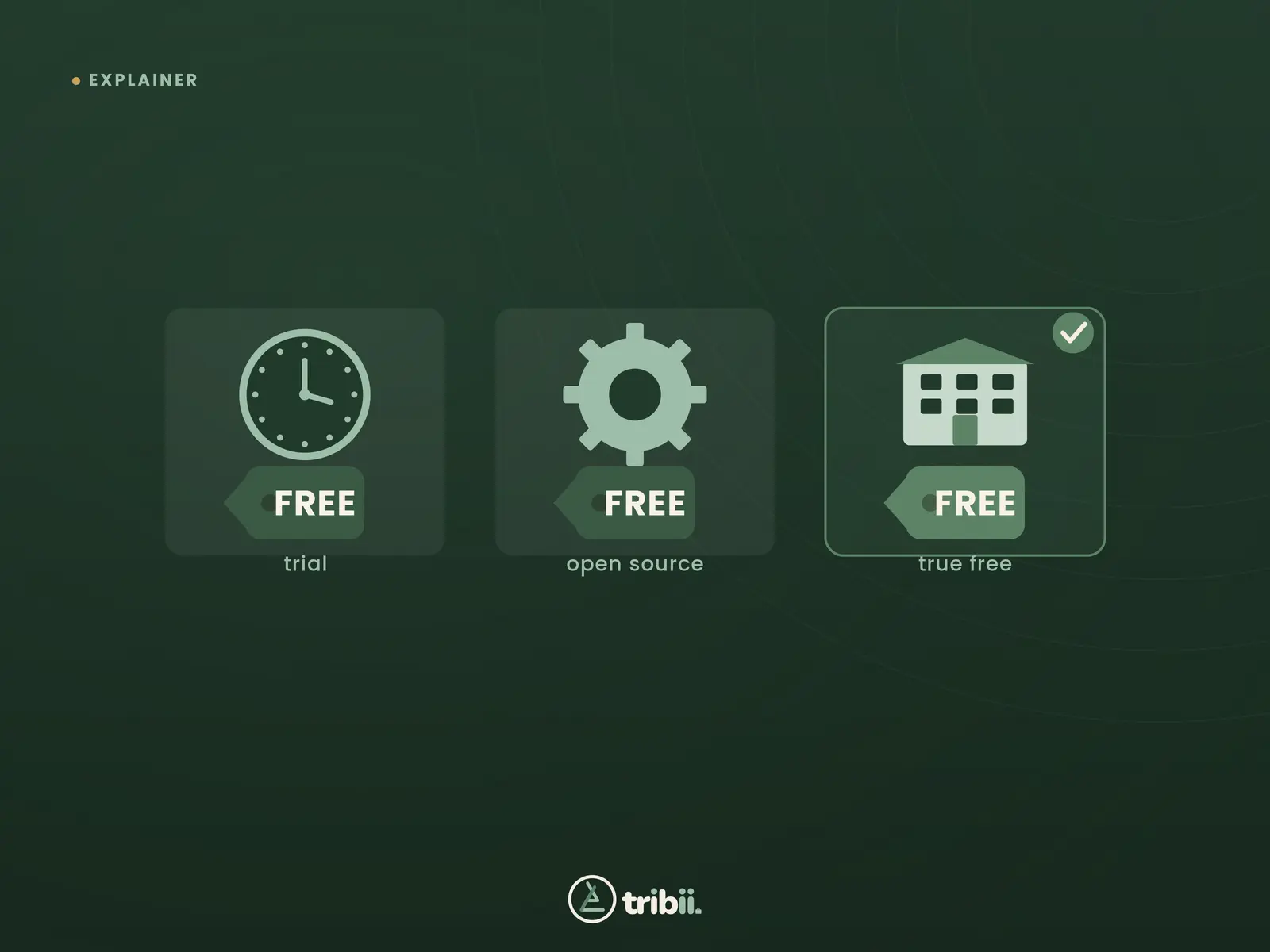
Is there a truly free hotel PMS? What "free" covers in 2026
Three different things get called free hotel software, and only one of them is free in the way you mean. Here is how to tell them apart.
Tribii